
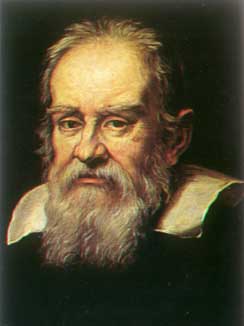
In the year 1564 Galileo Galilei was born in Pisa. Galileo�s father Vincenzo Galilei was born in Florence in 1520. Galileo�s father studied and taught music. Galileo�s mother was born in Pescia and married Vincenzo in 1563, Galileo was the couple�s first child. Galileo lived with his family in Pisa, but in the year 1572 Galileo�s family moved to Florence Italy. Galileo was eight years old when his family moved. Galileo did not move with his family he stayed behind and lived with Muzio Tedaldi. When Galileo turned ten he moved to Florence to live with his family. He was too young to go to a monastery, so Jacopo Borghini tutored him. When Galileo was old enough he was sent to Camaldolese Monastery, this was located Southeast of Florence in Vallombrosa. While attending, Galileo became fascinated with the life that the Camaldorese order lived and intended to join, but was not allowed to as his father wanted him to become a medical doctor. Galileo�s father had him return to Florence hoping he would forget about the Camaldorese order. Vincenzo sent Galileo to Pisa in 1581 and had him enrolled at the University of Pisa as a medical doctor. While Galileo was in Pisa he lived with Muzio Tedaldi. Unfortunately for Vencenzio, Galileo�s father, Galileo never took his medical studies seriously and often spent his time attending mathematic and natural philosophy classes instead. Galileo was later sent back to Florence with his family and in the summer of 1583 he was encouraged by his family to read the book Galen so he could further study and understand medicine. Galileo didn�t want to read the book, and later invited Ricci to his family�s home so he could try to persuade his father in letting him study Mathematics. With the help of Ricci, Galileo�s father allowed his son to study mathematics. However it was not until 1585 that Galileo was no longer enrolled in school as a medical student.
Childhood Audio
Family/Social life
Galileo�s father, Vincenzo Galilei died in 1591. Since Galileo was the oldest of his siblings, he became responsible for the financial well being of the family. His job as a mathematics professor at the University of Pisa did not pay enough to support everyone. He began to look for a job that had better pay and soon found one. He was appointed the professor of mathematics at Padua University in 1592. The salary Galileo received at Padua University was three times higher than what he previously made at the University of Pisa. This job opportunity was given to Galileo because of the recommendation from Guidobaldo del Monte. Galileo Galilei never married in his life, but he did have three kids with Marina Gamba. Galileo met Marina while he was a professor at the University of Padua. He would teach there for a period of eighteen years stating they were the best years of his life. Galileo had two daughters, Virginia who was the oldest, and Livia. They eventually put them in convents to be trained as nuns. Their third child, Vincenzo, was born in 1606. Galileo moved to Florence in 1610 leaving his son Vincenzo with Marina Gamba. Marina Gamba married in 1613, after the marriage Vincenzo came to Florence to live with his father.
Galileo�s social life was limited, but some of the friends that were mentioned were Sagredo. Sagredo was a young Venetian nobleman that spent time with Galileo in the town or at his house. One of Galileo�s other friends was Fra Paolo Sarpi, he was a Servite friar in 1606.
Family/Social life Audio
Professional life
Galileo Galilei discovered many things in his professional career. One of his discoveries was proving that the weight of an object had nothing to do with how soon the object would hit the ground. When he proved his statement he was located on the leaning tower of pizza. He proved his statement by dropping two weights of different size off the tower. By doing this it showed the public that the weight of an object had nothing to do with how long it would take for the object to hit the ground.
Galileo also became involved with astronomy. Galileo was informed that a Dutchman in 1609 invented a spyglass, which made small objects appear to be larger. Galileo soon became involved in the designing many different telescopes each with much better magnification than the Dutch instrument. Galileo soon had a working telescope with a magnification of about four times. He later developed a telescope with a magnification of eight or nine times by grinding and polishing his own lenses. Galileo soon demonstrated the telescope to the Venetian Senate. The senate liked the telescope and gave Galileo a large increase in salary for the sole rights of the telescope.
Galileo wrote books and some of them were published, the titles of two of the books were; Messenger of the Stars published in 1610, and Ptolemaic and Copernican published in 1632. The first book mentions Aristotle�s claims of the sun and moon to be perfect spheres but Galileo proves that this is false by observing the moons surface with his own eye. Galileo was able to make this statement since he was able to observe the planets with a telescope he made. With the use of his telescope he confirmed that there were craters and valleys on the moon. He stated that the moon had a surface similar to the earth�s surface. He also viewed that there were solar flares on the suns surface. Galileo faced much trouble with the church, because these statements were the complete opposite of what the church and public believed. They believed the planets and solar system were to be perfect or heavenly. Galileo would later be trialed by the church and sentenced to house arrest for the remainder of his life.
Professional life Audio
Golden years
Galileo Galilei lived an extremely long life compared to the rest of society since he lived to be seventy-eight years old, which was much older than the average person in that time. In the last years of his life he spent all of his time in his house. This is because of the book Ptolemaic and Copernican, which he had published in 1632. In his book he stated how the Ptolemaic view was wrong. The church then sentenced him to house arrest for his beliefs in the sun being the center of the universe and the solar system�s planets not being a perfect sphere. This sentence was for the remainder of his life and as Galileo grew older and came closer to his death Galileo went blind. Things couldn�t have gotten much worse for him, but he still carried on with his studies and he developed the first pendulum clock around 1640. Galileo died about two years later in early 1642. He was put to a final resting spot in a church in the year 1737 even though it was against the
Golden years Audio
O'Connor, JJ. Galileo Galilei. http://www-groups.dcs.st-andrews.ac.uk/~history/Mathematicians/Galileo.html 28 October 2004
Van Helden Albert, Burr Elizabeth, The Galileo Project http://galileo.rice.edu/ 28 October 2004
Hodges H. Miles, Galileo Galilei http://www.newgenevacenter.org/biography/galileo2.htm 28 October 2004
Fowler Michael, Life of Galileo http://galileo.phys.virginia.edu/classes/109N/lectures/gal_life.htm 28 October 2004