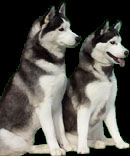
| History of the Siberian Husky GENESIS AND ORIGINAL PURPOSE OF THE BREED Several thousand years ago, primitive Eskimo-like tribes in Siberia used dogs for specific functions in everyday life. these dogs were essential to the humans' servival as they performed vital tasks, which included accompanying the hunters, scenting trails and helping to transport food back to the villages. Each tribe had its own specific type, which at this point was a precursor to a specific breed of dog, but all of the Northern dogs were similar in the sense of being jackel-type dogs that, at one time, had been crossbred with arctic wolves. Ofcourse, this was thousands of years ago, and through careful breeding and maintenance of pure bloodlines, the 'wolf' was bred out of the dog. the purebred Siberian Husky of today is not a wild wolf hybrid, as anyone close to the breed will attest, but a beautiful, friendly, tractable, wonderful dog in both pet ad working capacities. In Siberia, the ancestors of the Husky were origionally used for hunting until another use for them evolved. Each tribe bred and maintained its own specific type of dog. These Northern dogs eventually evolved into the distinct breeds that we know today: the Alaskan Malamute, Eskimo Dog and samoyed, to name a few. The Chukchi tribe is credited with the origination of the dog that we have come to know as the Siberian Husky. The Chukchis inhabited the part of the Siberia closest to Alaska; at one time the climate was not so harsh, but weather conditions changed for the worse, forcing the tribe to venture further from their settlement to find food. The tribe lived inland, but the came to depend on the sea for food. Thus arose the necessity for a method of transporting the food over the considerable distance, and the sled became the ever-important method of transport. Hence, the 'sled dog' was born! in addition to accompanying the tribesmen to the sea and bringing home food, the sled dogs were used for transporting goods and trading between tribes, and for hauling the tribes' possessions if they had to relocate to a more hospitable region. The Husky, then referred to as the Siberian Chukchi or simply Chukchi, was bred mainly for endurance rather than for speed or strength. The dogs were bred specifically to pull light loads at medium speeds; heavier loads required teams of dogs. The most important thing was that they were able to withstand the long distances and transport their cargo intact. The dogs had to be very energy-efficiant in that they had to perform their task with as little effort as possible; they needed to have energy left over to keep their bodies warm in the below-freezing temperatures. The Chukchi people were meticulous in thier maintanance of the dogs' pure bloodlines. Only the best male lead dogs were bred; the rest of the males were castrated. the dogs had to have almost endless endurance, superb scenting ability, think woolly coats to protect from the harsh climate, extreame tractabilty and willingness to obey. The breed today is reconised as one of the friendliest, and is especially known for being good with children. This has much to do with how the tribespeople treated the dogs. The Chukchi women and children were responsible for the dogs; daily care, so the dogs adapted to family life and became accustomed to much interaction with humans. The children were encouraged to play with the dogs. Today Soberian Huskies are regarded as exellent family pets--very playful and always ready to make a new friend. |
 |
 |
 |
 |
 |
 |
 |
 |
 |
|
|
 |
 |
 |
 |
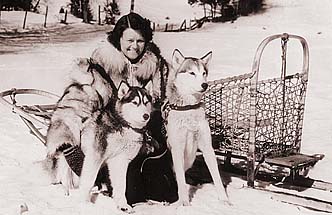
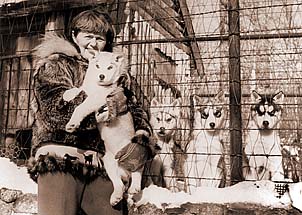
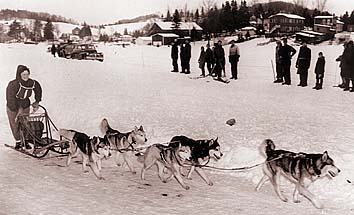
| ESTABLISHMENT OF THE SIBERIAN HUSKY Following the serum relay, Leonard Seppala toured the United states with a group of dogs, most of them siberian Huskies, to give sled dog demonstrations. Note that the word 'Husky' was used as a generic name for all of the sled dog breeds. The Chukchi dog was given the name 'Siberian Husky' by Americans. These demonstrations gave the Arctic dogs widespread exposure and sparked interest in the Siberian Husky. There was even a sled dog demonstration at the 1932 Olympic Games in Lake Placid, New York. After completing his exhibition tour, Seppala settled in New England and started racing extensively with his dogs. Not only did he establish himself as a top sled dog driver but he also helped establish the siberian Husky in the eastern United States through his own breeding programme. Seppala bred his dogs and they became foundation stock for other new England breeders. The Seppala name is known by everyone in Huskies today; in fact, all American Kennel Club registered Huskies can be traced back to Seppala bloodlines. New England became home to a concentration of quality Siberian Husky kennels, Arthur Walden's Chinook Kennels in New Hampshire being one of the most important. Walden had already been breeding sled dogs when Seppala arrived with his Huskies. Again , these dogs were smaller than those that were being produced in the area and people immediately discounted their skill as sled dogs. However, as soon as the dogs started racing, people took notice. Seppala's dogs consistently, and handily, beat the local dogs in sled races. Walden, with the help of Milton and Eva "short" Seeley, produced quality Siberian Huskies based on Alaskan stock, some of which came directly from Leonard Seppala. Lorna Demidoff established the prominent Monadnock Kennel, also in New Hampshire. Her first champion was a dog which she acquired from Chinook, and she followed with many home bred champions and top racing dogs. It is Important to note that both Lorna Demidoff and Short Seeley were not only top breeders but top sled dog drivers as well - they were two of the top women drivers of all time. The focus of the new England kennels was to preserve the Siberian Husky's working ability while producing dogs that were aesthetically pleasing and could win in the conformation ring. The Chikchis' breeding programme focused on function rather than form; for example, the dogs beautiful woolly coats were intended to insulate the dogs' bodies, not to be admired by fanciers. The tribe needed the dogs for survival; they had no need for a beautiful dog. The Americans, however with their interest in showing their dogs as well as racing them, wanted the best of both worlds - they wanted the best quality and best looking dogs possible. even with an emphasis on beauty, the new England kennels still managed to consistantly produce dogs that were some of the finest racing sled dogs around. The breed was recognised as the Siberian Husky by the American Siberian Husky Club in 1930; the first AKC- registered Husky was named Fairbanks Princess Chena. The breed is recognised by the country's other ' registry, the United Kennel Club, as the Arctic Husky. Today the breed is sometimes called by that name in England, although the breed's official name is Siberian Husky. |
 |
 |
 |
| "Short Seeley with Chinook kennels Pups. |
| Eva B. Seeley with Alyeska Siberians. |
| Chinook Kennels Siberian Team, obviously in no hurry, driven by Eva B. Seeley! |
| THE HUSKY IN THE UNITED KINGDOM The Siberian Husky was reconised as a breed in the United Kingdom in 1968. The first reconised Siberian Husky was Yeso Pack's Tasha, an American bitch who belonged to Lt. Commander William Cracknell. When she was first brought over from the U.S., there was a rabies scare in England that necessitated her being held in quarantine for a lengthy period. Upon her release, the Siberian Husky was designated as a seperate breed and she was registered. Amate for her was imported from the U.S., and when cracknell returned to the U.S., with the two Huskies, the puppies from their two matings were left in England. When the quarantine period was restored to the normal length of six months, more Siberian Huskies began to be imported into the Untied Kingdom. Don and Liz Leich were the first British fanciers to make strides in establishing the breed. They brought back Siberians from the U.S. in 1971 and started a kennel of their own, which produced some dogs who were very successful in the show ring. Like all true breed enthusiasts, they strived to keep their dogs' working ability intact and keen. The Siberian Husky in England had a sow but steady following, but by 1986 the breed was fully recognised and able to compete for championships. Many breeders have sence done very well with the breed and Siberian Huskies are making great strides as pets and show dogs in England and Northern Ireland alike. |
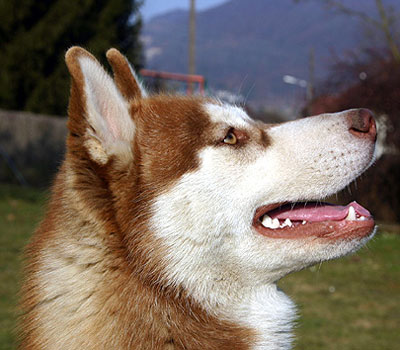 |
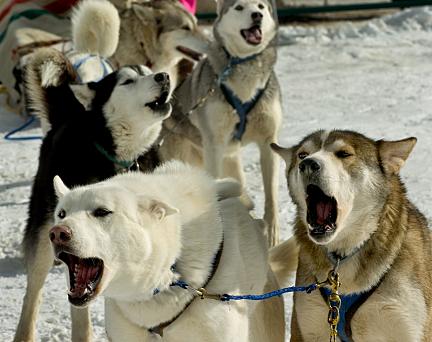
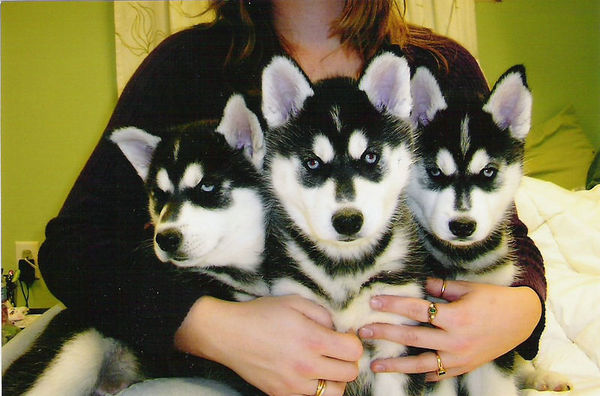
| CHARACTERISTICS OF THE SIBERIAN HUSKY A Friend For Life Siberian Huskies are Known all over the world as being friendly, playful dogs who make great family pets. Remember that the Chukchi people who origionated the breed raised the dogs in a family atmosphere in the midst of their own homes and with their children. The dogs grew-up knowing that they were part of a family, just as your siberian Husky will be an intergral part of your family. The Siberian Husky will be loyal to those in his family, but he will still remain friendly to everyone he meets. In fact, a Siberian Husky can never have too many friends. This being said, it is no surprise that the Siberian Husky has earned a reputation for being one of the friendliest and most people-orintated breeds around! If you are looking for a guard dog or an ominous presence in your home to ward of strangers, then you'd better keep looking... the Husky is more likely to great an intruder with a friendly lick than a menacing bark, infact a Cavalier king Charles would have more success in scaring of an intruder than a husky would, though if its a gaurd dog you want, you could'nt go wrong with such breeds as the Rotwhiller, German Shepard, or even better a Japanese Akita. The Huskies temperment and ability to get along with humans has to do with its background and history; the dogs were raised by the women and children of the Chukchi tribe as i have mentioned in the history of the Siberian Husky, and therefore, they are used to being around people and being cared for. Huskies are also very tractable in that they had to be extreamly amenable to discipline in order to perform their intended tasks. The sled driver had to have the utmost cinfidence in his dogs, since he depended on his dogs to be able to reliably scent a trail and find their way to food and back to the village. When man and dog are out on the frozen tundra there are no signs to tell them which way to turn and no petrol stations to stop to ask for directions, and getting lost in those conditions presents a life-threatening situation. Today however the most strenuous 'food hunt' that the pet husky will probably engage in consists of something along the lines of a walk to the cornor store with his owner, but trainability and dependability are still very much apart of the breeds character. Siberian Huskiesdon't just take well to be trained - they require it. Huskies need discipline. a sled dog driver had to rely on his dogs' ability to responed to his voice command. These dogs had to be dependable to a fault, especially the lead dog. Thus, Huskies look to a leader to provide them with direction. as you know, the role of the leader is yours - it is your job to hold the reins! The Husky was bred first and foremost to be a working dog, and these working instincts are also still a very large part of the dog's personality. Scince the average pet Husky owner will not be using his dog for hunting or pulling a sled, the dog needs to have its work energies redirected toward other activities. When not used in a working capacity, the Siberian Husky must have exercise or else it will be bored. A bored dog will find a way to amuse himself, which could spell trouble for your garden, furniature, shoes, ect. This is not to say that every dog will revert to a destuctive behaviour when he has nothing else to do, but wouldn't you rather be in control of how your dog spends his 'free time'? Besides, occupying your dog gives you a chance to spend time together, constantly reinforcing the bond you formed when your Siberian Husky was a pup. |
 |
 |
 |
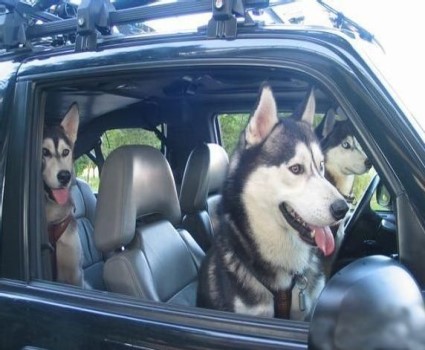
| While your Husky will adapt to very cold temperatures, excessive heat may bother him. Remember the Arctic climate whence he comes-he's 'well suited' for snow and ice, not for heat and humidity. keep that in mind and always give your Husky access to shade and fresh water. Never leave your dog in a parked car in warm weather. Dogs of Northern decent have practically no tolerance for heat and will succumb to heatstroke within a very short time. Siberian Huskies are also well known for being meticulously clean. Although they shed, this is not a hygiene problem. Instead, the dogs maintain their own cleanliness and have surprisingly little 'doggy' smell. They are also easy to groom. Although that thick coat may look intimdating, all they need is brushing; no special grooming is required for the show ring. Keep in mined that the double coat of the Siberian Husky will mat and become most untidy if not brushed regulary. No matter how fastidious your Husky is, he simply cannot groom his entire coat, especially the parts that he cannot crane his neck to reach. |
| BREED-SPECIFIC HEALTH CONCERNS The Siberian Husky, not unlike other breeds of purebred dogs, is prone to a number of hereditary and congenital diseases. Breeders around the world dedicate themselves to minimizing the occurrence of these problems and excluding any affected dogs from thier breeding programmes. Amongst the two most prominent areas of Siberian health, breeders are concerned with the eyes and hips of the breed. Health concerns are mentioned here not to dissuade the potentail Husky Owner, but only to raise awareness so that the owner can provide his dog with the best possible care. EYE PROBLEMS Few could argue that the eyes of the Siberian Husky are one of the breeds most attractive features. It is indeed ironic that the breeders should be concerned about preserving the vision of these dogs exquisite eyes of the Siberian Husky. Nonetheless, eye problems are the most prevalent of all disorders in the breed. Potential owners are not to be discouraged by this information. The incidence of problems is indeed low for the breed in general, maybe five percent. GLAUCOMA is a buildup of preasure in the dogs eyeball. The eyeball's drainage channel becomes narrow, and eventually blocked, and the increase in preassure can result in blindness. |
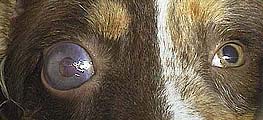 |
| This is a picture of a dog which has GLAUCOMA in its right eye, take note that it is not only Huskies which have this problem all dogs can suffer from this condition. |
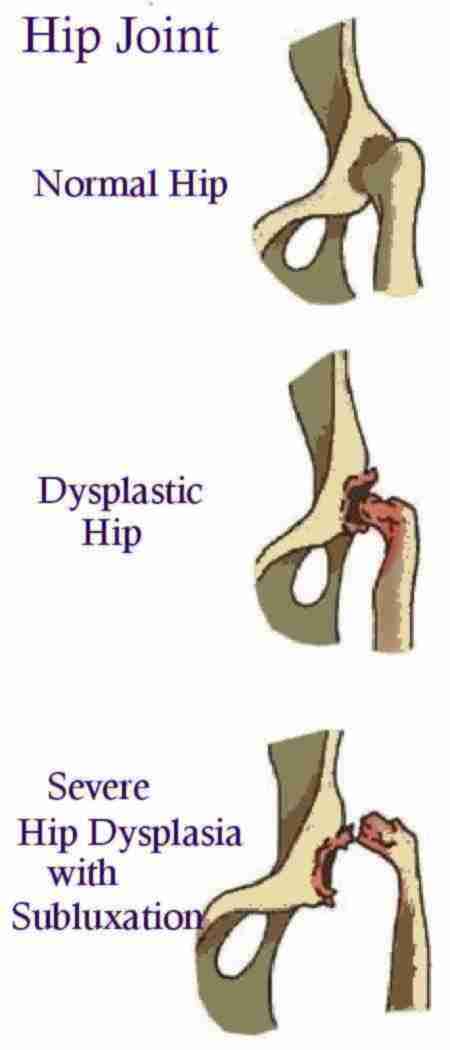
| All Siberia Huskies should be tested for glaucoma at one year of age, and if it is indacated that he is predisposed for glaucoma then he cannot be bred. Dogs that are labelled 'predisposed' must be tested anually, and dogs that actually develope glaucoma are labelled 'affected.' HEREDITARY CATARACTS cause a cloudiness in the eye that can lead to blindness. This can be operated on, but the dog's sight cannot be restored to that of a normal dog. Annual checkups will help detect cataracts, and an affected dog should not be bred. Bilateral cataracts, also known as juvenile cataracts, occur in younger dogs, and are hereditary in the Siberian Husky. In Huskies, the most commonly identified cataracts are found in the posterior axial subcapsular region of the lens. Such cataracts mature as the dog grows old. In certain cases, the cataract can detected in one eye before the other eye appears affected. In severe cases, the dog can go blind because of the intensity of opacities in the eyes. CORNEAL DYSTROPHY is a condition that has simular symptoms of those of cataracts in that the dog's eyes get clouldy and his vosion becomes blocked. The preffered veterinary term for the condition is crystalline corneal opacities(CCO). This term describes the cone-shaped crystals that are produced in the cornea and that spread across the surface, potentially interfering with the dogs vision. Both eyes are affected by CCO, as in bilateral cataracts, though not simutaneously or to the same degree in every incidence. HIP DYSPLASIA Canine hip dysplasia, the most common orthopaedic problem in dogs, refers to abnormal development of the hip joint. All dogs with hip dysplasia (HD) are born with normal hips, which eventually deteriorate by the time the dog is two years old. In dyspastic dogs, the femur or thigh bone does not properly fit into the acetabulum or the pelvic joint socket. Since the Siberian Husky is bred as a drafting sled dog, its ability to run with strength and stamina is tantamount to its reason for living. Considering that the hip dysplasia prohibits a Husky's being able to do the job that it was bred to do, breeders place much emphasis on eliminating HD from the breed. The occurence of HD in the Husky is estimated to be approximatly 4 or 5 percent, which is considerably low compared to some other larger breeds whose incidence can be as high as 40 to 50 percent. siberian Huskies screened for HD can generate for kinds of results: 1. Free of HD; 2. Mild HD; 3. Moderate HD; 4. Severe HD. Most Huskies fall into categories 1 and 2, and only dogs free of HD should be included in breeding programmes. This can be a heartbreaking scenario for the breeder who has an otherwise flawless champion who ranks in category 2. Not all dogs who are tested for HD will show signs of degeneration. These dogs nonetheless are carriers and can pass the disease to their progeny. Potential owners should inquire about the puppies parents and grandparents and other close relatives. Scince the mode of inheritance is not fully understood, careful discetion is well advised. In addition to excluding dysplastic dogs from breeding programmes, breeders also take other precautions to ensure that HD does not creep into thier lines. Environmental factors concern breeders as do the hereditary onces. Providing newborn puppies non-slip surfaces in the whelping boxes prevents awkward puppies from injuring their fradgile bones and ligaments. Likewise, breeders recommend diets free from supplements and low in fats to avoid puppies gaining more weight than thier growing frams can support. Owners of young puppies should also limit the kinds of exercise that thier pippies recieve. Unsupervised roughhousing and jumping should be excluded from the exercise regimen as it can cause damage to the huskies growing bones and joints. |
 |
| BREED STANDARD WHAT IS A STANDARD? A breed standard is the blueprint to the dog, a written description of what breeders and judges are looking for in a perfect example of a Siberian Husky. For the record, ofcourse, there has never been a 'perfect' siberian Husky, nor has there been an 'perfect' example of any breed. Breeders use the standard as a guideline, a set of goals, for which to strive. Judges use the standard to evaluate how well the breeders are doing in reaching that goal of a perfect dog. Regardless of an owners intention for his dog, no admirer and owner of the Siberian Husky should settle for a breed representative that does not look like what the standard describes in this section. While no other dog is perfect, an owner certainly doesn't choose the Siberian Husky as the dog for him and then settle for a poorly bred example that can only be defended as a 'Siberian Husky' because it says so on a peice of paper. Owners must also study the section on 'Temperament'. This section describes the personality of the breed - just as inportand as 'General appearance.' and arguable more important to the pet owner. a dog that is not friendly and outgoing could never be a siberian Husky. Choose your dog carefully and use the standard to firm up in your mind precisely what a Siberian Husky is. If you are planning to show your dog, use this standard as a barometer to determine how well your maturing puppy compares to the ideal set forth herein. Since the Siberian Husky is a slow developing breed, do not expect that your four month old puppy is going to mirror the standard perfectly. Some breed representatives do not fully mature until 3 years of age, although your Husky should begin shaping by 12 to 16 months. The following standard is reconised by the Kennel Club, Englan's dog reulating body. since the Husky is popular all round the world, there are several different standards even within the same country. These standards vary slightly in wording and detail, though each essentially describes the dog we recognise as the Siberian Husky. THE KENNEL CLUB STANDARD FOR THE SIBERIAN HUSKY General Apperance: Medium-sized working sled-dog, quick and light on feet. Free and graceful in action, with well furred body, erect ears and brush tail. Propotions reflect a basic balance of power, speed, and endurance, never appearing so heavy or coarse as to suggest a freighting aninmal, nor so light and fradgile as to suggest a sprint raceing animal. Males are masculine but never coarse, bitches feminine but without weakness of structure. Muscle firm and well developed, no excess weight. Characyeristics: Medium size, moderate bone, well balanced proportions, ease and freedom of movement, and good disposition. Temperament: Friendly and gentle, alert and outgoing. Does not disply traits of guard dog, not suspicious with strangers or aggressive with dogs but some measure of reserve expected in mature dog. Intelligent, tractable and eager disposition. an agreeable companion and willing worker. Head and Skull: Medium size in proportion to the body, presents a finely chiselled foxlike appearance. Slightly rounded on top, tapering gradually from widest point to eyes. Muzzle medium length and width, neither snipy nor coarse, tapering gradually to rounded nose. Tip of nose stop equidistant from stop to occiput. Stop clearly defined but not excessive. Line of the nose straight from the stop to the tip. Nose black in grey, tan or black dogs; liver in copper dogs; and maybe flesh coloured in pure white. In winter, pink-streaked 'snow nose' is acceptable. Eyes: Almond-shaped, moderatly spaced and set obliquely. Any shade of blue or brown, one of each, or parti-coloured equally acceptable. Expression keen, but friendly, interested, even mischievous. Ears: Medium size, relatively close together, triangular in shape, the height slightly greater than width at base. set hight on head, strongly erect, the inner edges being quite close together at the base, when the dog is at attention carried practically parallel. slightly arched at the back. Thick, well furred outside and inside, tips slightly rounded. Mouth: Lips well pigmented, close fitting. Jaws strong, with a perfect regular and complete scissor bite, i.e., upper teeth closely overlapping lower teeth and set to the jaws. Neck: medium thickness, arched and carried proudlyerect when standing. When moving at a trot, extended so that the head is carried slightly forward. Forequarters: Shoulder blade well laid back, upper arm angles slightly backward from point of shoulder to elbow, never perpndicular to the ground. Muscle holding shoulder to rib cadge firm and well developed. Straight or loose shoulders highly undesirable. Viewed from the front, forelegs moderatly spaced, parallel and straight with elbows close to the body, turning neither in nor out. Viewed from the side, pasterns slightly sloping, wrist strong but flexible. Length from elbow to top of withers. Bone Proportionate, never heavy. Dewclaws may be removed. Body: Straight and strong, with level topline from withers to croup. Medium length, not cobby or slack from excessive length. In profile, body from point of shoulder from near point of croup slightly longer than hight from ground to top of withers. Chest deep and strong but not too broad, deepest point being just behind and level with the elbows. Ribs well sprung from spie but flattened on sides to allow for freedom of action. Loins slightly arched, well muscled, taut and lean, narrower than rib cadge with a slight tuck-up. Croup slopes away from spine at an angle, but never so steeply as to restrict the rearward thrust of hind legs. Hindquarters: Viewed from the rear, hindlegs moderately spaced and parallel. Upper thighs well muscled and powerful, stifles well bent, hock joints well defined and set low to the ground. Dewclaws, if any, should be removed. Feet: Oval, not long, turning neither in nor out in natural stance. Medium size, compact, well furred and slightly webbed between toes. Pads tough and thickly cushioned. Trimming of fur between toes and feet is permissible. Tail: Well furred, of round fox brush shape set on just below level of topline and usually carried over back in graceful sickle curve when dog at attention. When carried up, tail should not curl too tightly, nor should it curl too tightly, nor should it curl to either side of body, or snap flat against back. Hair on tail of medium length and approximately same length all round. A trailing tail is normal for dog when working or in respose. Gait/Movement: Smooth and seemingly effortless. Quick and light on feet, gaited on a loose lead at a moderately fast trot, exhibiting good reach in forequarters and good drive in hindquarters. When walking, legs move in parallel, but as speed increases, gradually angling inward to single track. As pad marks converge, forelegs and hindlegs carried straight with neither elbows nor stifles turning in nor out, each hindleg moving in path of of foreleg on same side. Topline of back remaining firm and level during gaiting. Coat: Double, and medium in length, giving a well furred appearance, never so long as to obscure clean-cut outline of dog. Undercoat soft and dense; of sufficient length to support outer coat. Guard hairs of outer coat straight and somewhat smoothlying, never harsh, rough or shaggy, too silky, nor standing straight off from body. Absence of undercoat during shedding normal. No trimming of fur on any part of dog except feet. Colour: Al colours and markings, including white allowed. Variety of markings on head is common, including many striking patterns not found in other breeds. Size: Height: Dogs: 53-60 cms (21-23.5 ins) at withers; Bitches: 51-56 cms ( 20-22 ins) at withers. Weight: Dogs: 20-27 kgs (45-60 lbs) Bitches: 16-23 kgs (35-50 lbs). Weight should be in proportion to height. These measurements represent the extreames in height and weight, with no preference given to either extream. A dog should not exceed 60 cms (23 ins) or a bitch exceed 56 cms ( 22 ins). Faults: Any departures from the foregoing points should be considered a fault and the seriousness with which the fault should be regarded should be in exact proportion to its degree. Note: Male animals should have two apparently narmal testicles fully descended into the scrotum. |
|
|
 |
 |
 |
 |
 |
 |
 |
 |
 |
 |
 |
 |
 |
 |
|
|
 |
 |
 |