LOMBOK CRAFTS PROJECT
Municipalities and Districts
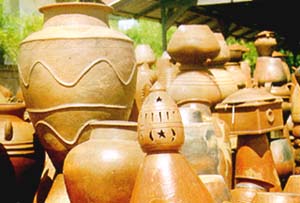
| Banyumulek Village | Masbagik Timur Village | Penujak Village |
My Crafts Project has been working with the women potters of Lombok since the beginning of 2000.
The aims of the Lombok Crafts Project are to raise the standard of living of the potter families in the three Project villages by technical, marketing and community development programmers such as literacy program, clean water. My advisers work with potters and local Project to improve the quality of pottery through clay processing, pot construction, finishing and firing techniques. Market outlets other than domestic village supply have been developed, mainly targeting the local hotel, restaurant trade and handicraft export sectors. Integrated community development programmers have been initiated aimed at increasing potter participation in managing their own enterprise. Training programmers run by Project advisers and outside consultants are teaching potters and my staff the skills required to run the export quality production. The ultimate goal is a self-sustainable organization Indonesian Trade run by local people, where decision making and distribution of profits is controlled by the potters groups.
The Lombok Crafts Project recognizes the importance of its position in influencing pottery production for the new markets that are rapidly developing on Lombok. One of the Project's aims is to fosters the continued production of traditional pottery forms and traditional techniques by actively promoting these pots to the market, rather than developing new forms imitated other cultural traditions.
West Nusa Tenggara
Municipalities and Districts
CARING FOR YOUR

| Banyumulek Village | Masbagik Timur Village | Penujak Village |
My craft project pottery's is a low fired, unglazed earthenware. Its maximum firing temperature is about 650 C - 750 C and it is therefore quite porous even when fired to maturity. Because of the nature of this pottery it is fragile, but with careful handling it will last for many years.
All the pottery is "burnished". This means that a "slip" - a mixture of finely sieved clay, water and an oily plan extract, of the consistency of thick paint is applied on the surface of the pot and when it is "leather hard" - this is then burnished by rubbing with a smooth stone, usually obsidian, or a similar tool. Sometimes a small glass bottle of fragment of shell is used.
The burnishing compacts and strengthens the surface of this clay. Sometimes the pots are burnished four or five times to bring a beautiful sheen to the pot which enhances the colours and firing marks brought about by the firing process using rice straw and coconut husks.
Some pots are decorated by burnishing a design on to the "leather hard" pot, contrasting with the unfurnished areas.
The large pots while traditionally used as water storage jars are presently used mainly for decorative purposes.
The colour and sheen of the pottery will last longer if not exposed to damp conditions. If used directly as plant pots without an inner plastic container, root growth and pressure will eventually crack the pots. Damp conditions are conducive to mould and moss growth which will spoil the surface of the pot and obliterate any colour, firing marks or decoration.
While pots have been stored outside in temperatures of around -14 C without breakage, we do not recommend this as once water freezes in the pottery it will expand and break the pot.
Because of these factors we therefore suggest that large pots be kept in dry conditions if possible.
My craft pottery's has been used traditionally for many years for food storage and cooking.
While it is being used regularly in large hotels and being put through dishwashers successfully, this will obviously shorten the life of your pottery. Normal washing by hand with detergent is recommended and the pottery should then be left to air dry. If stacked when not thoroughly, mould growth will develop. If this happens it can be simply washed off, but it is better to make sure the pottery is completely dry before putting away.
Cooking pots can be used directly on top of a flame or in the oven. Cooking with electric rings is not relay suitable. Oven cooking will be more successful if the pottery is soaked in water before cooking so that water from the food is not absorbed into the pottery.
Before using your teapot it is best to "season" it by letting it stand a few times with tea in it. The tannin build-up on the inside of the pot will seal it, making the tea taste better and preventing any seepage because of porosity.
If scratching occurs on your pottery through natural usage, the pot can be cleaned with water to which has been added a drop of detergent and a drop of oil. This will darken the surface slightly and therefore disguise the scratches.
When salt residues are present in clay a white bloom can often appear on the surface of the pot especially when exposed to damp conditions. This sometimes volatilizes or is burnt off in the firing but if not can reappear with changes in humidity. If this happens the salt can be very simply removed by washing with tap water.
If the fish pot PI16/H is used as a salt container the salt will slowly migrate to the surface of the pot which will eventually start to disintegrate. To prevent this happening you need empty the salt regularly and soak the fish tap water. Dry thoroughly before replacing the salt.
Because of the porosity the Peludahan village vase from Masbagik village is really only suitable for dried flowers or an inner container can be used for water.
We trust this information will be useful to you and it will help you to care for your pottery in the hope that it will give you many years of pleasure.
We can guarantee that our product is of the highest possible consistent quality for pottery produced using primitive techniques.
West Nusa Tenggara
Municipalities and Districts
THE SASAK PEOPLE
| Banyumulek Village | Masbagik Timur Village | Penujak Village |
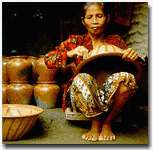
The Sasak people's ancestors migrated to Lombok from the fallen Hindu Majapahit Empire of East Java at the end of the 14th century. Their language and ancient script, art, songs and dance show their links with the Hindu Buddhism cultures that dominated much of Indonesia before the arrival of Islam
Today they are amongst the most under-developed groups in his country, living in densely populated village where illiteracy, birth rates and infant mortality rates are high. Few adults speak the national language of Bahasa Indonesia, droughts and food shortages are a common occurrence.
Although the Sasaks have an agricultural economy, and a culture closely dominated by the cycles of rice planting and harvesting, the poorest among them, including the potters do not own land to farm.
West Nusa Tenggara
Municipalities and Districts
LOMBOK POTTERY CENTRE
| Banyumulek Village | Masbagik Timur Village | Penujak Village |
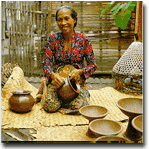
The island of Lombok in Indonesia is well known for its handicrafts and traditional craftwork, in particular pottery, basket-making, and weaving. The three villages of Banyumulek, Masbagik Timur, and Penujak represent the islands major pottery producing areas. Here, where pottery making is their main source of income, the village women have been producing pottery since the decline of the East Javanese Hindu Kingdom of Majapahit in the early part of the 16th century. Even today, the women potters of these three villages pass down their unique skills from mother to daughter in a tradition called "turun temurun".
The high level of skill of the Sasak potters is remarkable. With very simple tools, and materials gathered from the local countryside, the women potters of all three villages work in their homes to create earthenware pots of great beauty and utility, with skills passed down from generation to generation. They begin learning the process from a very early age.
Since 2000, my Crafts Project has been assisting the women potters of Banyumulek, Masbagik Timur, and Penujak, to improve their standard of living through technical and marketing assistance. This bilateral development my project between the Governments of the Republic of Indonesia is supported by the Indonesian Department of Industry. In each of the three villages, the Project has funded the building of work shelters and showrooms. Technical, quality and design skills have been improved through input by Indonesian Trade advisers, together with administrative, marketing, financial and logistic training.
The objective of the my Project Craft is to develop a potter-controlled cooperative commercial venture that will create adequate income opportunities for potters in the three villages, and also provide funding to improve social conditions in the villages for both project and non-project potters. Through this bilateral assistance program, quality, durability and marketability of the products has improved significantly. The project has helped to substantially increase the income of the potters, and all surplus profits from sales are used by the potters to improve living and working conditions in the villages.
The project has assisted the potters to process their clays in ways which produce a stronger product. The finished pots are coated with a slip made from the same clay, sieved to produce a fine surface which is later burnished with a stone. The earthenware clay that the women use is dug locally and has different qualities in each village. The potters never have to travel more than three kilometers from their houses to find sufficient clay for their needs.
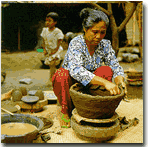
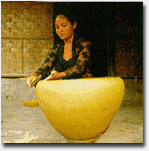
Grayish brown, the indigenous clay becomes a beautiful rich red brown color when fired. The potters work the clay by hand, sometimes using a round stone and wooden paddle. This is one of the oldest ways of making pottery, and Lombok is one of the few places in the world where it has survived. The large water storage jars are formed by the potter building up and scraping the walls of the pot as she walks around it.
Firing takes place as soon as the pots are dry. After half a day in the sun to finish drying, the pots are stacked in a pile with a variety of fuel including firewood and coconut husks. Once the fire is going well, the stack is covered with rice straw and rice husks which burn out to leave a thick ash cover, holding in the heat for the final stages of firing. The project has taught potters to use more fuel and a longer firing time so that pots are well fired and strong.
The clay used to produced Sasak pottery pots has been approved for food safety by the Indonesian Trade and Industrial Research.
Earthenware products from my craft pottery's project include food storage items as well as cooking vessels. While handmade earthenware is intrinsically fragile, if handled with care it will last for many years.
If you would like further details of Lombok Craft Project Pottery and the traditional Sasak earthenware products, please call me "Tirta" and phone number +62 - 0370 634275 or write by e-mail fax number +62 370 631638
Banyumulek Village
West Nusa Tenggara
Municipalities and Districts
East Lombok
| Banyumulek Village | Masbagik Timur Village | Penujak Village |
Vast ricefields surround the village of Banyumulek which is about 10 kilometres to the South of Lombok's capital city of Mataram. Here, the potters produce an incredible variety of earthenware traditionally used for many purpose, including preparation and serving of food and ceremonies connected with village life.
Masbagik Timur Village
West Nusa Tenggara
Municipalities and Districts
East Lombok
| Banyumulek Village | Masbagik Timur Village | Penujak Village |
The village of Masbagik Timur, situated in the Sub-district of Masbagik in East Lombok, is the most isolated of the three villages. Here, the earthenware designs are characterized by the use of geometric burnished decoration on simple forms.
Penujak Village
West Nusa Tenggara
Municipalities and Districts
Central Lombok
| Banyumulek Village | Masbagik Timur Village | Penujak Village |
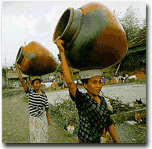
The village of Penujak, in the sub-district of West Praya in Central Lombok, is less than an hour by car from Mataram. The village is on the main road between Praya, the capital of Central Lombok, and Kuta, a tourist resort on the South Coast. In Penujak, the potters are using simple kilns to fire their pottery which often has carved or applied decoration such as lizards and frogs.
[My Craft Project Pottery]
[Catalog one] [Catalog two] [Catalog three] [Catalog four]
[Home]
Residence
Jalan Cendrawasih no.8 Cakranegara, Mataram, 83231, NTB, Indonesia
Telephone : + 62 370 634275
Fax : + 62 370 631638

|