 |
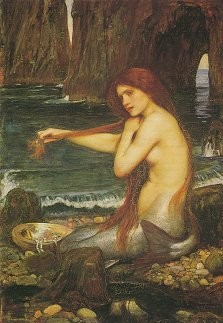
"A Mermaid", John William Waterhouse
The Mystery of Loch Ness: A Mythical Theory
|
|
In 565 CE, a man named Adamnan recorded a tale in which St. Columba, who helped to Christianize the British Isles, ordered a monster in Loch Ness to stop killing people; it seems that the creature was reputed to capture and drown unsuspecting folks in the manner of a Kelpie. The story is typical of wonder tales of its time; St. Patrick and other Christian evangelists were often said to have faced and defeated various creatures who were associated with the old religion. But in this case, the sightings go on; many visitors to the area report having seen the monster. Science had shown no sign of a beast living under the waters of the loch, but ordinary humans are still catching sight of the enchanting Nessie.
Last year, I was talking to an online group about Loch Ness, the monster, and what sort of mystical energy might be present at the loch. Most bodies of water in Celtic lands were associated with goddesses; there are countless Ladies of the Lake. Then it occurred to me--what if the monster is the goddess? How many goddesses, suppressed by later religions, were "transformed" into serpent-like creatures; how many goddesses became the demons of a new order?
In an astral journey, I saw the Lady/Monster of Loch Ness in two forms; a very young girl and a serpentlike beast. She transformed constantly between the two. And my experience with her told me that she is real--but will never be measured by scientific instruments, or detected by infrared cameras. She exists in the Otherworld, in the land of Faery. And enchanted tourists, or wide-eyed children, or dreamers, or witches may be the only ones who can see her. She is there--but only to those willing to believe, and look beyond the mundane world.
Still, I like to have some textual backup for anything I find out by personal experience; it helps me assure myself that I'm not just making it all up. My vindication came in the form of a few paragraphs in Donald Mackenzie's lovely book, Celtic Tales of Myth and Legend, a collection of Scottish folklore. This excerpt is from the story "Beira, Queen of Winter", and calls to mind the Irish story of Liban in its form.
"Beira had another well in Inverness-shire which had to be covered (by a slab) from sunset to sunrise. One of her maids, whose name was Nessa, had charge of the well. It happened that one evening the maid was late in going to the well to cover it. When she drew near she beheld the water flowing so fast from it that she turned away and ran for her life. Beira watched her from the top of Ben Nevis, which was her mountain throne, and cried: 'You have neglected your duty. Now you will run for ever and never leave water." The maiden was at once changed into a river, and the loch and the river that runs from it toward the sea were named for her. That is why the loch is called Loch Ness and the river the River Ness. Once a year, when the night on which she was transformed comes round, Nessa arises out of the river in her girl form, and sings a sad sweet song in the pale moonlight. It is said that her voice is clearer and more beautiful than that of any bird, and her music more melodious than the golder harps and silvern pipes of fairyland."
I only wish I knew which day that was...but I would lay my money on Samhain.