
 |
In the Middle Ages, even as "pagan superstition" fell out of favor in Europe, the archetypal Celtic "mermaid bride" reared her head in France. Not only was her story told far and wide, but nobles and even kings doctored their family trees to claim descent from her. Her name was Melusine. Some say the name is derived from "Mere-Lusigne", mother of the house of Lusignan. Others claim it is a corruption of "Mala Lucina", the "Evil Midwife"--referring to the strange children and happenings that Melusine brought to birth.
She was the eldest of three sisters, daughters of the Scottish water faery Pressine. Pressine fed her three children with tales of their father's calumny--for Pressine had been forced to leave her husband Elinas after her otherworldly nature was discovered. When Melusine grew to womanhood, she hatched a scheme of revenge against Elinas--a scheme she was sure would please Pressine. Enlisting the aid of her sisters, Meliot and Palatine, Melusine spirited Elinas away to a mountain wasteland, where she left him to wander alone. The three sisters noasted of their deed to Pressine--who was furious! Whether she thought the girls had been too harsh, or whether she was simply upset that they did not include her in the plan, we do not know. But angry she was. Pressine cursed her daughters. Meliot was cursed to solitude; Palatine was banished to the mountains to share Elinas's exile. And for Melusine, the ringleader, Pressine reserved a very specific, very fitting vengeance...
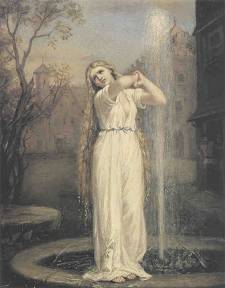
Some time after this, in the Poitou region of France, a handsome knight named Raimond de Lusignan walked alone in the woods. He came upon a fountain, where sat the most beautiful woman he had ever seen. The lady was Melusine, as you might guess, and Raimond fell in love with her at first sight. He impulsively proposed marriage. Melusine thought for a moment, and then said yes--on one condition. Raimond was never to seek Melusine's company on Saturday. (Some versions of the legend say Friday or Sunday instead; Jennifer Heath suggests a monthly seclusion, implying a menstrual theme.) Raimond, besotted, agreed to Melusine's unusual request.
Years passed, and love grew. Melusine disappeared once a week, as expected. Sometimes, during her period of seclusion, a castle magically appeared in the countryside. People wondered and speculated--but the land prospered, and no one suspected Melusine of anything untoward.
Until Melusine began to bear her children. They were healthy in all ways--except that each had a strange deformity, like a third eye or a tail. Fear began to run rampant in Poitou, and rumors of adultery and witchcraft began to hound the beautiful Lady of Lusignan.
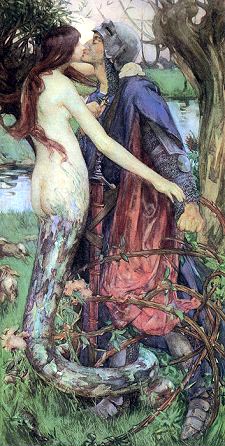
Raimond loved his wife, but he wanted to assure himself and his people that Melusine was doing nothing wrong. One Saturday he spied on her in her bath--and saw that her lower body had turned into the tail of a sea-snake. Before he could say a word, Melusine saw her prying husband--and Pressine's curse took full effect. Every shapeshifter bride has a rule which her husband must not break. Melusine sprouted wings and flew shrieking from the Chateau de Lusignan.
They say that Melusine secretly, invisibly returned to the chateau every night to nurse her children, who grew up to engender lords and kings. Melusine is also said to fly around the chateau whenever one of her line dies, shrieking and crying in the manner of the Irish beansidhe. Raimond de Lusignan died a hermit.
I am currently working on a theory in which Melusine is a memory of a sovereignty-goddess figure and Raymond her dying and reborn consort. I am hoping to have some stuff up about this soon.

 |
