Ceridwen, the Lady of Initiation
 |
|
|
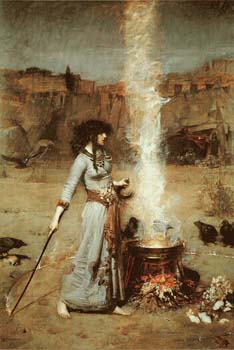
Ceridwen appears in only one story--the Welsh tale of Taliesin, the famous semi-mythical bard. You probably already know the story--how she brewed up a drink of infinite wisdom to ease her ugly son's way in the world, and that a young boy named Gwion Bach (accidentally or intentionally) consumed the precious drops instead. After a shape-shifting battle, Ceridwen devoured Gwion. She became pregnant, and nine months later rebirthed Gwion as Taliesin, and set him adrift on a river. He began reciting epics while still in swaddling clothes, and the rest is history.
The story seems to hint at an underlying meaning, and here I set out my guess as to what it might be. Much of this has been said before, I'll admit.
In his classic The Fairy-Faith in Celtic Countries, W.Y. Evans-Wentz speculates that the ancient Britons may have practiced initiatory rites similar to the Greek mysteries at Eleusis. (For more evidence, click the link above to view the text; most of the relevant information can be found in the chapters titled "Celtic Otherworld" and "Doctrine of Rebirth".) Now, the Eleusinian initiates used to say that anyone who died without having been initiated was to be pitied, for s/he died ignorant. What does this have to do with Ceridwen? I'm getting there, trust me.
But first, I must digress a little more. Let's look at another cauldron story. In "Branwen the Daughter of Llyr", the god/hero Bran owned a cauldron of rebirth which he gave as a placatory gift to King Matholwch of Ireland. The cauldron's property was this: if a dead man was thrown into it, he would be resuscitated, but would no longer have the power of speech. My gut tells me this refers to death and rebirth in general--we die, and are reborn as infants, unable to speak and having forgotten our past lives.
Back to Ceridwen. When Gwion drank the Lady's potion, he acquired all the knowledge of the past and the future, and was reborn talking. He was found by a man named Elphin, and immediately started telling him his life story--or should I say, his "lives" story, since he seemed to be relating all of his past existences. Why was he able to do this? Because he, like the initiates of Eleusis, did not die ignorant. He tasted of the Goddess's wisdom before he died, and so he emerged from death (Bran's cauldron) WITH the capacity of speech.
Now, it's a bit of exaggeration to say that normal human beings, if they learn about their past lives and such, will be reborn talking up a storm. But, perhaps we will be able to go into our next life with more wisdom, having absorbed the lessons of our past lives. The analogy definitely works when applied to major life changes, those "little deaths" we all experience on our way to the big one. We all experience major upheavals, but what happens after that depends on whether we learn the lessons that are presented to us. We can ignore the lessons and blunder into the exact same situation again, or we can gain wisdom. That is what Ceridwen has to teach.