Varanasi
Ghats
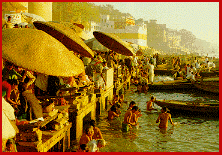
Varanasi, known to the devout as Kashi, is said to have been founded by Shiva, Lord of the Universe. One of the oldest living cities in the world, as also one of the most important pilgrimage sites in India, Varanasi is a major tourist attraction. Situated on the banks of the sacred Ganges, the city has been a centre of learning and civilisation for over 2000 years. It was at Sarnath, only 10 km away from Varanasi, that the Buddha, first preached his message of enlightenment, 25 centuries ago.
Varanasi derives its present name from the two tributaries of the Ganga - Varuna and Asi - between which it is situated. According to historians, the city was founded around ten centuries before the birth of Christ. The city finds mention in holy scriptures like 'Vamana Purana', Buddhist texts and the 'Mahabharata'. The unique relationship between the mighty Ganga and the city forms the essence of Varanasi - 'the land of sacred light'.
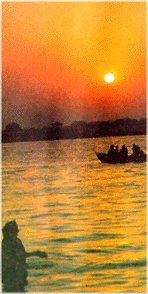
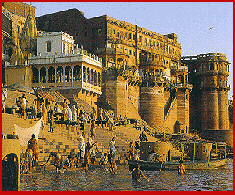 Varanasi's principal attraction is the long string of
ghats, which line the west bank of the Ganges. Ghats are the steps
which lead down to the river. There are around 100 ghats in
Varanasi, each with its own significance. Most Indians believe that
anyone dying on the banks of the river, in Varanasi, attains instant
'moksha' or enlightenment.
Varanasi's principal attraction is the long string of
ghats, which line the west bank of the Ganges. Ghats are the steps
which lead down to the river. There are around 100 ghats in
Varanasi, each with its own significance. Most Indians believe that
anyone dying on the banks of the river, in Varanasi, attains instant
'moksha' or enlightenment.
The Dasaswamedh Ghat is the most significant ghat here, and conveniently placed at the centre. The Manikarnika ghat is associated with Goddess Parvati, Lord Shiva's wife. The five ghats where pilgrims are supposed to bathe in order, and on the same day are Asi ghat, followed by Dasaswamedh, Barna Sangam, Panchganga, and finally, Manikarnika, in that order. Manikarnika and Harishchandra ghats, are the ghats used primarily for the cremation of the dead. Other main ghats include Kedar ghat, a shrine popular with Bengalis; Mansarovar ghat built by Man Singh of Amber; and PanchGanga Ghat where the five rivers are supposed to meet.
Temples and other attractions
Vishwanath temple
 Dedicated to Shiva or Vishveswara (Vishwanath) is the
Golden Temple, the main temple of Varanasi. The original
temple was located across the road, but it was destroyed by
Aurangzeb who had built a mosque over it. The present temple was
built by Ahalya Bai of Indore in 1776. The Mosque of Aurangzeb, has
been built using columns from the original temple razed by Aurangzeb. This mosque has minarets towering 71 metres above the
Ganges.
Dedicated to Shiva or Vishveswara (Vishwanath) is the
Golden Temple, the main temple of Varanasi. The original
temple was located across the road, but it was destroyed by
Aurangzeb who had built a mosque over it. The present temple was
built by Ahalya Bai of Indore in 1776. The Mosque of Aurangzeb, has
been built using columns from the original temple razed by Aurangzeb. This mosque has minarets towering 71 metres above the
Ganges.
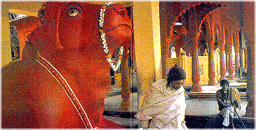
The Durga Temple, commonly known as the Monkey Temple, was built in the 18th century by a Bengali Maharani, and is stained red with ochre. This small temple, dedicated to Goddess Durga, consort of Shiva, is built in north Indian Nagara style, with a multicoloured shikhara or umbrella.
The Bharat Mata temple was inaugurated by Mahatma Gandhi and houses one of the most perfect relief maps of India carved out of marble.
Devotee
 The unique Tulsi Manas temple, built in white
marble, has the entire Ram Charit Manas (Ramayana) inscribed on its
walls. Wonderful landscaping around the temple adds to its
appeal.
The unique Tulsi Manas temple, built in white
marble, has the entire Ram Charit Manas (Ramayana) inscribed on its
walls. Wonderful landscaping around the temple adds to its
appeal.
Banaras Hindu University, founded by Pandit Madan Mohan Malviya, is considered to be the largest residential university in Asia. Within the University campus, Vishwanath Temple and Bharat Kala Kendra (museum) are worth a visit. Tel: 311833
Ganga
 Ramnagar Fort & Museum (16 km) - The residence
of Kashi Naresh (Former Maharaja of Varanasi) across the Ganga at
Ramnagar houses a museum comprising exhibits like palanquins,
costumes, swords, sabres etc. The vibrant celebration of Dussehra at
Ramnagar is an event not to be missed.
Ramnagar Fort & Museum (16 km) - The residence
of Kashi Naresh (Former Maharaja of Varanasi) across the Ganga at
Ramnagar houses a museum comprising exhibits like palanquins,
costumes, swords, sabres etc. The vibrant celebration of Dussehra at
Ramnagar is an event not to be missed.
The other attractions are Raja Jai Singh's Observatory at Man Mandir Ghat, Annapurna temple, Anand Mayee Math, Kaal Bhairav temple, Nepali temple, Guru Ravidas Mandir near the university and Kabir Janmasthali Lahartara.
Varanasi (also known as Banaras) is one of
the oldest living 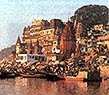 cities in the world and
the ultimate pilgrimage for Hindus, who believe that to die in the
city, is to attain instant salvation. Situated on the banks of the
Ganga, Varanasi is the tract of Holy Land lying between the rivers
Varuna and Assi. which flow into Ganga. Varanasi is also known as
Kashi, the city of light, since of the twelve "Jyotirlinga" is
installed here. Mark Twain, the American writer who visited the
city, wrote: "Benaras is older than history, older than tradition,
even older than legend and looks twi
cities in the world and
the ultimate pilgrimage for Hindus, who believe that to die in the
city, is to attain instant salvation. Situated on the banks of the
Ganga, Varanasi is the tract of Holy Land lying between the rivers
Varuna and Assi. which flow into Ganga. Varanasi is also known as
Kashi, the city of light, since of the twelve "Jyotirlinga" is
installed here. Mark Twain, the American writer who visited the
city, wrote: "Benaras is older than history, older than tradition,
even older than legend and looks twi ce as old as all of
them put together".
ce as old as all of
them put together".
Varanasi has been a great cultural centre, especially in the fields of music, learning and the craft of silk weaving. Some of the most renowned exponents of music have drawn their inspiration from Varanasi. Banaras brocades are treasured textiles and considered collector' items.
The eminent novelist Prem Chand belonged to this city and so did Tulsi Das, the famous poet who wrote Ram Charit Manas also lived here for many years. Ravi Shankar, the internationally renowned Sitar maestro is another of Varanasi's illustrious sons.
