 Sikhism
Sikhism

Sikhism has been defined as the youngest and most modern of the world religions, being an original and practical religion. having the whole humanity in view for its welfare and amelioration, Sikhism has made valuable contribution towards the uplift of man and society in almost all spheres: thought, conduct, outlook, organization and cultural patterns. It arose, in the 15th century, as a new mode of humanitarian thought, heralding a new conception of Ultimate Reality, a new vision of the Universal Man, a new altruistic ideal of a democratic state and a new pattern of a caste and classless society.
The Golden Temple
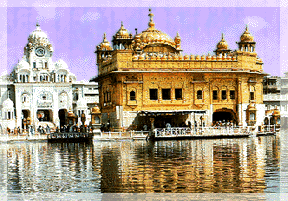
The globally renown Golden Temple, Harmandir Sahib, which enshrines the Holy Book of the Sikhs, the Guru Granth Sahib, is located in Amritsar. Amritsar, literally 'a pool of nectar', was founded by the fourth Guru of Sikhs, Guru Ram Das, who had initially constructed a pool here. The vital nucleus of Sikhism, Amritsar is also believed to be the site, where Sage Valmiki wrote the epic, Ramayana. According to popular belief, Rama and Sita had spent a brief period of their 14 year exile here.
Guru Arjun Dev - Nanak V(1563-1606) laid down the foundation of the temple in 1589. He requested his great contemporary Muslim mystic, Mir Mohammed Muayyinul Islam, popularly known as Mian Mir, to lay the foundation stone.
The construction of the temple was completed in late sixteenth century. It was rebuilt by the Sikh ruler, Maharaja Ranjit Singh in 1803. The Golden Temple is a two storey marble structure, with an imposing dome of pure gold. The architecture of the Golden Temple, is a blend of Hindu and Muslim styles. The golden dome is meant to represent an inverted lotus flower. The interior of the temple is decorated with semi precious stones, frescoes and glass work.
The Akal Takht, or immortal throne, established by the sixth Sikh Guru, Guru Hargobind, is the supreme seat of Sikh religious authority, and is also the repository of ancient weapons, used by the Sikh warriors and Gurus. The original copy of the Granth Sahib, which is kept in the Golden Temple during the day, is ceremoniously returned to the Akal Takht, at night.
The temple interior
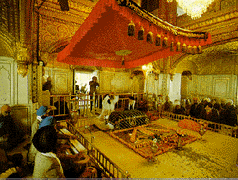
The gnarled old Jubi Tree in the north west corner of the compound, is believed to possess special powers. It was planted 450 years ago, by the Golden Temple's first high priest, Baba Buddhaya. Guru-ka-Langar or the communal canteen, is towards the eastern entrance of the temple complex, and it provides free food to all visitors, regardless of colour, creed, caste or gender.
Pilgrims and visitors to the Golden Temple, must remove their shoes and cover their heads, before entering the temple premises. The best time to visit the temple is early in the morning, on weekdays, before it gets crowded.
Sikhism began with the preaching of Guru Nanak, the founder of the
religion. he based his right to teach on his personal experience of a hukum
(command) received
from God. Nanak's simple monotheistic creed, supported by a set of
humanitarian principles of conduct and presented with humility and
conviction, made a deep impact on Indian population, then suffering under
the Mughal conquerors and the ritualized religious observances. It was the
beginning of a new religious fellowship which in course of time developed
into a well defined new Faith. Its chief principles were the unity of God,
brotherhood of man, rejection of caste and the futility of idol
worship.
he based his right to teach on his personal experience of a hukum
(command) received
from God. Nanak's simple monotheistic creed, supported by a set of
humanitarian principles of conduct and presented with humility and
conviction, made a deep impact on Indian population, then suffering under
the Mughal conquerors and the ritualized religious observances. It was the
beginning of a new religious fellowship which in course of time developed
into a well defined new Faith. Its chief principles were the unity of God,
brotherhood of man, rejection of caste and the futility of idol
worship.
Guru Nanak is viewed as the founder and preacher of a new gospel but
not to be worshiped as God.
The religion founded by Nanak was nurtured by nine other Gurus who succeeded him in the holy office of Guruship.
The term 'Guru' means Enlightener. Guru is one who delivers those
who accept his teachings and discipline from darkness to enlightenment
i.e. spiritual realization.
