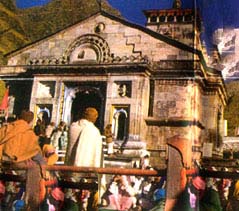
 Shiv temples, the deity is
roughly a conical rock signifying the hump of Lord Shiv as he tried to
escape disguised as a bull, is credited to Adi Shankracharya, the
8th century AD sage and religious reformer.
Shiv temples, the deity is
roughly a conical rock signifying the hump of Lord Shiv as he tried to
escape disguised as a bull, is credited to Adi Shankracharya, the
8th century AD sage and religious reformer.One of the 12 jyotirlings of Lord Shiv, Kedarnath is amongst the premier pilgrmages in the country. A number of legends in Hindu mythology explain its divinity. It was from here, narrates the epic Mahabaharat, Yudhisthra, the eldest of the Pandav brothers departed for heaven.
The present temple, in which unlike other Shiv temples, the deity is
roughly a conical rock signifying the hump of Lord Shiv as he tried to
escape disguised as a bull, is credited to Adi Shankracharya, the
8th century AD sage and religious reformer.
Kedarnath, at the head of Mandakini river, is one of the most scenically located pilgrimage. The valley, about 2km long and ½ km wide, is like an amphitheatre surrounded by high snow-covered mountains.
At the approach of winters in the month of
November, the holy statue of Lord Shiva, is carried down from Garhwal
(Kedarkhand) to Ukhimath, and is reinstated at Kedarnath, in the first
week of May. It is at this time, that the doors of the temple are thrown
open to pilgrims, who flock from all parts of India, for a holy
pilgrimage.
Samadhi of Adi Shankaracharya : Behind Kedarnath temple is the
samadhi of Adi Shankaracharya.
Bhairav Nath Temple : To the south of the main temple on a hillock stands the temple of Bhairav, the deity who guards the Kedarnath temple in winter, when it is closed for worship.
Badrinath
Badrinath, located
on the right bank of river Alaknanda, is a shrine, that evokes the most
intense religious feelings
When Ganga was requested to descend on earth to
help the suffering humanity, the earth could not withstand the 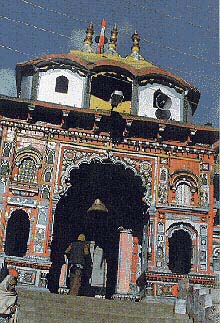 force of her descent. Therefore,
the mighty Ganga split into 12 channels, each of these holy as the Mother.
The Alaknanda is one of those constituents.
force of her descent. Therefore,
the mighty Ganga split into 12 channels, each of these holy as the Mother.
The Alaknanda is one of those constituents.
An abode of seers, saints and yogis from time immemorial, Badrinath is one of the four Dhams, was founded by Shri Shankaracharya, who was considered to be a Hindu saint and reformist. This temple is dedicated to Lord Vishnu, who is said to have done penance in the mythical Brindavan, that once covered the mountains of Uttarkhand. A devout Hindu has to visit this place in his lifetime to attain salvation.
Known as 'Tapobhumi', a land of meditation and
penance, and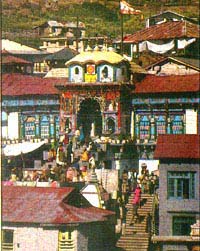 'Bhubaikunth', heaven on earth,
it is surrounded on either side, by two mountain ranges known as Nar and Narayan, with the Neelkanth peak, providing a spectacular backdrop. Facing the Badrinath temple, is a hot water spring, known as 'Tapt Kund'. Other famous springs, here, are the Narad Kund and the Surya Kund.
You can visit Kedarnath during the months of
May to October after which it is closed during the winter.
Temple of Sri Badrinathji : Legends dates it back to the vedic age. The present temple is believed to have been established by Adi Shankaracharya in 8th century, who also established a math here.
Tapta Kund, Surya Kund, Narad Kund : These are all natural thermal springs on the bank of the Alaknanda.
Mata Murti Temple
: Is
devoted to the mother of Sri Badrinathji.
Gangotri
When in answer to the
prayers of King Bhagirath, Ganga descended on earth, Lord Shiva received
her into his matted locks to break the great force of her falls. From
there Ganga emerged in many streams, that which originated from Gangotri
was called Bhagirathi. According to the mythological acc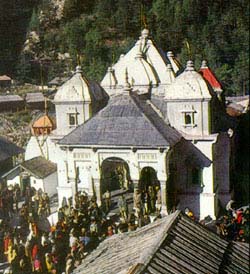 ounts Lord Shiva resided here and
Goddess Parvati would bathe in the waters of the Ganga everyday before it
touched the ground.
ounts Lord Shiva resided here and
Goddess Parvati would bathe in the waters of the Ganga everyday before it
touched the ground.
The source of the Ganga, the Gangotri glacier, has now shifted 19km further up the valley and traces of its passage are still visible.
The Gangotri temple is open for worship from
May till October. During winter due to the snow, the temple is
closed.
Submerged Shivling
: A
natural rock Shivling, submerged in the river, where according to legend,
Lord Shiva sat when he received Ganga in his matted locks, is visible in
winter months when the sediment content in the Ganga water is the
least.
Gomukh : This is 19km up from Gangotri,
this is the snout of the Gangotri glacier and the present source of the
Bhagirathi. The distance can be covered on foot or on
ponies.
Yamunotri
In
the shadow of the 6,315 mt. high Bandarpunch mountain, Yamunotri, the
source of river Yamuna, is one of the four most important pilgrimages,
collectively called ‘Char Dham’, of the Garhwal Himalayas. The premier
attraction of Yamunotri is the temple devoted to Goddess Yamuna and the
holy thermal springs.
Yamunotri
In
the shadow of the 6,315 mt. high Bandarpunch mountain, Yamunotri, the
source of river Yamuna, is one of the four most important pilgrimages,
collectively called ‘Char Dham’, of the Garhwal Himalayas. The premier
attraction of Yamunotri is the temple devoted to Goddess Yamuna and the
holy thermal springs.
What to
See
Temple of
Yamuna : The temple was built by Maharani Gularia of Jaipur in
the 19th century.
Surya Kund : There are a number of thermal springs in the vicinty of the temple which flow into number of pools.
Divya Shila : A rock pillar
which is worshipped before entering the Yamunotri Temple.
