Haridwar
Haridwar is situated on the right side of the
bank of the holy Ga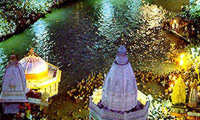 nga,
and is the point where the river spreads over the northern plains. Associated
with both Lord Shiva and Lord Vishnu, Haridwar is among the seven sacred cities
of India. It is also one of the four venues for the Kumbh Mela, held in its
magnitude every twelve years. Essentially a religious centre which holds promise
of salvation for devotees, Haridwar is also a centre of herbal medicine, and
traditional studies at Gurukul Kangri. There are many places of scenic beauty on
the outskirts of the town.
nga,
and is the point where the river spreads over the northern plains. Associated
with both Lord Shiva and Lord Vishnu, Haridwar is among the seven sacred cities
of India. It is also one of the four venues for the Kumbh Mela, held in its
magnitude every twelve years. Essentially a religious centre which holds promise
of salvation for devotees, Haridwar is also a centre of herbal medicine, and
traditional studies at Gurukul Kangri. There are many places of scenic beauty on
the outskirts of the town.
I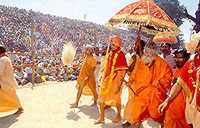 t is
said that when the Gods left their footprints on the land of
Haridwar, metaphorically they also left an indelible mark on the
spiritual ethos of every Hindu – more so, the devout, who would
later follow their holy paths all across this blessed land. Haridwar
stands as the gateway to the four pilgrimages of Uttrakhand.
Mentioned as Mayapuri, Gangadwar, Mokshadwar in the ancient
scriptures and epics, Haridwar has always remained as a major
Shaktipeeth for the devotees. Of such significance is Haridwar in
the thought of India’s traditional Hindus that it has earned its
sobriquet of honour, `the gateway to the Gods’.
t is
said that when the Gods left their footprints on the land of
Haridwar, metaphorically they also left an indelible mark on the
spiritual ethos of every Hindu – more so, the devout, who would
later follow their holy paths all across this blessed land. Haridwar
stands as the gateway to the four pilgrimages of Uttrakhand.
Mentioned as Mayapuri, Gangadwar, Mokshadwar in the ancient
scriptures and epics, Haridwar has always remained as a major
Shaktipeeth for the devotees. Of such significance is Haridwar in
the thought of India’s traditional Hindus that it has earned its
sobriquet of honour, `the gateway to the Gods’.
Legend has it that the holy
Ganga, the holiest of all rivers, which flows through this sacred
city has actually been sanctified by the powerful Trinity of Hindu
mythology and the centre of the pantheon – Lord Brahma, Vishnu and
Mahesh.
Down the ages, this special
importan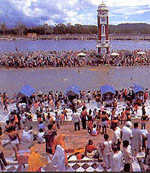 ce of
Haridwar as the ever-refreshing mystic venue for the purification of the
mind, body and soul gained more impetus…and today, manifests into
great events that take place here, i.e. the memorable Kumbh Mela
which happens once every 12 years and the Ardh Kumbh Mela, which
comes once every six years. Yet, beyond the mystic aura and
mythology, Haridwar casts another magic spell on the visitor. Being
one of the oldest living cities, Haridwar finds its mention in the
ancient Hindu scriptures as it weaves through the life and time
stretching from the period of Buddha to the more recent British
advent. Haridwar has not only remained the abode of the weary in
body, mind and spirit, but also served as a centre for attraction
for many, for learning the arts, science and culture.
ce of
Haridwar as the ever-refreshing mystic venue for the purification of the
mind, body and soul gained more impetus…and today, manifests into
great events that take place here, i.e. the memorable Kumbh Mela
which happens once every 12 years and the Ardh Kumbh Mela, which
comes once every six years. Yet, beyond the mystic aura and
mythology, Haridwar casts another magic spell on the visitor. Being
one of the oldest living cities, Haridwar finds its mention in the
ancient Hindu scriptures as it weaves through the life and time
stretching from the period of Buddha to the more recent British
advent. Haridwar has not only remained the abode of the weary in
body, mind and spirit, but also served as a centre for attraction
for many, for learning the arts, science and culture.
Ha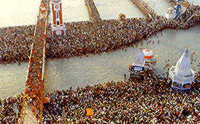 ridwar’s
longstanding position as a great source for Ayurvedic medicines and
herbal remedies as well as its unique Gurukul school of traditional
education, the scenic beauty and lush greenery…all give the city a
unique flavour and charm; a must among the sojourn centres in a
discoverer’s itinerary of Western U.P. – A destination of all
seasons.
ridwar’s
longstanding position as a great source for Ayurvedic medicines and
herbal remedies as well as its unique Gurukul school of traditional
education, the scenic beauty and lush greenery…all give the city a
unique flavour and charm; a must among the sojourn centres in a
discoverer’s itinerary of Western U.P. – A destination of all
seasons.
