Buddhism
From Siddharth to Sakyamuni and finally to the budha or the Enlighted
one - an incredible transformation of a prince to an enlighted teacher,
who walked the earth more than 2500 years ago.
Upon Seeing
sorrow, misery, pain and death, in the prime of his youth, prince siddhath
decided to discover their causes and means of overcoming
their
occurences.
Thus renouncing worldly pleasures and leaving
home and family behind, he travelled from place to place until finally
attaining enlightment by fixed meditation under the Bodhi Tree.
He
then Preached the truth he discovered and exhorted his disciples to follow
the Eight Fold Path for the cessation of the endless cycle of birth and
re-birth.
Rajgir
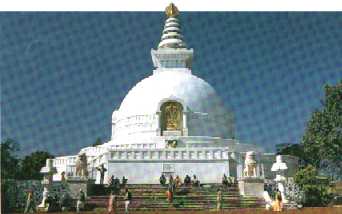
Kapilavastu - 110 kms from
Gorakhpur in Uttar Pradesh. The capital city of the Sakya clan and one of
the earliest republics, it was in kapilavastu's opulent environs that the
holy soul of prince Siddharth(Gautam Buddha) spennt his childhood.
Bodhgaya - Bodhgaya in the state of Bihar, reckoned as the most
important Buddhist Pilgrimage Centre, is the place where Lord Sakyamini (Gautam
Budha) entered into the meditation afetr being movd by the
sufferings of mankind.
Gaya - Gautam Buddha realised the Supreme
Truth here that "Neither extreme self indulgence nor self mortification is
ever required. What is needed is to follow the Middle Path."
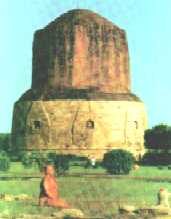
Sarnath - The begining of the celeberated
Mantra "Buddham Sharnam Gachhami", owes it Origin to Sarnath. The three
jwels " I go for refuge to the Budha. I go for refuge to the Wheel of law,
I go for refuge to the Sangha" first laid down here.
Kushinagar - Kushinagar is a revered place
for Buddhist pilgrims. It was here that the Tathagata, the reciter of
truth, breathed his last with the last words, "Behold now, brethen , I
exhort you, saying, decacy in inherent in all component things ! Work out
your salvation with diligence !"
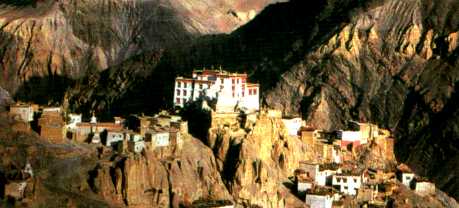
Ladakh
Ladakh - Popularly known
as "Hermit Kingdom", Ladakh is a land of snow carved peaks, translucent
lakes, barren terrain and mystic culture. Quite like Tibbet it has a great
Buddhist tradition which is evident from the high monk to people atio of
1:8 In the month of June, the famous Hemis festival is held, when a large
number of tourists visit it.
The Ajanta Caves consists of 30 Caves including the unfinished ones,
dating back from 200 BC to 250 AD. The caves are cut from the volcanic
lava on the Deccan in the forest ravines of the Sahyadri Hills and are set
in beatiful sylvan surroundings. Ajanta provides a unique combination of
architecture, sculpture and
paintings. Two basic types of Buddhist
Architecture are preserved at Ajanta, the Chaitya or Prayer Hall and
Vihara or monastery.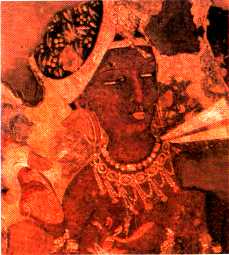
Other Paces are
Rajgir, Kaushambhi, Sravasti, Vaishali, Nalanda, Orissa, Sikkim, Tawang,
Tabo, Sankisa, , Sanchi, Karla
Caves, Kanheri Caves, Junnar Caves, Bhaja Caves & Ngarjuna Konda.
Customised Package Tours are available for all or selected
Buddhist sites in India.
DARJEELING is
the most important and organized hill Resort in
eastern India it is perched at a height of 2134 Mts. with a back
drop of the mighty Himalayas peaks .
Darjeeling offers a panoramic
view of the mighty Kanchanjunga Peak
. Darjeeling derived its name from Darjeling
which means the "abode of dorja" who was a mystic.It
was a name given to a Buddhist Monastery in
the center of town.
SIKKIM a
remarkable destination, offbeat and unknown,nestles
between Nepal ,Bhutan ,Tibet and Darjeeling ,
district of West Bengal . The
rich Himalayan flora and fauna,soaring peaks, cascading
waterfalls and lush moist valleys provide
a scenic eauty and aesthetic grandeur, that
unfolds before our eyes and fills
our heart and spirit with a
new satisfaction. Sikkim is noted for its flora and
fauna The smallest and the least populous state in India,Sikkim
is nestled in the eastern Himalayas bounded by Tibet Nepal
and Bhutan , and the Indian state
of West Bengal . Sikkim
is inhabited by three ethnic groups "
Napelese ,Lepchas and the Bhutias". Napelese
are mostly Hindus while Lepchas and Bhutias largely
profess Buddhism.Sikkim is therefore dominated by Buddhist sects and
practices of Tibet and Bhutan. Its landscape
is dotted with Buddhist Monasteries and Shrines.The
cultural fabric and festivals are mostly drawn from
Budd-
hist history and mythology. Gangtok is
the heart of Sikkim and based
for all other places in Sikkim
like Rumtek monastery, Phodong monastery and Pemayangtse
monastery.
Bodhgaya
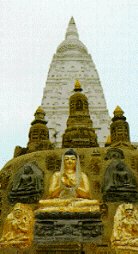 The four most holy places associated with the Buddha are
Lumbini, his birthplace, in Nepal; Sarnath, near Varanasi, where he
preached his first message; Kushinagar, near Gorakhpur, where he
died; and Bodhgaya, where he attained enlightenment. Bodhgaya is the
most important Buddhist pilgrimage site in the world. Apart from
being a significant archaeological site, it is also a vital Buddhist
centre.
The four most holy places associated with the Buddha are
Lumbini, his birthplace, in Nepal; Sarnath, near Varanasi, where he
preached his first message; Kushinagar, near Gorakhpur, where he
died; and Bodhgaya, where he attained enlightenment. Bodhgaya is the
most important Buddhist pilgrimage site in the world. Apart from
being a significant archaeological site, it is also a vital Buddhist
centre.
Devout Buddhists and tourists from all over the world visit
Bodhgaya, to study Buddhism and the art of meditation, or to simply
absorb the aura of solemn grandeur that surrounds the place.
Bodhgaya is a quiet and peaceful place. You could visit Bodhgaya in
a day, or even plan a long study leave, depending on your
inclination.
The focal point of Bodhgaya is the Mahabodhi Temple. A 50 metre
high pyramidal spire crowns the Mahabodhi temple, inside which, is a
large gilded image of the Buddha. The temple is believed to be
standing on the site of a shrine, erected by Ashoka in the 3rd
century B.C. Although the current temple was restored in the 11th
century, and again in 1882, it is said to be the same as the one
standing here since the 7th century. The Bo tree growing here is
believed to be the direct descendant of the original tree, under
which the Buddha sat, meditated and attained enlightenment. A
sapling from the original tree, was taken to Sri Lanka by
Sanghamitra (Emperor Ashoka's daughter), when Ashoka took Buddhism
to the island. The tree now flourishes in Anuradhapura in Sri Lanka.
A cutting of this tree was brought back to Bodhgaya, when the
original tree here died. A red sand stone under the tree is said to
be the Vajrasan, or diamond throne, one which the Buddha sat on.
Most countries with a large Buddhist population have a temple or
a monastery here, usually built in a representative architectural
style.
The archaeological museum houses a small collection of Buddha
figurines, and pillars that were discovered in the area. The Hindu
Shankaracharya Math has a temple here, and across the river are the
Dungeshwari and Suraya temples.
BHUTAN
: Behind the great natural barriers of Himalayas lies the
hidden
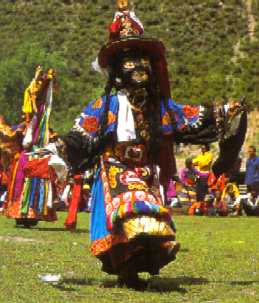 kingdom of Druk yul,the land of Thunder
Dragon .It is known to the World as
BHUTAN. It is the last of
Mahayana Buddhist Kingdom.Bhutan is the only country in the
World,where Tantric form of Buddhism plays a vital role
in people's every day life.Prayers and
devotion are as natural as work and play .With
the advent of Buddhism in the middle of
8th century by an Indian
Saint called Padma Sambhava , one who was
born
kingdom of Druk yul,the land of Thunder
Dragon .It is known to the World as
BHUTAN. It is the last of
Mahayana Buddhist Kingdom.Bhutan is the only country in the
World,where Tantric form of Buddhism plays a vital role
in people's every day life.Prayers and
devotion are as natural as work and play .With
the advent of Buddhism in the middle of
8th century by an Indian
Saint called Padma Sambhava , one who was
born
from a lotus flower
became the object
of spiritual worship . The foot prints
monasteries and temples constructed by him remain as
the holy memories of this great Saint . Bhutan is a
hidden Paradise in the Himalayas. It
has preserved a wealth of sights for
many visitors . The unique culture
and traditions of this small country
has maintained a strong identity
of its own and it
leaves a life time experience
for the visitors. Cultural
and ritual festivals are celebrated through out
the year. Your visit can be timed in such a way
to coincide with one of
these festivals.
NEPAL ,
THE ABODE OF GODS a
culturally rich country with
an abundance of natural beauty
, this small landlocked country
with an area of
56,139 square miles (1,45,139 sq km) is the home of 8 of
the 14 highest mountains in the
World. Nepal contains a diversity of natural and cultural wealth you
will find in few places on earth,the varied landscape offers a fascinating
array of sightseeing and adventure opportunities.
The major religion of Nepal
Hinduism (90%), Buddhism ( 6 %), Islam (3%), others
1%. Kathmandu is the capital of
the kingdom of Nepal
