 .
.
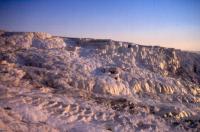
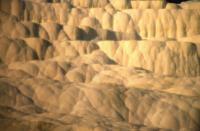
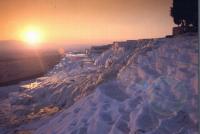
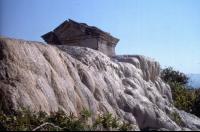
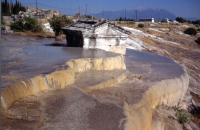
Travertine is a kind of rock which is formed as calcium bicarbonate precipitates out of hot spring water. It may be formed in many ways under different atmospheric conditions. Geological activity of the past affected a large area in which the Pamukkale thermal springs are found. There are 17 thermal sources in this special area with temperatures ranging between 35-100°C. The source of Pamukkale is only one unit of that whole area.
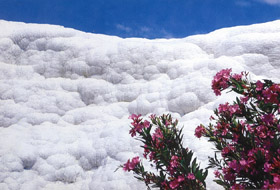 The thermal water flows to the top of the cascades by a 320-meter-long
channel and then flows on the cascades about 240-300 m. CaCO3 begins to
precipitate on the cascades as the carbon dioxide evaporates, but in the
beginning the precipitate is soft like gel. It needs time to completely
dry and harden. In order to protect the cascades from destruction and to
preserve their natural beauty, entrance to the travertine area has been
prohibited since 15 May 1997. .
The thermal water flows to the top of the cascades by a 320-meter-long
channel and then flows on the cascades about 240-300 m. CaCO3 begins to
precipitate on the cascades as the carbon dioxide evaporates, but in the
beginning the precipitate is soft like gel. It needs time to completely
dry and harden. In order to protect the cascades from destruction and to
preserve their natural beauty, entrance to the travertine area has been
prohibited since 15 May 1997. .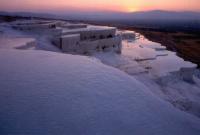
Weather conditions, the temperature of the water, and sufficient time for water tospread and flow are very important for the maintenance of white travertines. Precipitation goes on until the levels of carbon dioxide in the thermal water and the surrounding air are balanced. While the
 quantity of CO2 is 725 mg/l in the source, it is only 125 mg/l at the end
of the travertines. Calcium bicarbonate also decreases from 1200 mg/l to
400 mg/l, and calcium decreases from 576 to 8 mg/l. Analysis indicates
that 499.9 mg of CaCO3 precipitates per liter of thermal water over the
cascades. The average density of the thermal water is 1.48 g/cm3 with a
flow rate of 466.2 liters/second. That means 43,191 grams of calcium
bicarbonate precipitate from the thermal water per day.
quantity of CO2 is 725 mg/l in the source, it is only 125 mg/l at the end
of the travertines. Calcium bicarbonate also decreases from 1200 mg/l to
400 mg/l, and calcium decreases from 576 to 8 mg/l. Analysis indicates
that 499.9 mg of CaCO3 precipitates per liter of thermal water over the
cascades. The average density of the thermal water is 1.48 g/cm3 with a
flow rate of 466.2 liters/second. That means 43,191 grams of calcium
bicarbonate precipitate from the thermal water per day.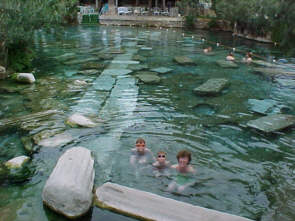 Theoretically,
that can whiten a 13,584 m2 area. However, whitening a 13,584 m2 area is
practically very difficult. The whole travertine area currently covers
22,000 m2 .There is an area called ''Domuz Cukuru'' which is about 3000 m2
on an old street which used to be connected to Pamukkale Town. It is free
for tourists.
Ions: Potassium (K) 13.5 mg, Sodium (Na) 332.3 mg, Calcium (Ca) 464.5 mg,
Magnesium (Mg) 911 mg, Iron (Fe) 0.036 mg, Aluminum (Al) 2.34 mg.
Anions: Chlorinate (CL) 53, Nitrate (NO3), Sulfate (SO4) 675.5, Hydro
phosphate (HPO4) 1.08, Hydro Carbonate (HCO3) 1045.3.
Theoretically,
that can whiten a 13,584 m2 area. However, whitening a 13,584 m2 area is
practically very difficult. The whole travertine area currently covers
22,000 m2 .There is an area called ''Domuz Cukuru'' which is about 3000 m2
on an old street which used to be connected to Pamukkale Town. It is free
for tourists.
Ions: Potassium (K) 13.5 mg, Sodium (Na) 332.3 mg, Calcium (Ca) 464.5 mg,
Magnesium (Mg) 911 mg, Iron (Fe) 0.036 mg, Aluminum (Al) 2.34 mg.
Anions: Chlorinate (CL) 53, Nitrate (NO3), Sulfate (SO4) 675.5, Hydro
phosphate (HPO4) 1.08, Hydro Carbonate (HCO3) 1045.3.
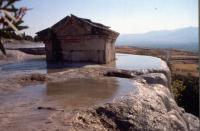
 Red Travertines
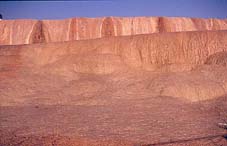
The Thermal Source is in Karahayit Town about 5 km north of
Pamukkale and also a part of the Pamukkale Thermal Sources System. The
water composition resembles that of Pamukkale Thermal Sources, but it is
warmer and has less CO2. There are three sources. The first one is 420C,
the second is 50 0C and the third source is 56 0C. The water also has
mildly radioactive elements.The thermal water is good for the heart,
hardening of the arteries, high blood pressure, rheumatism, sciatica,
skin and nerve diseases. Thermal Water Contents: The water has calcium
(466.000), bicarbonate (1329,569), sodium (114,950), iron (2,485),
potassium (32,883), magnesium (131,344), carbon dioxide (730,40) mg and
radioactivity is 183,14. There are several oxides in thermal water.
That's why the water has formed different colored travertines according
to its contents.
Red Travertines
The Thermal Source is in Karahayit Town about 5 km north of
Pamukkale and also a part of the Pamukkale Thermal Sources System. The
water composition resembles that of Pamukkale Thermal Sources, but it is
warmer and has less CO2. There are three sources. The first one is 420C,
the second is 50 0C and the third source is 56 0C. The water also has
mildly radioactive elements.The thermal water is good for the heart,
hardening of the arteries, high blood pressure, rheumatism, sciatica,
skin and nerve diseases. Thermal Water Contents: The water has calcium
(466.000), bicarbonate (1329,569), sodium (114,950), iron (2,485),
potassium (32,883), magnesium (131,344), carbon dioxide (730,40) mg and
radioactivity is 183,14. There are several oxides in thermal water.
That's why the water has formed different colored travertines according
to its contents.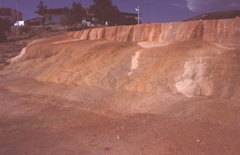 Karahayit used to be just a local tourist destination, but nowadays it is
an international destination because many hotels have been built.
Karahayit Town is almost as important as Pamukkale.
The Karahayit Red Cascades cover about 500 m2. The cascades are one of
the most interesting places to see in Denizli.
Karahayit used to be just a local tourist destination, but nowadays it is
an international destination because many hotels have been built.
Karahayit Town is almost as important as Pamukkale.
The Karahayit Red Cascades cover about 500 m2. The cascades are one of
the most interesting places to see in Denizli.