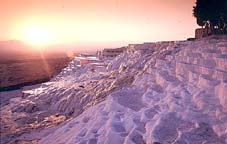
HIERAPOLIS (PAMUKKALE)
It's about 20 km north of Denizli. It is called a Holy City in Archeological literature, because there were many temples and religious buildings in Hierapolis. The ancient city is situated between several historical areas. According to the ancient geographers, Strabon and Ptolemaios, Hierapolis was very close to Laodicea and Tripolis which was in Kario's Border. That's why it was a Phrygian City. There is no information about Hierapolis' history before the Hellenistic Era, but we know there was a city there before then. It's called Hierapolis because of its Mother goddess Cult.
 Information about Hierapolis is limited. It is known that the king of Pergamum,
Eumenes II, founded the city in 190 BC. It was named Hierapolis after the
Amazon's Queen Hiera, the wife of Telephos, the founder of Pergamum.
(Pergamum is also called Pergamon or Pergamos).
Information about Hierapolis is limited. It is known that the king of Pergamum,
Eumenes II, founded the city in 190 BC. It was named Hierapolis after the
Amazon's Queen Hiera, the wife of Telephos, the founder of Pergamum.
(Pergamum is also called Pergamon or Pergamos). Hierapolis was completely destroyed by the earthquake in 60 A.D. during the time
of Roman Emperor Nero. During the reconstruction after the earthquake, the city
lost its Hellenistic Style and became a typical Roman City. Right after the Roman
period started,
Hierapolis was completely destroyed by the earthquake in 60 A.D. during the time
of Roman Emperor Nero. During the reconstruction after the earthquake, the city
lost its Hellenistic Style and became a typical Roman City. Right after the Roman
period started,  Hierapolis became an important center because of its commercial and
religious position. In 80 A.D. St. Philip came to Hierapolis and was murdered by the
Jewish inhabitants. Hierapolis was conquered by the Turks at the end of the 12th century A.D.
Hierapolis became an important center because of its commercial and
religious position. In 80 A.D. St. Philip came to Hierapolis and was murdered by the
Jewish inhabitants. Hierapolis was conquered by the Turks at the end of the 12th century A.D.
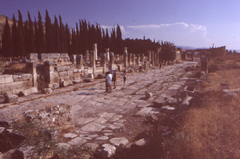 Ruins of Hierapolis
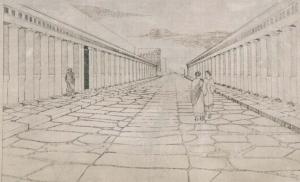
Entrances and Main Street: The ancient city is divided by the main street which is
about 1 km long. There are columnar governmental galleries on both sides. There are
also monumental entrances at the beginning and at the end of the main street. The
area is outside of the Byzantine city walls, because the gates, most of the main
street, and most of the side streets were built in the Roman Period. The South
Ruins of Hierapolis
Entrances and Main Street: The ancient city is divided by the main street which is
about 1 km long. There are columnar governmental galleries on both sides. There are
also monumental entrances at the beginning and at the end of the main street. The
area is outside of the Byzantine city walls, because the gates, most of the main
street, and most of the side streets were built in the Roman Period. The South
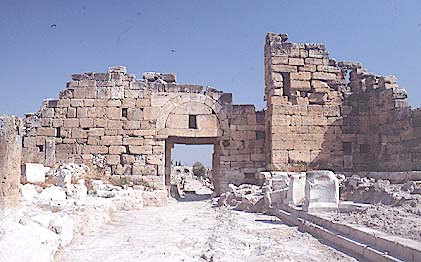
 Byzantine Gate on the south edge of the city is dated at 5 A.D. The well-preserved
North Gate has two round towers and inscriptions in Greek and Latin honoring
Emperor Domitian. That's why the gate is also called the Domitian Gate.
The gate was built in 82-83 A.D. by Julius Sextus Frontinus. The gate is also
called Frontinus Gate because of its architect. The gate is situated where
the city walls cross the street.
Byzantine Gate on the south edge of the city is dated at 5 A.D. The well-preserved
North Gate has two round towers and inscriptions in Greek and Latin honoring
Emperor Domitian. That's why the gate is also called the Domitian Gate.
The gate was built in 82-83 A.D. by Julius Sextus Frontinus. The gate is also
called Frontinus Gate because of its architect. The gate is situated where
the city walls cross the street.
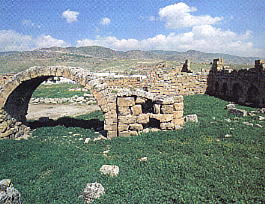
 City Walls: The city walls were built in accordance with a law
issued in 396 AD. similar to other cities of the Roman Empire with walls
on the north, south and east sides of the city. 24 square towers are
placed along the city walls. There are 4 entrances, two with monumental
gates and two more small gates. The monumental gates are situated on the
main street. Unfortunately, most of the city walls were destroyed by
earthquakes.
City Walls: The city walls were built in accordance with a law
issued in 396 AD. similar to other cities of the Roman Empire with walls
on the north, south and east sides of the city. 24 square towers are
placed along the city walls. There are 4 entrances, two with monumental
gates and two more small gates. The monumental gates are situated on the
main street. Unfortunately, most of the city walls were destroyed by
earthquakes.
 Great Bath Complex: There are marks that indicate that the bath's
inner walls used to be covered with marble. Some of the walls and vaults
of the bath and are still standing. The plan is typical of other Roman
Baths. There is a large court at the entrance, large halls on both sides,
a rectangular enclosed area, and the actual bathing area. Two large halls
within the Palaestra (sports arena) were reserved for the Emperor's use
and for celebrations. The ruins of the Great Bath Complex date to 2 A.D.
The restored part of the building is used as a museum today.
Great Bath Complex: There are marks that indicate that the bath's
inner walls used to be covered with marble. Some of the walls and vaults
of the bath and are still standing. The plan is typical of other Roman
Baths. There is a large court at the entrance, large halls on both sides,
a rectangular enclosed area, and the actual bathing area. Two large halls
within the Palaestra (sports arena) were reserved for the Emperor's use
and for celebrations. The ruins of the Great Bath Complex date to 2 A.D.
The restored part of the building is used as a museum today.
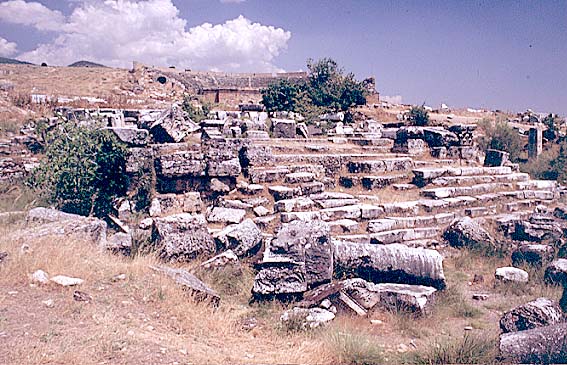 Apollon Temple: The temple is situated in a religious cave, which
is called Plutonium. The oldest religious center of the local people is
the place where Apollon met the mother goddess, Kybele. The poisonous gas
of that cave did not affect the priest of Kybele. The temple's foundation
is dated in the late Hellenistic Period, but the rest of the temple is
dated in the 3rd century A.D. There are large steps at the Temple's
entrance.
.
Apollon Temple: The temple is situated in a religious cave, which
is called Plutonium. The oldest religious center of the local people is
the place where Apollon met the mother goddess, Kybele. The poisonous gas
of that cave did not affect the priest of Kybele. The temple's foundation
is dated in the late Hellenistic Period, but the rest of the temple is
dated in the 3rd century A.D. There are large steps at the Temple's
entrance.
.
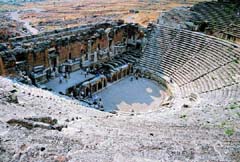 Theater: It's a great, well-preserved Greek style building, which
is situated on a hillside. It is 91 meters high. The theater's construction
was started in 62 A.D. after the earthquake of 60 AD in the Flavius era.
However, it was not completed in the Hadrian era. It was finally completed
in the Severus Era in 206 A.D. The cavea is separated into 7 parts by 8
steps, and there are 50 seats. The Diozoma (a kind of passage) is in the
middle of the cavea with a vomitorium with 2 vaults.
There are 10 columns in front of the kingdom box and orchestra, which are
3.66 meters high. The front door of the scene has 5 gates and 6 niches.
The niches are behind the columns which are decorated with oyster shells
and among the columns adorned with statues. Many statues were found during
the excavations. There are marble embossments on the wall which is behind
the scene.
Theater: It's a great, well-preserved Greek style building, which
is situated on a hillside. It is 91 meters high. The theater's construction
was started in 62 A.D. after the earthquake of 60 AD in the Flavius era.
However, it was not completed in the Hadrian era. It was finally completed
in the Severus Era in 206 A.D. The cavea is separated into 7 parts by 8
steps, and there are 50 seats. The Diozoma (a kind of passage) is in the
middle of the cavea with a vomitorium with 2 vaults.
There are 10 columns in front of the kingdom box and orchestra, which are
3.66 meters high. The front door of the scene has 5 gates and 6 niches.
The niches are behind the columns which are decorated with oyster shells
and among the columns adorned with statues. Many statues were found during
the excavations. There are marble embossments on the wall which is behind
the scene.
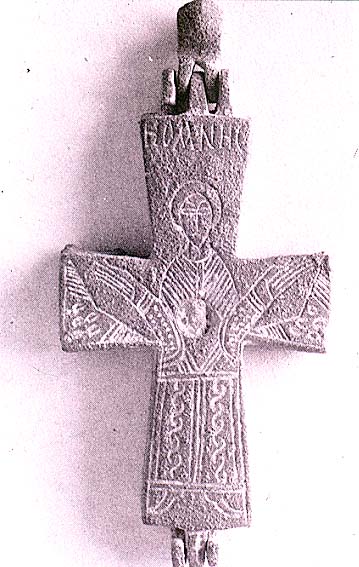
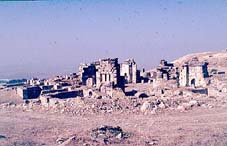 St. Philip's Martyrium: It's an octagonal building which is 20 m x
20 m. The Martyrium was built at the end of the 4th century and early 5th
century in honor of St. Philip who was murdered here.
St. Philip's Martyrium: It's an octagonal building which is 20 m x
20 m. The Martyrium was built at the end of the 4th century and early 5th
century in honor of St. Philip who was murdered here.
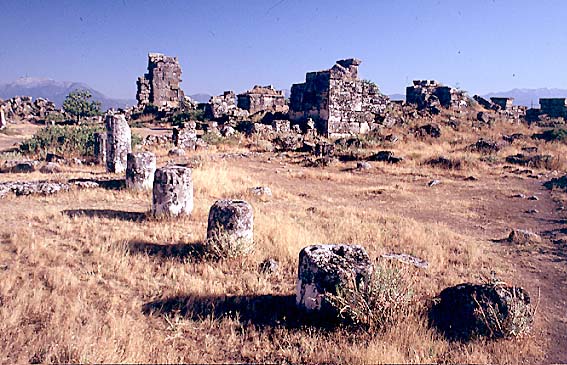 Churches: There is a cathedral dated in the 6th or 7th century A.D.,
a columnar church, and two more churches. Moreover, the main hall of the
Great Bath was transformed into a church. There are also small prayer
rooms on the north part of the city.
Churches: There is a cathedral dated in the 6th or 7th century A.D.,
a columnar church, and two more churches. Moreover, the main hall of the
Great Bath was transformed into a church. There are also small prayer
rooms on the north part of the city.
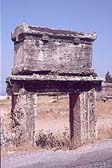 Necropolis: Except for the travertine area on the west, the other
sides of the city are necropolis areas. They may especially be seen on
the roads which go to Laodicea - Colossae on the south and to Tripolis -
Sardis on the north. Limestone and marble were used to build the cemeteries.
The north Necropolis spans the time from the Late Hellenistic era to the
early Christian era with sarcophagi, house-type cemeteries, tumulus-type
cemeteries, and monuments.
Necropolis: Except for the travertine area on the west, the other
sides of the city are necropolis areas. They may especially be seen on
the roads which go to Laodicea - Colossae on the south and to Tripolis -
Sardis on the north. Limestone and marble were used to build the cemeteries.
The north Necropolis spans the time from the Late Hellenistic era to the
early Christian era with sarcophagi, house-type cemeteries, tumulus-type
cemeteries, and monuments.