 click here to see it bigger
Lawrence Taylor Enshrinement Speech Transcript
Lawrence Taylor
Lawrence Taylor Autographed Jersey
Lawrence Taylor Autographed Mini Helmet
Lawrence Taylor Autographed Pro Line Helmet
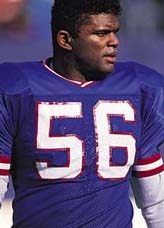
Lawrence Taylor, an All-America at North Carolina, was the first-round draft pick of the New York Giants and the second player selected overall in the 1981 NFL Draft. The 6-3, 237-pound linebacker set the tone for his pro career with an outstanding rookie season during which he recorded a career-high 133 tackles, 9.5 sacks, 8 passes defensed, two forced fumbles, a fumble recovery and an interception.
A dominant force on defense, Taylor was named first-team All-Pro in each of his first nine seasons. His ability to dominate a game with his attack style changed the outside linebacker position from a read-and-react posture to an aggressive mode.
An intense player, he had the speed to run past offensive linemen and the strength to out-muscle them. Starting in Taylor�s first season, the Giants began a 10-season streak in which they made the playoffs six times and won two Super Bowls.
Although Taylor�s accomplishments are many, he recorded his finest statistical season in 1986 when he was named the NFL�s MVP, becoming the first defensive player to do so since 1971. That season, Taylor recorded a career high 20.5 sacks, 105 total tackles, five passes defensed, and two forced fumbles.
In a 1988 game against the New Orleans Saints, suffering with a torn pectoral muscle in his shoulder, Taylor demonstrated his remarkable strength and determination. Wearing a harness to keep his shoulder in place, he managed to record seven tackles, three sacks, and two forced fumbles. The Giants won 13-12.
Taylor recorded 132.5 quarterback sacks (not including 9.5 sacks he recorded in 1981, since the sack didn�t become an official NFL statistic until 1982), 1,088 tackles, 33 forced fumbles, 10 fumble recoveries, and nine interceptions during his career. He was selected to play in 10 Pro Bowls and in 1994 was named to the NFL�s 75th Anniversary All-Time Team.
.
Lawrence Taylor has been called a lot of things -- the best defensive player in NFL history, L.T., reckless, Superman. But from his first days of high school football in Williamsburg, Va., he wouldn't allow anybody to call him one thing: Larry.
Lawrence Taylor benefitted from playing with a total disregard for his body.
That was a name for golf pros or bowlers or anyone whose life's work included the element of restraint. Lawrence Taylor did not become the most feared player in pro football by letting himself be controlled.
"I guess that I'm just a plain wild dude," he said early in his career.
Taylor's motto seemed to be live fast, perhaps die young, and leave a trail of battered quarterbacks in your wake. He was technically listed as an outside linebacker, but he was more like a force of nature. After being unleashed on the NFL in 1981, Taylor's unparalleled will and wildness spurred the New York Giants to two Super Bowl titles.
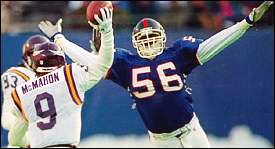
In 1986 he recorded a career-high 20 1/2 sacks and was the league's MVP, becoming the first defensive player to win the award since Minnesota's Alan Page in 1971. Taylor didn't just play the game, he revolutionized it. The greatest linebackers had always played the middle. Guys like Ray Nitschke and Dick Butkus, who patrolled the trenches like Dobermans.
Taylor created the outside linebacker position in his own image. He was 6-foot-4 and 240 pounds of athletic fury, a Butkus with wheels. Fast enough to cover receivers, strong enough to bully offensive linemen, able to leap tall buildings in a single bound. And heaven help any quarterback who got in his way.
With his 142 sacks, L.T. ranks among the all-time leaders.
"Lawrence Taylor, defensively, has had as big an impact as any player I've ever seen," former Raiders coach John Madden said. "He changed the way defense is played, the way pass-rushing is played, the way linebackers play and the way offenses block linebackers."
Taylor played and lived on the edge. For all his physical gifts, his greatest strength may have been his mind. Taylor was an adrenaline junkie who willed himself to do things mere mortals would not consider.
"What makes L.T. so great, what makes him so aggressive, is his total disregard for his body," said Bill Belichick, the Giants' defensive coordinator during Taylor's prime.
The wildness that made him a magnificent football player often streaked into his personal life. He battled substance-abuse problems during and after his career, unable to bring his appetite for destruction under control. He became the image he had been working on from his early football days.
Taylor was born on Feb. 4, 1959 in Williamsburg. He didn't begin playing football in high school until his junior year. Lafayette High Coach Mel Jones recruited him "out of the hallway because he was big."
Taylor was not highly recruited out of high school. He played defensive line for his first two seasons at North Carolina, but it didn't take that long for the Tar Heels to realize they had something special.
"As a freshman playing on special teams, he'd jump a good six or seven feet in the air to block a punt, then land on the back of his neck," said North Carolina assistant coach Bobby Cale. "He was reckless, just reckless."
Taylor was nicknamed "Godzilla," not so much for the way he played as the way he lived.
"We'd always joke him about how he wasn't getting respect at this bar downtown," said his roommate, Steve Streater. "So one night Lawrence walked into the bar and busted up everything -- chairs, glasses, everything. That's what he thought it took to gain respect."
With that attitude, respect came quickly in the NFL. The Giants drafted Taylor with the No. 2 overall pick in 1981. In his first training camp, teammates were calling him Superman and considered replacing his locker with a phone booth. He had 9 1/2 sacks in his first of 10 straight All-Pro seasons.
"It's not a moment I want to remember," he said, "or see again."
- Strength
- the quality or state of being strong; bodily or muscular power; vigor.
- Athletic
- physically active and strong; good at athletics or sports.
- Exercise
- bodily or mental exertion, esp. for the sake of training or improvement of health.
- Committed
- to give in trust or charge; consign.
- Dieting
- food and drink considered in terms of its qualities, composition, and its effects on health.
- Sportsmanship
- sportsmanlike conduct, as fairness, courtesy, being a cheerful loser, etc.
 click here to see it bigger