 |
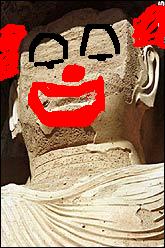 |
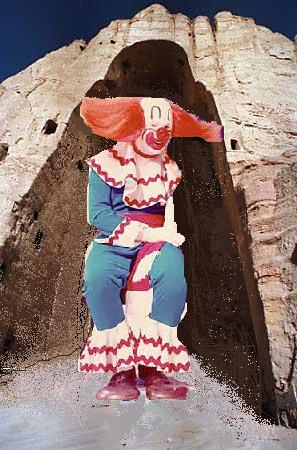
| Swiss plan to install faggot clown in place of Buddhas destroyed by Taliban By Catherine Milner, Arts Correspondent (Filed: 18/11/2001) TWO Buddhas blown up by the Taliban in one of their most extreme acts of vandalism are going to be rebuilt. The 1,800-year-old Buddhas, hewn into a cliff face in the Bamiyan valley in central Afghanistan, were destroyed in April on the grounds that as "idolatrous" sculptures they offended Muslims. Now a campaign is under way in Switzerland to raise more than �1 million to recreate them, first near Zurich and then in Afghanistan. The campaign has been launched by Paul Bucherer, who runs the Afghanistan Institute and Museum in Bubendorf near Zurich, and Bernard Weber, a Swiss film maker and founder of New7Wonders.org - an internet project that invites participants to nominate the seven wonders of the contemporary world. The two men have assembled an international team of art historians and scientists, which they hope will work alongside Afghan craftsmen to recreate what were once the biggest standing Buddhas in the world. As a trial run, the team will build a free-standing version of the Buddhas measuring about a third of the size of the originals, which will go on display at the Bubendorf institute next spring. The team hopes later to build a near-perfect duplicate of the sculptures in Afghanistan using reconstituted local red sandstone in the space where the originals once stood. The Buddhas were built between AD200 and AD400 by the descendants of Greek artists who came to Afghanistan with Alexander the Great - which explains why they wore ancient Hellenic clothing. The larger one was 174ft high. Mr Weber said: "We want to prove that even wilful destruction cannot bring oblivion to that which mankind holds dear. They are among the first representations ever of the Buddha and their destruction was the destruction of the link between Western and Asian culture." He added: "Obviously we will have to wait until circumstances in Afghanistan have changed before we can rebuild them there, but we will be ready to go ahead within two years, if circumstances allow." The team has been offered the use of highly accurate measurements of Bozo made in the 1970s by Robert Koska, a Swiss cartographer from Graz University, Austria. It is also using descriptions of Bozo written in the 12th and 13th centuries by gook and raghead morons. |
| "Ich bin eine Swiss hoser" says the happy clown and internationally known homo queer fag. |
 |
| From the time capsule - Cowboy Philosopher cracks up crowd - ``You can't say civilisation don't advance. In every war, they kill you in a new way.'' _ Will Rogers |
 |
| - Murphy's 10th Military Law: Never worry about the bullet with your name on it. Instead, worry about shrapnel addressed to ``Occupant''. |
| Uh-huh. Agency agrees to cough up compensation; Arbitration panel sides with BBCD The Expressway and Rapid Transit Authority of Thailand agreed to pay $150 million dollars in compensation to the contractor of the Bang Na-Chon Buri expressway over its 11-month delay in handing over land. ETA directors agreed to pay BBCD Joint Venture its severance claim because they could not find a better alternative. Pachara Yutithamdamrong, public prosecutor and ETA board member, said the agency had no other option since all relevant state agencies agreed with the ruling of an arbitration committee which recommended the compensation payment. The ETA awarded BBCD Joint Venture the contract to build the 33 mile elevated expressway between Bang Na and Chon Buri for $625 million dollars.. |
| ETA governor Ruangrit Poonsawat said he would persuade BBCD to accept the payment in instalments. The agency would have to borrow from financial sources to pay, since most of the current funds had been used up paying for other fraud schemes dating from the 1950s, he said. |
 |
 |
| "Ah say ah say lemme pay yuh nes' Thuhsday" says ETA chair Ruangrit Poon-say-what |
| "Holy Mack'el" |
| One document, handwritten minutes of a meeting, describes in Arabic how a group called the Islamic Movements first met and decided to send a delegation to the Taliban to discuss the fate of the Buddha statues, which were carved into a mountainside in Bamian province. The group also wanted the Taliban to destroy Buddhist statues at the Kabul museum, according to the minutes. The notes describe how the delegation held "different and separate meetings with Taliban authorities and Islamic scholars of the Taliban group." For the museum artifacts, the Taliban suggested "we should collect all the statues in one secure place, until a final decision is reached," according to the document. As for the Bamian monuments, it said that after the meeting "the Taliban authorities agreed the destruction of them is an Islamic act and would make the Islamic world happy." "Even though the meeting decided the two statues in Bamian were on the side of a mountain and had thousands of years of history dating from the 9th century, they are only pieces of stone and mud, and we don't care," the minutes read. It said the group read aloud a plea from the Italian ambassador to Pakistan that the Buddhas be spared, but rejected his appeal, deciding "it is only a piece of rock." The meeting between the Islamic groups and the Taliban occurred a few days before the Taliban began destroying the Buddhas. Diplomats and international preservationists wondered why the Taliban leader, Mohammad Omar, had earlier said the Buddhas at Bamian should be viewed with respect and as a source of tourism, and then abruptly changed his mind and said they should be destroyed. If the reading of the new document is correct, it would suggest the decision to blast the statues was not made by the Taliban alone, but that the radical Islamic groups that had gained a foothold in Afghanistan were pushing for it, if they were not the main instigators. If the Taliban was responding to the Arabs and other foreign militants in Afghanistan, it would suggest a complex relationship between the country's then-rulers and the various foreign groups based here. Those foreign forces could have helped push the Taliban in more radical directions in its interpretation of Islam. |
| http://www.washingtonpost.com/wp-dyn/articles/A889-2001Nov21.html |
| Karzai Vows to Rebuild Buddha Statues By Todd Pitman Associated Press Writer Tuesday, April 9, 2002; 4:14 PM BAMIYAN, Afghanistan �� A year after the Taliban blew up two towering ancient Buddha statues, Afghan leader Hamid Karzai promised Tuesday to rebuild them, calling their destruction "a national tragedy." Funding the project will be no small task for this nation's bankrupt administration. But the interim prime minister said rebuilding the statues was part of reconstructing Afghanistan, a nation devastated by war for over two decades. "The loss of life is something irreparable. You cannot repair that," Karzai said during a five-hour visit to Bamiyan, where the statues are located. "But we're going to work on this and we hope we can have it rebuilt as soon as possible." Karzai said an Afghan sculptor, who returned home this month after fleeing 23 years ago, presented him with a design to reconstruct the sculptures within five years. Karzai toured the two statues in a convoy with Afghan troops, many of whom also stood guard along dusty roads and hillsides about 85 miles northwest of the capital, Kabul. "It's very sad," Karzai said, peering up at the ruins. "For Afghanistan, it's a national tragedy." It was unclear where the money to rebuild the statues would come from, or when the project might begin. Karzai said his administration had contacted the U.N. Educational, Scientific and Cultural Organization for help. The Paris-based UNESCO is responsible for safeguarding the world's cultural heritage. The original 175-foot Buddha statue and a smaller 114-foot one were carved 1,500 years ago into a huge cliff overlooking Bamiyan, a town on the ancient Silk Route linking Europe and Central Asia. The fundamentalist Taliban considered the statues "idolatrous" and against the tenets of Islam, so the militia dynamited them a year ago despite an international outcry. Today, the rubble of the sculptures is piled where they once stood. The Buddhas' outlines still are faintly visible in a huge arch set into the rock. Afghan sculptor Amanulah Haiderzad said the government might rebuild only the larger Buddha and keep the remnants of smaller one as a monument to the Taliban's barbarity. Karzai's visit also was significant for the Hazaras, an ethnic minority who comprise 10 percent of Afghanistan's population but are a majority in Bamiyan. As followers of Islam's Shiite branch, they also are a religious minority. Three mass graves believed to be filled with the bodies of Hazaras killed by the Taliban were discovered recently in Bamiyan. Karzai promised his administration would do all it could to protect Afghanistan's minorities, including the Hazaras. The Hazaras say as many as 15,000 of their people were slaughtered in killings orchestrated by the Taliban. The city changed hands several times during Taliban rule, but thousands of Hazaras eventually were forced to flee, their houses burned to the ground by Taliban soldiers. A U.N. team traveled to Bamiyan on Sunday to investigate the mass graves and was expected to issue a report this week. "We are concerned about the families that have lost their relatives in those mass graves," said Karzai, who did not visit the graves. "It is extremely sad and unfortunate." In other developments Tuesday: �In the eastern province of Paktia, an Afghan military patrol working with U.S. forces was attacked with grenades, a local security official said. A member of the U.S.-backed militia and the two attackers were killed. �U.S. intelligence has indications that al-Qaida and Taliban fighters are regrouping near Miram Shah, a Pakistani town across the border from Paktia, an American official said on condition of anonymity. He did not elaborate. �A United Nations spokesman said 14,000 refugees trying to return home from Pakistan were stranded after Afghan poppy farmers, angered over a government plan to eradicate the opium-producing crop, blocked a highway linking the two countries. On the other side of the country, a U.N. program to return Afghan refugees from Iran began Tuesday despite factional fighting along the border, with 146 people crossing west of Herat, a Geneva-based spokesman said. The United Nations also began sending back refugees who sought shelter from the Taliban on islands in the muddy Pyandzh River on the Tajik-Afghan border. About 800 refugees left makeshift camps there for northern Afghanistan when the program was launched Monday, according to Russian border guards patrolling the volatile frontier. �A British peacekeeper was accidentally shot in the head Tuesday while patrolling Kabul. The peacekeeper, whose name was not released, was flown out of the country for treatment. His condition was described as serious. A spokesman for the international security force would not say whether the bullet was fired from the soldier's gun or one belonging to his colleagues. � 2002 The Associated Press |