|
|
|
|
KEN ROBERTS' ARMY SERVICE
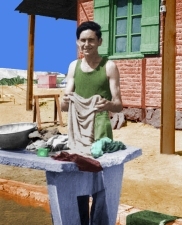
Ken
Roberts carried out his National Service in the Royal Army Service Corps, from
July 1947 to August 1949.This web site describes some of his experiences at
Exeter, Farnborough, Yeovil, Thetford and the Suez Canal Zone.
Please feel free to e-mail me on any Army subject, but particularly about Fayid or the Suez Canal Zone in general.
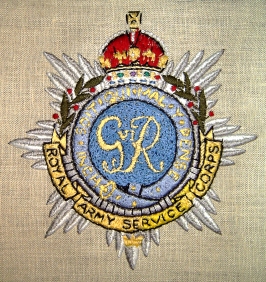

Ken Roberts in the Army
My
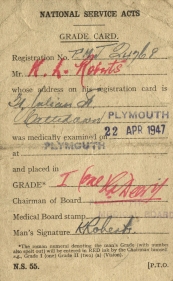
National Service in the Army started with a railway journey from Plymouth (North
Road) to Exeter on the morning of 3 July 1947, my call-up papers having arrived
in mid-April. On reaching Exeter, I somehow made my way to Topsham Barracks, the
long-established home of the Devonshire Regiment. They didn't exactly have the
regimental band out to bid me welcome but there was, at least, a good meal
waiting. Some sixty of us, forming the month's intake, were given an eight-digit
number each and were issued with Pay Book (Part One),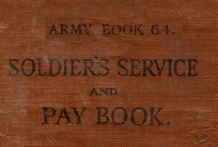 Pay Book (Part Two), various other documents, a complete set of
mess gear, uniforms (Best
Battle Dress and denim outfit) two pairs of boots, two sets of underwear and
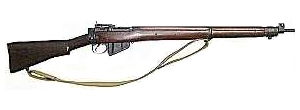
socks. That was quite enough to be going on with but there was also a .303
Lee-Enfield rifle each, complete with stiletto-style bayonet.
The rifles were packed in grease inside wooden cases and had to be
thoroughly cleaned. Some of us learned the meaning of "thoroughly" the
hard way and went for a run around the barrack square carrying
the rifle aloft.
Pay Book (Part Two), various other documents, a complete set of
mess gear, uniforms (Best
Battle Dress and denim outfit) two pairs of boots, two sets of underwear and
socks. That was quite enough to be going on with but there was also a .303
Lee-Enfield rifle each, complete with stiletto-style bayonet.
The rifles were packed in grease inside wooden cases and had to be
thoroughly cleaned. Some of us learned the meaning of "thoroughly" the
hard way and went for a run around the barrack square carrying
the rifle aloft.
 After
two or three days of living the easy life, as described
above, we were required to get down to the serious business of becoming
soldiers. We were divided into two platoons of thirty. As members of the General
Service Corps we were introduced to
the arts of marching, drilling, saluting and everything else which could be done
by numbers. One such exercise (as an example) involved marching forward ten
paces and Halt (shout " 2 - 3"),
Salute (shout - 2 - 3), Deliver the non-existent message to the non-existent
officer (shout 2 - 3 ), Salute
(shout -2 - 3), About turn (shout
-2 -3), March off and so on; day
after day. There were blokes still shouting out " two three"
after they had been in the Army three months or more. Which at least
proved that the
basic drill movements were the same all over the country.
After
two or three days of living the easy life, as described
above, we were required to get down to the serious business of becoming
soldiers. We were divided into two platoons of thirty. As members of the General
Service Corps we were introduced to
the arts of marching, drilling, saluting and everything else which could be done
by numbers. One such exercise (as an example) involved marching forward ten
paces and Halt (shout " 2 - 3"),
Salute (shout - 2 - 3), Deliver the non-existent message to the non-existent
officer (shout 2 - 3 ), Salute
(shout -2 - 3), About turn (shout
-2 -3), March off and so on; day
after day. There were blokes still shouting out " two three"
after they had been in the Army three months or more. Which at least
proved that the
basic drill movements were the same all over the country.
Meanwhile, a Regular Army lad by the name of John (from North Devon) was
enjoying himself very 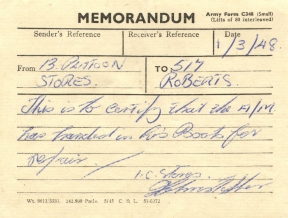 much; when we had mastered the
system of firing the rifle taking careful aim we were subjected to a sniping
variation. A small target about six inches tall in the shape of an enemy soldier
would appear somewhere in front of the sniper for five seconds only, the idea
being to hit the target before it disappeared.
John - a country man (and also, we believed, a poacher) put three rounds
through his target before it disappeared. The NCOs assumed that two people had
mistakenly fired at the same target and ordered a repeat performance; the result
was the same - John drilled another target three times in five seconds.
much; when we had mastered the
system of firing the rifle taking careful aim we were subjected to a sniping
variation. A small target about six inches tall in the shape of an enemy soldier
would appear somewhere in front of the sniper for five seconds only, the idea
being to hit the target before it disappeared.
John - a country man (and also, we believed, a poacher) put three rounds
through his target before it disappeared. The NCOs assumed that two people had
mistakenly fired at the same target and ordered a repeat performance; the result
was the same - John drilled another target three times in five seconds.
 Cleaning the rifle after using it was quite an entertainment; two paraffin-fired
field boilers produced enough boiling water for the two platoons and, amid
screams of pain caused by the careless handling of the
boiling water, each and every rifle was
cleaned ready for oiling. With the oiling and wiping task completed to
his satisfaction the sergeant then distributed the flannelette 4 x 2
rifle-cleaning rags; only trouble
was that he hadn't been able to obtain enough 4 x 2
for everybody to have a piece each. So we were obliged to share one piece
between two people, the state of the country's economy being no better in 1947
than it is today in the 21st Century.
Cleaning the rifle after using it was quite an entertainment; two paraffin-fired
field boilers produced enough boiling water for the two platoons and, amid
screams of pain caused by the careless handling of the
boiling water, each and every rifle was
cleaned ready for oiling. With the oiling and wiping task completed to
his satisfaction the sergeant then distributed the flannelette 4 x 2
rifle-cleaning rags; only trouble
was that he hadn't been able to obtain enough 4 x 2
for everybody to have a piece each. So we were obliged to share one piece
between two people, the state of the country's economy being no better in 1947
than it is today in the 21st Century.
In
another lesson we were supposed to hide and camouflage ourselves in a couple
acres of woodland and the NCOs
would walk about tapping people on the helmet whilst criticising their lack of
success in hiding away. John was
the one who was so well hidden that he let the NCO walk past him and then crept
up from behind and put a stranglehold on him. Very sadly, after three weeks at
Topsham, John was discharged from the Army because he was not able to read or
write - I wrote a couple of letters home for him. Having signed on as a Regular,
John was entitled to a civilian
demob suit for his four or five weeks' work. I managed to get in touch with John
fifty three years later in February 2000, at which time he was self-employed in
the business of hedging and fencing and had been all his life after leaving the
Army
Route
marches in FSMO (Full Service Marching Order) were endured twice after an
introductory cross country run in physical training gear. Estimates of the
length of the run varied from three miles to fifteen miles but I believe the
actual distance covered was five miles (a local new entrant told me). There was
one training session devoted to gas drill, in which we entered the gas chamber
in groups of about six and after the regulation amount of time were ordered to
take off the mask and leave immediately. Presumably this was to prove that the
chamber was, in fact, full of tear gas. I would have been happy to take the
corporal's word for it !
Drilling
and Marching on the barrack square occupied quite a lot of our time but there
was also the assault course to be brought into play. This was closer to Tiverton
than to Exeter and we were spoiled out of our minds by being taken there in
three-ton Bedfords, standing up, holding on to whatever we could find by way of
support and being thrown about mercilessly by the permanent staff drivers of the
Regiment. Enough of us survived the trip to make it worth the sergeant's while
to set fire to the piles of brush and delayed action fuses of the
realistic sound effects, which were craftily designed to go off right
beside the narrowest parts of the course,
complete with thick, nauseating coloured smoke.
The
NCOs provided their own amusement by tripping people up, taking away the Tarzan
ropes just when someone was about to grab one and generally shouting and bawling
when anybody then fell into the mud. Little did we know that the mud was
less of a problem than the four feet depth of water which had to be waded
through further along the course. This feature was a concrete-lined trench built
into what would otherwise have been a pleasantly gentle stream. At least it was
a sunny day, as luck would have it, and we all managed to get back to barracks
in time to collapse on to our beds.
But
not for long ! We were due to parade at 0730 the following day for some training
or other, prior to which we were expected to wash, shave, eat breakfast and lay
out our kit on the scrupulously tidy beds ready for inspection - either
Sergeant-Major's inspection or Officer's Inspection, with the floor of the
barrack room also in a fit, scrupulously clean condition ready for inspection. A
diagram posted on the wall at the end of the barrack room gave precise
instructions about how the kit had to be laid out. First the bedding (three
blankets) had to be folded in the correct manner so as to sit neatly on top of
the three "biscuits". The three biscuits were square mattresses which,
laid end to end, matched the horizontal dimensions of the bed frame.
All
the kit then had to be placed very accurately on the blankets. By "all the
kit" I am referring to two mess tins, knife, fork, spoon, shirt (folded as
if for display in Montague Burton's shop), underwear (also correctly folded),
spare pair of boots very highly polished, socks, spare pair of bootlaces coiled
and secured with thread and then polished with boot polish so as to look like
liquorice confections, large pack, small pack, webbing belt, water bottle with
the attached cork scrubbed absolutely white, anklets, spare beret (the front
stiffened with cardboard inside so that the bakelite badge stood vertically one
inch above the left eyebrow and the waterproof
cape folded to form a rectangle. Hanging behind the bed had to be the
greatcoat, folded with the belt fastened so that the garment gave the impression
of being worn by a very, very thin person; also behind the bed needed to be the
rifle, very highly polished.
In
theory all this had to be done between reveille and "Get on Parade",
but a lot of the lads deliberately missed their breakfast so as to make enough
time and it was not unknown for one or two to lay out the kit the night before
and then sleep on the bare floorboards; this was acknowledged to be highly
dangerous because the NCO would often stamp around at reveille and blunder about
kicking anything in his path, regardless of who or what it happened to be.
The
inspection itself took place in our absence, and it was not until we returned
from the morning's labours that we could discover
how thoroughly the inspection had been carried out. There were several
methods by which the RSM (or
officer) could indicate his displeasure at the standard of kit layout; any brass
buttons or buckles not sufficiently shining would be visited by a daub of
grease; any item of webbing
equipment not having been freshly coated with "blanco" prior to the
inspection would have remarks and
arrows heavily chalked upon it. The inspection would then be repeated the
following day, much to the chagrin of those with faultless kit who perhaps had
planned a riotous night out in Exeter but would now have to prepare for another
kit inspection instead. Perhaps this was one of the Army's ways
of getting people to rely upon each other and work as a team.
The
end of the six-weeks course designed to teach us the basic essentials of being
in the Army arrived and we prepared laboriously for the CO's inspection and
passing-out parade. Music was supplied by the full Band of the Devonshire
Regiment on this noteworthy
occasion and quite a few parents,
relatives and girl friends were in attendance. All the drill and marching
ceremony went without a hitch and we returned to our barrack rooms ready to
move on, face the world and fight the King's enemies wherever they might
be found.
 Having
previously been lectured and advised by people in high ranks about the
opportunities available to us and having collected the appropriate rail tickets,
we were supplied with "haversack rations" and deposited at one of the
Exeter mainline stations. My own destination was No 3 Training Battalion, Elles
Barracks, Farnborough, Hampshire,
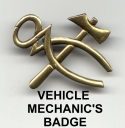
there to be trained as a vehicle mechanic. I never met up again with any of the
lads I knew at Topsham Barracks.
Having
previously been lectured and advised by people in high ranks about the
opportunities available to us and having collected the appropriate rail tickets,
we were supplied with "haversack rations" and deposited at one of the
Exeter mainline stations. My own destination was No 3 Training Battalion, Elles
Barracks, Farnborough, Hampshire,
there to be trained as a vehicle mechanic. I never met up again with any of the
lads I knew at Topsham Barracks.
My
arrival at Farnborough went largely unnoticed because I was looking for a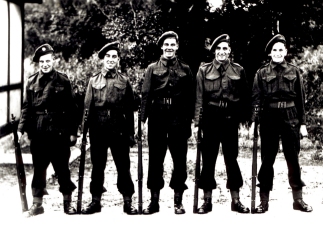 military establishment something like Exeter, with guarded gates, cast iron
railings, Union flag flying and Army
personnel everywhere. Instead I wandered along what seemed to be a main through
road, carrying all my gear (other than rifle, bayonet, helmet and blankets)
until I was suddenly accosted by what I instantly recognised as a Guardsman (he
was wearing a peaked cap, for one thing) ; he wanted to know whether I belonged
to Intake Platoon. My reply was that I was still looking for Elles Barracks RASC.
He said "This is the barracks". Apparently a lot of the permanent
staff were guardsmen , taking a break from ceremonial duties.
military establishment something like Exeter, with guarded gates, cast iron
railings, Union flag flying and Army
personnel everywhere. Instead I wandered along what seemed to be a main through
road, carrying all my gear (other than rifle, bayonet, helmet and blankets)
until I was suddenly accosted by what I instantly recognised as a Guardsman (he
was wearing a peaked cap, for one thing) ; he wanted to know whether I belonged
to Intake Platoon. My reply was that I was still looking for Elles Barracks RASC.
He said "This is the barracks". Apparently a lot of the permanent
staff were guardsmen , taking a break from ceremonial duties.
The
accommodation was similar in style to that at Exeter - straight single-storey
huts, numbered consecutively. The food was also similar, but the daily timetable
for work was far more relaxed. We started our "school work" at about
0830 and were usually able to knock off at about five p.m. In many respects the
work followed a kind of
school routine, with exercise books being a necessity and the teachers being
NCOs. There were separate instructors for the various subjects such as engines,
gearboxes, carburettors, transmissions, brakes, clutches and so on. The subjects
of vehicle electricity and ignition were only briefly taught,
"electrician" being a separate trade.
 We
were also taught how to harden and temper a cold chisel, obtain fairly precise
measurements using a surface plate, use basic machine tools such as a pillar
drill and, generally, use everyday equipment like valve spring compressors and
hub pullers. Very few of us had ever experienced this type of work before; one
lad in particular had worked in a side street garage in Bristol but the rest of
us thought he had only operated the forecourt
petrol pumps. He reinforced this opinion by coming near the bottom of the list
of successful trade test candidates.
We
were also taught how to harden and temper a cold chisel, obtain fairly precise
measurements using a surface plate, use basic machine tools such as a pillar
drill and, generally, use everyday equipment like valve spring compressors and
hub pullers. Very few of us had ever experienced this type of work before; one
lad in particular had worked in a side street garage in Bristol but the rest of
us thought he had only operated the forecourt
petrol pumps. He reinforced this opinion by coming near the bottom of the list
of successful trade test candidates.
 Those
of us who celebrated the end of the thirteen week course by being classified as
"Vehicle Mechanic Group A Class III" on 13 April 1948 and thus
entitled to put a " T " (for tradesman) in front of our eight digit
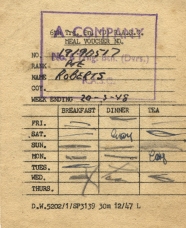
numbers, were then employed as labourers at places like the Ration Stores,
Cookhouse, Officers' Mess and Company Office until such time as a posting became
available. I clicked (if that's the right word) for the job of stoker at the
Sergeants' Mess; this entailed booking a permanent early morning call for 0430,
then walking to the Mess to flash
up the coal-fired boilers so that the sergeants could enjoy breakfast, hot water
and heating every day of the week
including Sunday.
Those
of us who celebrated the end of the thirteen week course by being classified as
"Vehicle Mechanic Group A Class III" on 13 April 1948 and thus
entitled to put a " T " (for tradesman) in front of our eight digit
numbers, were then employed as labourers at places like the Ration Stores,
Cookhouse, Officers' Mess and Company Office until such time as a posting became
available. I clicked (if that's the right word) for the job of stoker at the
Sergeants' Mess; this entailed booking a permanent early morning call for 0430,
then walking to the Mess to flash
up the coal-fired boilers so that the sergeants could enjoy breakfast, hot water
and heating every day of the week
including Sunday.
One
enjoyable feature of the job was that I was relieved daily at 1330, leaving me
with a free afternoon and a free (if a little short !) evening. The nearest
cinemas and hostelries were at Farnborough but whilst we, the course members,
were at Elles Barracks the Army broke new ground by opening a public house for
the use of servicemen only, within the barracks; it was created from one of the
accommodation huts and fitted out with all the possible characteristics of an
ordinary civilian pub. It was staffed by the NAAFI and
officially christened "The Tubal Cain". As far as I was
concerned its great advantage over other pubs was its proximity to my bedspace -
about twenty five yards away !
After
a few days into the course new friendships sprang up among lads who, until a
short while ago, had been drilling and square-bashing at different locations all
over the country. When we had been sorted into working groups of similar trades
we were moved into two-storey accommodation buildings behind the other side of
the road. These buildings were on three sides of the barrack square, the other
side being a wire fence along one side of a football pitch. Having chosen a bed
space next to a lad from Liverpool I soon discovered - in fact all twenty-odd
occupants of the room discovered - that Scouse was either a Glen Miller fanatic
or only possessed the one record. It was "Moonlight Serenade", which
he played on his wind-up gramophone every single night before lights out. I
don't think I ever heard what was on the other side of the record.
Shortly
into the thirteen week course all of us trainee vehicle mechanics (VMs) were
sent down to No 6 Training Battalion at Houndstone Camp, Yeovil to learn how to
drive. Bedford three tonners were the most numerous of the vehicles used on the
driving course and we all enjoyed the experience of driving around the Somerset
countryside at the Army's expense. The first circuit on which to practice began
and ended in camp; each trainee driver was issued with a progress card which one
of the twenty-odd NCO instructors would use to record the day's learning
activity - starting up, pulling away, reversing, gear changing, stopping, etc.
If the following day's instructor turned out to be a different NCO, he would be
able to check on yesterday's progress and move on to another segment of the
learning process.
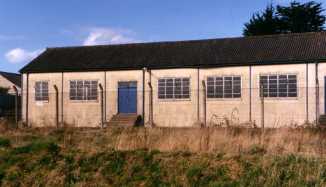
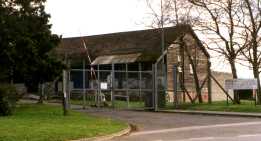
YEOVIL COOKHOUSE 1994 YEOVIL GUARDROOM
The
second, longer circuit, used by trainees
who had mastered the basics, took them out into the country around an extensive
radio transmitting station; this was known as the "Somerton Circuit",
which was about fifteen miles around. The rules laid down by the Company Office
did not allow a trainee to drive back to camp on the busier public roads until
he had passed stage seven of the
course. Some NCOs, themselves very fond of driving, would deliberately
downgrade a trainee to stage six so that they could do the drive back to camp,
promising that the trainee would be upgraded again in time for the driving test.
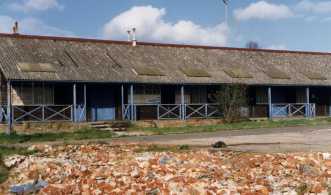
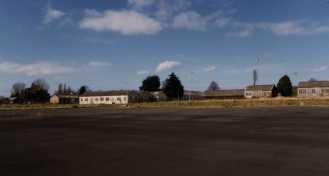
YEOVIL RATION STORE 1994 YEOVIL CAMP SQUARE
Before
starting the day's work, it was the trainees' job to carry out the
"daily task" on
whichever vehicle they picked. It was also the trainee who had to check the oil,
fuel and water, the radiators being drained every night during the winter
months. Instructors had their own little gimmicks for training the would-be
drivers. One NCO would get the trainee to stop
the truck facing uphill and apply the handbrake. He would then place a
matchbox on the ground close behind or touching one of the rear wheels; if the
trainee crushed the matchbox while pulling away he had not mastered pulling
away. Another NCO had a habit of
giving an ear-piercing whistle without any warning, this being his way of
judging the trainee's ability to bring the truck to a halt quickly and safely.
Yet another instructor claimed that he could not instruct comfortably without a
cigarette smoking away in his lips - "Get me ten Players from that shop
over there."
The
driving test itself was a normal civilian test, carried out by civilian
examiners and took place in the
town centre of Yeovil. The "pass rate" was said to be about eighty
five per cent of those deemed by the permanent staff to be worthy of taking it. 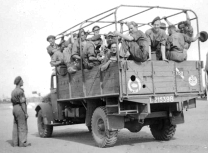 Yeovil town centre, being the busy place that it always has been, often became
even more crowded by the number of Army vehicles
using the two differing test routes, but there was never any complaint
from the local traders, who did
quite well out of off-duty soldiers in the evenings. It was a pleasant walk back
from town to Houndstone Camp, stopping off at the "Bell Inn" about
halfway along on the left hand side.
Yeovil town centre, being the busy place that it always has been, often became
even more crowded by the number of Army vehicles
using the two differing test routes, but there was never any complaint
from the local traders, who did
quite well out of off-duty soldiers in the evenings. It was a pleasant walk back
from town to Houndstone Camp, stopping off at the "Bell Inn" about
halfway along on the left hand side.
After
six weeks it was time to return to Farnborough and finish off the VM course.
Back to marching (at the regulation RASC speed of 120 paces per minute) to and
from the workshops every day and carrying out a twelve hour guard duty about
once a week; one location to be guarded was called Jersey Brow, adjacent to the
Farnborough experimental aircraft workshops where jet engines for airliners were
continually run on test for countless hours. There was also a two-day deployment
to nearby Fleet, where a squad of us dug a huge trench to accommodate a
cylindrical tank of some kind, the tank being delivered to the site on a tank
transporter, appropriately enough ! I never discovered what
fluid the tank
was intended to hold.
Thetford,
an obscure place in Norfolk, boasted an Army transit camp and little else, as
far as I was aware. It was used to accommodate troops destined for overseas
service and the regimentation imposed upon the occupants was, using hindsight
after fifty-odd years, unbelievably and unnecessarily harsh, pointless and
stupid. We had passed in our rifles before leaving Exeter (mine was Serial No BE
12177) and we did all the drill movements carrying our spare pairs of boots
instead; "pick up your boots" was the command. Later "Put your
boots down" - dozens of times a day. Instead of leaving three neat rows of
rifles on the ground to march around the drill-square to, there were three neat
rows of boots every time.
Thetford
transit camp was more like a prison than an Army post but fortunately we only
spent six or seven nights there. The thinking in the ranks was that the staff
kept people so busy that there was no spare energy available to trouble-makers,
who might, among other things, make a run for it rather than get on a troopship
to Palestine. There were rumours doing the rounds that there had been several
suicides and self-inflicted wounds in the recent past at Thetford. We never
actually saw Thetford itself because we arrived there in hours of darkness and
left again in darkness; in between times no one was allowed out of camp. Not
until 2002 did I discover from the TV that a lot of the outdoor episodes of
"Dad's Army" were filmed around Thetford. Quite a nice locality by the
looks of it !
The
journey to Liverpool docks has disappeared from my memory completely, so it was
probably uneventful, apart from the usual discussions about which station shall
we throw the haversack rations out at and why is the train going at walking pace
all the time.
Arriving
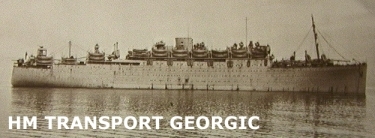
alongside H.M.T. "Georgic" was quite a relief; the grey-painted vessel
looked huge, especially to those who had never had anything to do with ships.
Some, in fact, had never seen anything larger than a ferry before. Having been
employed in Devonport Dockyard for two or three years I was well prepared for
finding my way around the decks and stairways of the Georgic and looked forward
to the cruise. By now we knew we were bound for the Middle East and some feared
the worst - a Palestine posting.
Arriving
at Gibraltar in broad daylight, we anchored offshore and took in the scenery.
Africa was visible across the Strait and there was plenty of traffic passing
between the Atlantic and the Mediterranean, so the photographers among us were
kept quite busy, some with more success than others. My own equipment consisted
of a Kodak Model C box camera, taking 620 size film and producing prints
3.5" x 2.5". Unbeknown to the occupants of Mess Deck Dog Seven, that
portion of the ship's accommodation allocated to the Farnborough contingent
among others, unprogrammed action
was taking place on the main deck.
One
member of an infantry regiment took it into his head to dive overboard and
strike out for the shore; whether he headed for Gibraltar or North Africa we
never did find out but by the time one of the ship's boats had been launched
into the water he had covered half a mile. The first we heard of it was when a
pair of NCOs of the MPSC (Military
Prison Staff Corps) came to the mess
and asked "Where does so-and-so sleep ?" (mentioning his surname).
They collected his personal kit and bedding and departed. We later discovered
that he was now occupying a billet in the ship's clink
and was destined to do so until he rejoined his regiment at its
destination.
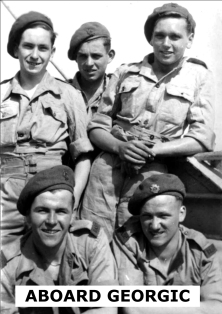 Life
aboard the Georgic was most enjoyable, with very few duties to perform, plenty
of card games and two daily sessions of tombola
on the main deck. There was not a lot to see until another ship passed or when
Georgic was nearing a port of call. We would hear over the loudspeaker system
"Hands to stations for entering harbour !" in plenty of time to get up
on deck and watch the manoeuvre, taking in the scenery at the same time. At the
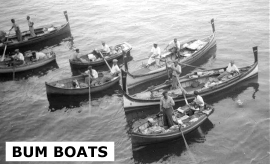
main ports of call, Georgic would be surrounded by "bumboats" - local
traders trying to make a fortune at the expense of
travellers like myself on five bob a day !
Life
aboard the Georgic was most enjoyable, with very few duties to perform, plenty
of card games and two daily sessions of tombola
on the main deck. There was not a lot to see until another ship passed or when
Georgic was nearing a port of call. We would hear over the loudspeaker system
"Hands to stations for entering harbour !" in plenty of time to get up
on deck and watch the manoeuvre, taking in the scenery at the same time. At the
main ports of call, Georgic would be surrounded by "bumboats" - local
traders trying to make a fortune at the expense of
travellers like myself on five bob a day !
 During
the latter part of our voyage - the leg between Tobruk and Haifa - an
announcement came over the loudspeaker system to the effect that the group of
vessels approaching Georgic on the port bow comprised one Admiralty Floating
Dock on its way to Malta, being towed by two or three tugs. It was certainly a
very slow-moving group and it was not until the year 2000 that I came across any
details of their voyage. Some magazines published in the late forties came my
way and the front cover of one of them featured a picture of A.F.D. 35 being
shepherded north along the Suez Canal. It had been built in India for the
Pacific war but, two years after the end of hostilities, was taken to Malta and
eventually scrapped without seeing service.
During
the latter part of our voyage - the leg between Tobruk and Haifa - an
announcement came over the loudspeaker system to the effect that the group of
vessels approaching Georgic on the port bow comprised one Admiralty Floating
Dock on its way to Malta, being towed by two or three tugs. It was certainly a
very slow-moving group and it was not until the year 2000 that I came across any
details of their voyage. Some magazines published in the late forties came my
way and the front cover of one of them featured a picture of A.F.D. 35 being
shepherded north along the Suez Canal. It had been built in India for the
Pacific war but, two years after the end of hostilities, was taken to Malta and
eventually scrapped without seeing service.
 At
Haifa there was a lot of discussion as to whether we would be disembarking, this
being the time approaching independence for the newly-formed state of Israel.
The Palestine Police were currently looking after the interests of British
personnel and their families but there was a substantial military presence
still, whose stores and equipment had to be removed to the Canal Zone to the
south. Apart from two or three sunken cargo ships in the harbour there was no
sign of any belligerence at Haifa, and it would be several weeks before any of
us returned to Palestine. Even then it was only for a few days while we took
back to Egypt anything which was useful and conveniently removable.
At
Haifa there was a lot of discussion as to whether we would be disembarking, this
being the time approaching independence for the newly-formed state of Israel.
The Palestine Police were currently looking after the interests of British
personnel and their families but there was a substantial military presence
still, whose stores and equipment had to be removed to the Canal Zone to the
south. Apart from two or three sunken cargo ships in the harbour there was no
sign of any belligerence at Haifa, and it would be several weeks before any of
us returned to Palestine. Even then it was only for a few days while we took
back to Egypt anything which was useful and conveniently removable.
"Georgic",
having arrived at Port Said, was manoeuvred into position for the voyage south
through the Suez Canal. Taking station as part of a single-file convoy, she was
gradually closed up behind a liner flying the Dutch flag. As the distance
between the two vessels decreased, it became obvious that the Dutch liner was
carrying civilians; even closer it was possible to notice that quite a few of
the passengers were female, bent on
obtaining a first class suntan. It was evidently going to be a pleasant few
hours sailing down to the Great Bitter Lake, at which point the convoy would
come to a halt and allow a northbound convoy to pass through to Port Said and
the Mediterranean.
The
name of the liner was "Willem Ruys"; her hull was painted light blue
and the upperworks white; I think she had a single buff-coloured funnel. This
was her maiden voyage. Many years later - in October 1985, after having changed
hands several times and re-named as the 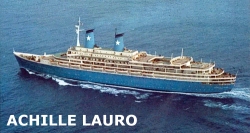 Italian "Achille Lauro" - she was to become high-jacked by terrorists
in the Mediterranean and was front page news for quite a while. Less newsworthy
was her subsequent grounding on the coast of Madagascar in the 1990s, an
accident from which she would never recover.
Italian "Achille Lauro" - she was to become high-jacked by terrorists
in the Mediterranean and was front page news for quite a while. Less newsworthy
was her subsequent grounding on the coast of Madagascar in the 1990s, an
accident from which she would never recover.
 Arriving
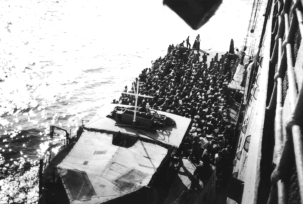
at Suez, we disembarked into an R.A.S.C. landing craft and were landed on the
crowded quayside. We were then taken to the local railway station by R.A.S.C.
road transport. Of the group of five vehicle mechanics who did their training at
Farnborough two of us - Bob Oldridge and myself - remained together and
travelled by Egyptian State Railway to Fayid, on the western shore of the Great
Bitter Lake. On arrival we were collected by an R.A.S.C. driver in a Humber 4 x
4 field car and taken to the guardroom of 591 GHQ (Staff Car ) Company. The
guardroom consisted of a large tent surrounded by whitewashed jerricans. The
corporal on duty there pointed us in the general direction of the Workshops
Platoon area and said he couldn't spare anybody to show us the way.
Arriving
at Suez, we disembarked into an R.A.S.C. landing craft and were landed on the
crowded quayside. We were then taken to the local railway station by R.A.S.C.
road transport. Of the group of five vehicle mechanics who did their training at
Farnborough two of us - Bob Oldridge and myself - remained together and
travelled by Egyptian State Railway to Fayid, on the western shore of the Great
Bitter Lake. On arrival we were collected by an R.A.S.C. driver in a Humber 4 x
4 field car and taken to the guardroom of 591 GHQ (Staff Car ) Company. The
guardroom consisted of a large tent surrounded by whitewashed jerricans. The
corporal on duty there pointed us in the general direction of the Workshops
Platoon area and said he couldn't spare anybody to show us the way.
We
managed to find a tent (No 75) in the Workshops Platoon line which had a couple
of empty bedspaces available but the sand floor was fitted with a coconut
mat, wall-to-wall. We
thought we must have stumbled into an NCO's tent by mistake, especially since
the only occupant was a lance-corporal. But he introduced himself as Reg Miller,
of Ipswich and made us welcome. He was a fitter/turner and spent most of his
time as a fitter; he was called upon from time to time to exercise his skills
with the various machines.
After
showing us around the workshops and nearby buildings he pointed us towards the
Quarter Masters Stores and invited us to go up there and obtain overalls - we
could make a start the following day. By the time we got back it was early
afternoon and he suggested that we go along with him to have a look (or a "shufti")
at Fayid village; there was no need to obtain a pass or permission to leave the
camp, we could just go. As long as we didn't try to leave camp alone there was
no formality attached to it. "You're no longer in training", he said,
and made us both feel like real soldiers after eleven months of learning to
march, drill, shoot, drive and repair things. This was definitely going to be
the life !
Reg
took us to the open-air village alongside the main road leading to the Great
Bitter Lake; looking back now, it was very similar to a car boot sale but
without any cars. All the items for sale were laid out in the sand or on
blankets which looked as if they had once belonged to the British Army.
Here and there we found rickety tables set up. The one thing common to all the
goods offered for sale was a complete absence of price tickets - all prices were
negotiable and people serving in the British forces were offered special prices.
So we were assured by the vendors, anyway !
We
then made our way around the outside of the camp to the upmarket part of Fayid;
here we found concrete buildings, some with doors, even. Whereas the outdoor
shopkeepers sold mainly souvenirs and small items of jewellery destined to be
sent back to the UK as gifts, this part of Fayid boasted photographic shops,
made-to-measure clothing, barbers' shops, a miniature golf course, roller-skating
rink and a cinema. The skating rink, which backed on to 591 Company's plot, kept
us all awake until about midnight with its gramophone record (no, not a spelling
mistake - I only ever remember them playing one record - "Wish You Were
Here" - over and over again).
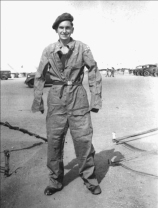 An
early job the following day was to get the civilian upholsterer to take some
length off the sleeves and legs
of the ill-fitting overalls; he did a good modification which merited the
five ackers (about one shilling) I paid him. Second job was to drive out on to
the public roads and experience driving a right hand drive vehicle on the right
hand side of the road in amongst
Egyptian civilian traffic. I chose
to use a Bedford 3 tonner, that
being the model I was most used to
driving before leaving the UK . Straightforward enough until I arrived at my
first roundabout; a moment of indecision, change down to third, sigh of relief
and proceed anti-clockwise.
An
early job the following day was to get the civilian upholsterer to take some
length off the sleeves and legs
of the ill-fitting overalls; he did a good modification which merited the
five ackers (about one shilling) I paid him. Second job was to drive out on to
the public roads and experience driving a right hand drive vehicle on the right
hand side of the road in amongst
Egyptian civilian traffic. I chose
to use a Bedford 3 tonner, that
being the model I was most used to
driving before leaving the UK . Straightforward enough until I arrived at my
first roundabout; a moment of indecision, change down to third, sigh of relief
and proceed anti-clockwise.
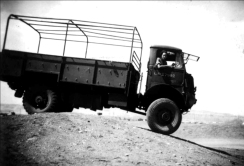
My
first operational work as a VM was to adjust the valve clearances on a Bedford
15 cwt which the electricians had
been working on. More or less all
my training had been carried out on Bedfords and
all Bedfords
- 15 cwt, 3-tonner and QL 4
x 4 3-tonner -
all used the same engine as far as I recall, but with different
gearboxes. Obviously this first job involved a drive down to the test route
which took
fifteen minutes or so, followed by a session of
testing out the
brakes, steering and suspension on the test track itself. Ah yes, and the
tappets ! Adjusting the tappets was best carried out with the engine hot and
ticking over slowly.
Reg
Miller accompanied me on this first trip and the only formality involved was to
buckle on "test plates" front and rear. A test plate consisted of a
piece of sheet metal about nine inches by seven
fitted with a leather buckle-strap. This was painted in the regimental
colours of blue and yellow divided diagonally with a white horizontal band at
the top bearing the legend "591 COY -
ON TEST". This,
as well as being a warning to other drivers that something dramatic might happen
without notice, permitted the VM to drive to the test route without a work
ticket. Which was very useful when a crate or two of beer was required for the
evening. We were issued with typewritten permits
a month at a time to dispense with the formality of a work ticket for each
journey. I don't recall that the permit stipulated "no beer to be carried
en route".
Going
to the test route involved a circumnavigation of the camp and then a ten-m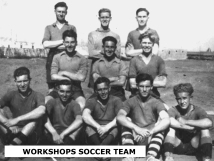 inute
drive to the test track itself, which consisted of the first half a mile or so
of a tarmacked area which
had previously been an RAF airstrip. The actual length of the useable
tarmac depended on how much sand had recently encroached upon it and the time
spent there was enough to carry out
the testing and, in some cases, improving
one's driving ability and
technique. Some VMs saw it as a way of passing
the time towards demob and
could be seen dozing happily under
the truck or in the back seat
of the staff car; these were mostly the ones
approaching the end of their National Service - they were fed up with Egypt.
inute
drive to the test track itself, which consisted of the first half a mile or so
of a tarmacked area which
had previously been an RAF airstrip. The actual length of the useable
tarmac depended on how much sand had recently encroached upon it and the time
spent there was enough to carry out
the testing and, in some cases, improving
one's driving ability and
technique. Some VMs saw it as a way of passing
the time towards demob and
could be seen dozing happily under
the truck or in the back seat
of the staff car; these were mostly the ones
approaching the end of their National Service - they were fed up with Egypt.
Some
rather strange driving exercises took place
on the test track, particularly when two like-minded people
arrived at the same time. There
was a fore-runner of stock car racing, with two (or more) evenly matched three
tonners competing around a course marked out with a mixture of jerricans and
boxes, sometimes broom handles stuck vertically into the soft sand. I don't
recall any real damage being suffered by any of the vehicles, just an occasional
graze which could conveniently be painted over back at 591,
which might cost a tin of
fags or so.
An
early form of cross country rallying required
four- wheel drive wagons to
be driven off
the tarmac surface on to the soft sand ; the one which got the farthest -
and returned to the tarmac -
being the winner. The losers included those which needed towing out of
the sand and the ones which had to be lifted by the recovery truck and then
dragged out. The most memorable loser was the lad who tipped a Federal fire
engine right over on to its side; he was disqualified anyway because the fire
engine was a 4 x 2. Popular favourites for this competition were Humber 4 x 4
field cars which were heavier than
the jeeps and generated more traction with their bigger wheels.
All
these activities back in 1948/49 took place out of sight of those who would have
objected because there was no
official road to the test track.. It was a case of driving along the main road
and turning right just before the
C-in-C's Mess onto a gravel patch about two
hundred and fifty yards long. This was followed by the half mile of tarmac. The
only people who used the test track were 591 Coy Workshops staff - it was too
far off the main road for anyone else to arrive there accidentally.
Although
most of the sergeants and certainly those above that rank were Regular Army
people, quite a few corporals were
National Servicemen like ourselves (some achieved
the dizzy height of corporal because they had been offered a carrot to
"sign on" for five and
seven years). Nobody offered me a carrot until three weeks before my demob was
due to take place, by which time I could have gone home, had some disembarkation
leave and then, if I wanted to, sign
on with a much more
lucrative arrangement in the REME.
There
was plenty of leisure time at 591 Coy; very often the Officer in Charge of
Workshops would get us on parade at about 1400 and tell us to knock off for the
day. This would happen once or twice a week, and was a very civilised way of
running a Workshops Platoon, in our opinion. We would clean up and stroll to the
village, or to the lido or even to
the NAAFI inside camp. After tea there was a wide choice of cinemas, the skating
rink, the golf course ; three cinemas were within walking distance and they all
screened different programmes.
Other
cinemas involved a degree of travel, for which there were several options:
Egyptian taxi, which was the very fastest mode of transport, albeit dangerous to
life and limb. Can't say I ever
lashed out on a taxi but I believe if a group of squaddies all shouted loud
enough at the driver they would finally finish up at the right place and then
beat the price down a bit. The Austin 6 x 4 recovery truck was ideal for taking
a dozen or so of the lads to their selected places of entertainment. There was
no great difficulty in arranging a work ticket for this nefarious purpose.
I
don't believe I sat through more than three or four film shows in the twelve
months or so which I spent in the Canal Zone. There were too many other, more
enjoyable, activities to indulge in. Top of the list was football, played on the
sand pitch adjacent to the cookhouse. The pitch was normally made ready for play
by having great sheets of coconut matting dragged over it by a squad of
civilians employed within the camp. The neat, parallel lines left by this
operation would provide a fairly playable surface capable of supporting ninety
minutes of football between the various platoon teams.
When
a company game was due to be played there would be special attention by a
Bedford 15 cwt water tanker and a diesel four ton roller. On the one occasion
when an inter-command
match took place this arrangement was repeated
during the half-time interval - no expense spared !
I recall that a man by the name of Mel Charles took part in this match;
he was the brother of John Charles, the legendary Welsh international player. My
only claim to footballing fame was sinking a NAAFI pint
in the company of Mel Charles !
So
what else did we do to fill our leisure time? Apart from the activities already
mentioned, most of the civilian
attractions were either out of bounds or strongly discouraged by the
Army authorities. Company Orders (Part One ) made it quite clear
that any ailment arising
from the discouraged pursuits
would be regarded as having been self-inflicted and therefore
the subject
of a court-martial charge.
Besides, most of the ladies involved lived in Ismailia, Port Said or Cairo -
very expensive places, I'm told ! ! !
Largely,
we made our own entertainments; reading and letter-writing were pleasant enough
to perform at any time. I always tried to write home once or twice a week and my
sister kept up a comprehensive stream of news from Plymouth, together with
copies of the Western Evening Herald. National magazines would arrive from UK
and would be passed around from hand to hand until unreadable. A lad in the next
tent received a regular supply of an American magazine - "Saturday Evening
Post" - with which I was quite familiar, having obtained plenty from the US
Navy during the wartime days.
Another
fellow always had a Wilson model lorry kit under construction and kept himself
amused for hours. Adverts for Wilson lorry kits can probably still be found in
old copies of modelling magazines of the late forties.
Another very popular periodical was "Commercial Vehicle".
Locally printed leaflets publicised the programmes available on
"Forces Radio", although radio sets were few and far between
among the tents. For important UK sports broadcasts there was always the MT
Storeman's radio. All the many services' cinemas
were well -advertised at the
village and within tthe camp.
Most
of us at some time
would block up an ants' nest with matchsticks just to observe the
ingenuity and strength of the occupants. Fayid ants measured about half an inch
long and each was capable of carrying a complete matchstick unaided; sometimes,
however, they worked in pairs with equally successful results. Any ant finding
himself at the bottom of a cigarette tin sunk
in the sand would somehow
get in touch with a rescue team and they would either kick sand into the tin
until he could climb out or pass matchsticks or other materials down to him.
Fascinating creatures.
On
one of the few occasions when I was caught for a twelve hour guard duty, the
whole squad (including the guard
commander) were ordered to parade again at 0930 the following day, behind the
main workshops building where there was a 20 foot space between the wall and the
barbed wire fence. As we assembled, some in working rig, some in football gear,
others in their best battledress, the reason for our summons became quite clear.
There was an Austin Utility propped up on bricks and blocks, minus all its
wheels; even the spare had gone. It had obviously been pushed or driven some
fifty yards from where it had been parked the previous evening and some scheming
Egyptian now possessed an updated van or trailer. Somewhere. All this happened
between nightfall and sunrise. While we were on guard ! Luckily, no further
action was taken by the authorities.
The
biggest (or at least , the longest)
card game I ever took part in lasted seventy two hours over the Christmas leave
period. It started at about
midnight (or 2359 in Army terms) in Tent 75 - my tent - the one nearest the
Workshops - and gradually moved up the line. Only two or three tents enjoyed the
luxury of a table and even those did not have chairs so the game took place on a
few square feet of plywood placed on a bed; when the owner of the bed had had
enough brag for the day, the game shifted to another bed. When all four, five or
six of the tent's occupants wanted
to sleep, the whole game moved to a
different tent.
After
the Orderly Officer had done the rounds and
retired to the Mess for the
night, the game continued in the guard tent until it was time for the guard
dismounting parade (0600 hrs). Then there would be organised upheaval for an
hour or so whilst a couple of losers went to the cookhouse and prevailed on the
staff to supply what would today be called a takeaway breakfast for the
appropriate number of players.
Over the three days and nights, the guard tent became the most popular venue
for the card game; nowhere else could be found
electric light, a table and chairs, unlimited cocoa and a steady supply
of lads coming off their two-hour
"stags" to join in the game.
A
"stag" was the two-hour period which the sentry
had to fill before being relieved by someone else ; the first stag - 1800
to 2000 hrs - was popular with most of the troops because there was still a bit
of life or movement to be seen whilst
wandering about with the .303 Lee-Enfield rifle slung on one shoulder. There was
also a very powerful searchlight mounted on a tripod with which to scan the
perimeter occasionally. First stag also meant getting out again at midnight to
relieve the third stag ; another advantage of being first stag was that when
0200 rolled around you could sleep until dismount (or play cards !). Second stag
- 2000 to 2200 and 0200 to 0400 - was generally regarded as a bit of a pain.
Not
that I minded whether first second or third stag was best - after two or three
twelve hour guard duties in my first month at 591 Coy I was taken off the list
and placed instead on Recovery Duty. This
was much, much preferable to spending all night either prowling around inside
the perimeter wire keeping the Egyptian civilians on their feet or conversing
with the German Army P.O.W. patrols who also did two hours on and four hours off
all night. The Egyptians were equipped with paraffin hurricane lamps and were
supposed to keep awake and shout to the armed sentry as soon as they saw
anything suspicious. Most of the time they would crouch down and put the lamp
underneath their galabias to keep warm; from a distance they looked like
Christmas tree lights. They patrolled the six-foot wide track between the outer
barbed wire fence and the second one.
The
space between the two inner fences was patrolled by German prisoners of war;
they were all former members of Erwin
Rommel's Afrika Corps - no Kreigsmarine
or Luftwaffe personnel as far as I
can remember. While on guard duty they were armed with pickaxe handles. I found
it interesting to hear Egyptians and Germans in the middle of the night
conversing with one another in a form of English language. By day, the Germans
displayed no further interest at all in conquering the world
and simply wanted to get back to Germany as soon as possible; this didn't
happen until early 1949. They were, of course, much older than our own rank and
file; they had largely been in North Africa for more than six or seven years and
were deeply suntanned, with leathery skin.
A
lot of the lads struck up friendships with some of the POWs but those of us who
had endured
and survived
the blitzes on Plymouth,
Liverpool, Bristol and other places kept our distance as far as possible. There
were quite enough chances of becoming involved in private arguments and
fisticuffs without starting World War Three, which already seemed to be brewing
in Berlin, according to the newspapers. The POWs passed their leisure time by
fashioning cigarette cases and other souvenir articles out of discarded
(British) army mess-tins. This would bring them in a few piastres with which to
buy luxury items such as writing paper, cigarettes, matches and so on.
If
they managed to squander their money on beer they must have done so in secret,
because never in the few months that we occupied the same patch of sand did I
see any POWs drinking. Neither did I ever hear groups of POWs singing patriotic
numbers like the Horst Wessel marching music or Deutschland Uber Alles. There
are ex-Army personnel even today who keep in touch with German prisoners they
met during National Service. Count me out.
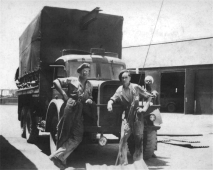 Vehicle
breakdowns could occur at any time of the day or night, thus it was possible to
be woken up (by the petrol picket or
guard commander) at an instant's notice to drive out and recover the vehicle
involved. Most breakdowns were dealt with by towing the vehicle back to 591 with
the Austin 6 x 4 using a small towbar, with the driver steering his vehicle as
necessary. Others were a little more interesting, such as disentangling a road
accident, possibly requiring some inventiveness with the 6 x 4's jib.
Among the many pieces of equipment belonging to the 6 x 4 was a set of
ground anchors but these were of limited use in sand and I never did have
occasion to use them. We also had a smaller recovery truck, an Army modified
Chevrolet 30 cwt, which was used for straightforward towing jobs with staff
cars, although it was known to have recovered 15 cwt Bedfords on suspended
tow.
Vehicle
breakdowns could occur at any time of the day or night, thus it was possible to
be woken up (by the petrol picket or
guard commander) at an instant's notice to drive out and recover the vehicle
involved. Most breakdowns were dealt with by towing the vehicle back to 591 with
the Austin 6 x 4 using a small towbar, with the driver steering his vehicle as
necessary. Others were a little more interesting, such as disentangling a road
accident, possibly requiring some inventiveness with the 6 x 4's jib.
Among the many pieces of equipment belonging to the 6 x 4 was a set of
ground anchors but these were of limited use in sand and I never did have
occasion to use them. We also had a smaller recovery truck, an Army modified
Chevrolet 30 cwt, which was used for straightforward towing jobs with staff
cars, although it was known to have recovered 15 cwt Bedfords on suspended
tow.
Apart
from the variety of breakdowns and crashes to be dealt with from time to time,
there was an occasional bending of the rules to make life more bearable. For
instance, it was a court-martial offence in the Canal Zone to run out of petrol
whilst on duty. Woe betide anyone who did so. A couple of times I got called out
in the middle of the night to recover a "broken down" staff car
complete with officer passenger. It normally didn't take long to determine the
cause of the engine coming to a halt, but to announce
it out loud would have got the driver into deep trouble
It
was therefore politic to tell the driver his car would have to be towed back to
591 because of a defect in the petrol pump or a leaking fuel line (nudge
nudge, wink
wink). This was long established routine among recovery truck mechanics;
there were so many staff cars on so many journeys that people were always
running out of petrol. The settling up came early next morning, with a quantity
of cigarettes changing hands, the size of the transaction depending on what time
I was awakened and how long it kept
me out of my bed. Telling fibs on a
recovery report would probably also have been a court martial offence - I never
found out.
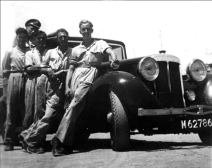 The
foreman of the civilian staff at 591 Coy was an Italian called Mr Pitta - I
never heard anybody call him by his first name. He was in his early forties at
the time and before the war was part of the Bugatti international racing team.
He could always be relied upon to come up with the right solution to problems
associated with the ignition or fuel systems of our more expensive staff cars,
such as the Daimler and the Humbers. Not that I ever encountered many of those
problems - 90 per cent of the repairs I carried out
were on Dodge, Ford and Bedford trucks - but our Staff Sergeant was very
glad to have Mr Pitta on the books.
The
foreman of the civilian staff at 591 Coy was an Italian called Mr Pitta - I
never heard anybody call him by his first name. He was in his early forties at
the time and before the war was part of the Bugatti international racing team.
He could always be relied upon to come up with the right solution to problems
associated with the ignition or fuel systems of our more expensive staff cars,
such as the Daimler and the Humbers. Not that I ever encountered many of those
problems - 90 per cent of the repairs I carried out
were on Dodge, Ford and Bedford trucks - but our Staff Sergeant was very
glad to have Mr Pitta on the books. 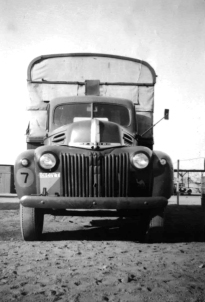 There
was one occasion when even Pitta was lost for an answer, that was when the
Cadillac Imperial lost some of its impetus due to what turned out to be a valve
problem. Fortunately, one of the German NCO prisoners had formerly worked for
the General Motors agency in Cologne and he was able to advise on the necessary
treatment.
There
was one occasion when even Pitta was lost for an answer, that was when the
Cadillac Imperial lost some of its impetus due to what turned out to be a valve
problem. Fortunately, one of the German NCO prisoners had formerly worked for
the General Motors agency in Cologne and he was able to advise on the necessary
treatment.
A
typical day at 591 would start off with wash, shave and make for the cookhouse,
stopping en route at the civilian laundry tent to collect/deliver KD items.
Khaki Drill shorts, shirts and
trousers would sometimes last two
or three days without attention from the Chinese laundryman (known as
a "dhobi wallah", a name which
originated in India during a much earlier time of the British Empire) whereas
most of us would manage to launder our own smaller items of clothing. The dhobi
wallah had a gap between his front teeth and he would use this for spraying
water on to the KD items prior to ironing them; the resultant creases never gave
cause for complaint. Perhaps he put
starch in the water before spraying. Shaving was accomplished at weekends by the
one drawing the short straw making a pre-breakfast trip to the cookhouse to
bring back a mug or two of hot tea. This was luxury compared with weekday
shaving which involved cold water.
Breakfast
often consisted of hot porridge (with not enough sugar), bacon, egg, sausage,
toast, butter and unlimited tea. On other days there might be fish or corned
beef instead of bacon. A short discussion with members of other platoons to get
wind of the latest rumours about the demobilisation programme or who crashed the
15 cwt into the side of B Platoon office the night before, and it was back to
the tent to get ready for work. Rumours of demob "must be speeded up next
week without fail" were normally put about by staff car drivers who were
obviously in pole position to overhear snippets from the back seat during their
duty runs. Invariably the rumours turned out to be absolutely unfounded,
unreliable and untrue. Far more interesting to discuss the latest car crash.
Work
of a routine nature was relatively interesting for those of us who were anxious
to expand our knowledge of vehicles. Not only of vehicles but of components
also; it was just not possible to obtain new replacements for engines,
gearboxes, starter motors, dynamos, distributors and the like. Faulty ones had
to be repaired unless the fitter doing the job struck lucky and was able to get
a lift to the scrapyard at Tel el Kebir, where he might be able to pick up a
serviceable one before the REME lads got hold of it.
REME
people at the time carried out full reconditioning of popular vehicles right
down to the paint job (but not the div signs) and it was sometimes impossible to
recognise that a particular wagon had not come direct from the UK. Midway
through the morning there was a NAAFI break, when somebody whose turn it was
would take a vehicle and load it up with a couple of dozen fancies, doughnuts,
marzipan slices, a gallon of tea and so on. It had to be cash up front at the
NAAFI and cash up front at the other end when
the orders were sorted out back in the workshop.
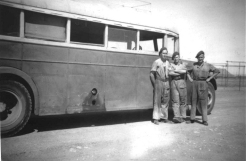 The
591 Coy camp area also accommodated 101 Coy;
I believe they must have shared the same Commanding Officer (Maj. F.
Lindop-Evans) and the same Company Office and administration set-up. They
certainly shared everything else including the cookhouse, football pitch, car
parks and boxing ring. 101 Coy ran forty or fifty Troop Carrying Vehicles (TCVs),
all of which were of Dodge or Ford origin. Built as two and a half tonners, they
had all been fitted with wooden bench-type seats in the passenger compartment
and access was via a wooden flight of steps at the rear
with metal
tubular handrails. 101 Coy's only other vehicles were two Leyland Hippo
33-seater coaches of late 1930s vintage, labelled "A" and
"B" for identification purposes. One or the other was usually parked
on the concrete ramp having its clutch gear repaired.
The
591 Coy camp area also accommodated 101 Coy;
I believe they must have shared the same Commanding Officer (Maj. F.
Lindop-Evans) and the same Company Office and administration set-up. They
certainly shared everything else including the cookhouse, football pitch, car
parks and boxing ring. 101 Coy ran forty or fifty Troop Carrying Vehicles (TCVs),
all of which were of Dodge or Ford origin. Built as two and a half tonners, they
had all been fitted with wooden bench-type seats in the passenger compartment
and access was via a wooden flight of steps at the rear
with metal
tubular handrails. 101 Coy's only other vehicles were two Leyland Hippo
33-seater coaches of late 1930s vintage, labelled "A" and
"B" for identification purposes. One or the other was usually parked
on the concrete ramp having its clutch gear repaired.
 The
CO was keen on sport and arranged for the 591 Coy soccer team to be entered in
the MELF (Middle East Land Forces) Championship. One day the CO attended an
important home match and was dismayed to see the reserve goalkeeper between the
sticks; he asked the RSM why the first-choice 'keeper was not playing and the
reply was to the effect that he - the CO - had had the goalkeeper put inside for
some misdemeanour. "Get him out straight away", said he, and the
kick-off was delayed for ten
minutes until the 'keeper arrived. I can't remember whether the company won or
lost on that occasion.
The
CO was keen on sport and arranged for the 591 Coy soccer team to be entered in
the MELF (Middle East Land Forces) Championship. One day the CO attended an
important home match and was dismayed to see the reserve goalkeeper between the
sticks; he asked the RSM why the first-choice 'keeper was not playing and the
reply was to the effect that he - the CO - had had the goalkeeper put inside for
some misdemeanour. "Get him out straight away", said he, and the
kick-off was delayed for ten
minutes until the 'keeper arrived. I can't remember whether the company won or
lost on that occasion.
On
another occasion there was a bit of a crunch and one of
the company players suffered a dislocated wrist. The trainer (a sergeant)
ran on to the pitch and rendered first aid, with the result that the player was
helped off the pitch with the same wrist broken. And there were no substitutes
in those far-off days !
On
the lower levels of soccer, there was an inter-platoon competition with teams
entered from Workshops, 101 Coy A, B, C, and D plus Admin. The football kit was
kept in a wooden hut adjacent to the pitch and there was a free-for-all when it
came to the issue of boots, jerseys and shorts, although some of the more
affluent or enthusiastic players had privately-owned shorts.
Referees were appointed according to their knowledge of the game, their
desire to get away from work and the number
of supporters for each of the two teams. Workshops certainly won the competition
in 1948/49 season and I still have the scars to prove it. But no medals were
issued - just the glory !
The
boxing ring was frequently in use for training and about once a month for a
programme of serious bouts. On these occasions it was necessary to purchase a
ticket to see the action, and truckloads of enthusiastic supporters came from
near and far as well as staff cars bringing the officers from other units. The
Navy supplied contestants from time to time and these arrived at the Fayid Lido,
being brought to the camp by 591 road transport. Civilian catering and ice cream
suppliers did a roaring trade and
the NAAFI dispensed the beer. No one ever seemed to know what happened to the
takings from these boxing
tournaments but rumours were widespread !
Driving
vehicles was my main hobby in those days; repairing them
gave a certain measure of satisfaction, but driving was the reward. With
so many different makes and models to pick from, it is not possible to look back
fifty-odd years and select a favourite drive. With one exception !
Having met up one evening in Ismailia with a couple
of RASC drivers on some sort of scheme or exercise from outside the Canal
Zone, John Aucutt and I arranged a rendezvous for the following morning. The
arrangement was for the two
visitors to have a drive along the Canal Road in a staff car: Aucutt and I would
each have a drive in a tank transporter along the Treaty Road, nothing bigger
than a car being allowed to use the Canal Road in those days, except in
emergency.
Five
years previously, as a thirteen-year-old, I had been an enthusiastic admirer of
the U.S.Army's vehicle fleet; in the days prior to D-Day it was customary to
wave and cheer at the lengthy convoys of trucks and jeeps which made their way
down our street on their way to the docks and wharves where their passengers
would be offloaded for the voyage in
troopships to the Normandy beaches. On the roads leading to Slapton Sands in the
South Hams a lot of the vehicles were tank transporters carrying Sherman and
other tanks; these were then offloaded and reversed into the LSTs. The area
around Slapton Sands was not open to the public, but the destination was fairly
obvious. The U.S.Army had been rehearsing there for months.
Nostalgia
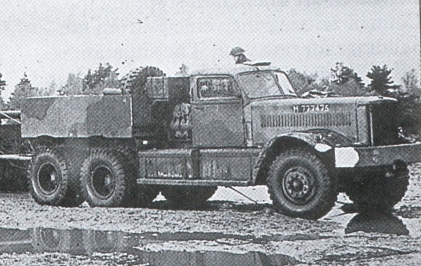
set in when I spotted the Diamond T parked up at the Fayid test route; apart
from a slight alteration to the colour scheme and the addition of British Army
div signs, this was exactly the same make and model as those which had used the
roads of the South Hams I can not
now remember whether this was diesel or petrol driven, but the engine was
already ticking over nicely when I climbed aboard. I had a good look round at
the controls and was given some rudimentary advice before finding no difficulty
at all in pulling away smoothly; before long I was in top gear and enjoying the
sensation of power under the five foot long bonnet. In top gear, with a clear
road, it was easy to achieve top speed (about
25 m.p.h. I seem to recall !). This was real living - and these two other
squaddies were getting paid to do it !
All
too soon my twenty minutes was up and it was time for one of the visitors to
take the wheel of the Super Snipe which we had managed to
arrange for the
demonstration (with test
plates in position, of course !).
I stayed behind with the driver's mate - couldn't leave any vehicle
unattended - and the other pair were back within half an hour,
the visitor having been thoroughly impressed with his
high speed drive. We mentioned having another meeting in the near future
but this, regrettably, never materialised.
Of
the other vehicles available at 591 Coy, I did most of my driving in the Austin
6 x 4 recovery truck, but another favourite was the Bedford QL; its main
features were high ground clearance, a ratchetted hand throttle, excellent
visibility from the driver's seat and a circular gun ring in the roof (passenger
side) of the cab which would let in any available fresh air.
The fifteen cwt had an almost inflexible suspension when empty but was a
much better drive when fully loaded. The three tonner was a very
versatile wagon at all times
and was the most comfortable of the three to drive.
A
Thornycroft mobile workshop was recorded as being on my charge but I never had
occasion to drive it anywhere outside the camp area. Each and every Army vehicle
had to be on somebody's charge for the convenience of the admin people when
anything went wrong with it; they needed to know who to put on a fizzer if the
tyres became flat or the engine wouldn't start. In the case of the Thorny, the
engine had to be able to start so that the machine tools, lathes, etc could be
used. For the same reason I was also responsible for the good working order of
the two-stroke engine which kept the paint shop's spraying equipment going; this
was no problem because Rollinson the painter was also Rollinson the right-back
of the football team; he looked after it very well and I never needed to do
anything to it.
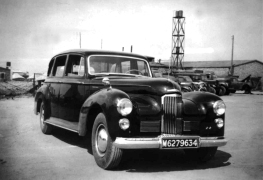 The
Humber family of vehicles was very well represented at 591, with several
Pullmans, two or three 4 x 4
field cars and about a dozen
Snipes and Super Snipes, one of the
latter supplying my first experience
of driving in excess of 100 m.p.h.
- that was on the Canal Road, which was iddeal for the purpose. The Super Snipes
had originally belonged to the Palestine Police, I understand.
The
Humber family of vehicles was very well represented at 591, with several
Pullmans, two or three 4 x 4
field cars and about a dozen
Snipes and Super Snipes, one of the
latter supplying my first experience
of driving in excess of 100 m.p.h.
- that was on the Canal Road, which was iddeal for the purpose. The Super Snipes
had originally belonged to the Palestine Police, I understand.
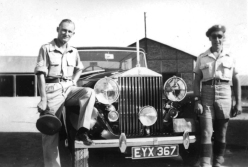 There
were various odds and ends of cars, perhaps the most odd being a black 1938
Rolls Royce Wraith with civilian number plates EYX 367. It was used exclusively
by the Commander-in-Chief, Middle East Land Forces and might, perhaps, have been
his own private property. A correspondent of mine - the late Bill Derbyshire -
put in a lot of work re-constructing the history of this vehicle and it
was last heard of doing duty as a hearse in the U.S.A.
There
were various odds and ends of cars, perhaps the most odd being a black 1938
Rolls Royce Wraith with civilian number plates EYX 367. It was used exclusively
by the Commander-in-Chief, Middle East Land Forces and might, perhaps, have been
his own private property. A correspondent of mine - the late Bill Derbyshire -
put in a lot of work re-constructing the history of this vehicle and it
was last heard of doing duty as a hearse in the U.S.A.
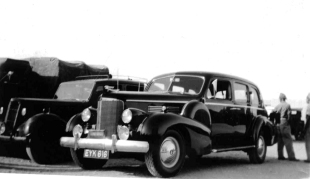 Another
oddity, also with civilian plates, was a black 1940 Cadillac Imperial; this one
was, likewise, used only by the C-in-C. Moving
on to the more run-of-the-mill staff cars we had American and Australian
Chevrolets, with the gearstick on the steering column, bench.-type front seat
and one-piece front windscreen. Not much fun to drive compared with the Humber
staff cars. One more oddity was a Daimler saloon, which drew quite a lot of
attention with its old-fashioned but regal appearance.
Another
oddity, also with civilian plates, was a black 1940 Cadillac Imperial; this one
was, likewise, used only by the C-in-C. Moving
on to the more run-of-the-mill staff cars we had American and Australian
Chevrolets, with the gearstick on the steering column, bench.-type front seat
and one-piece front windscreen. Not much fun to drive compared with the Humber
staff cars. One more oddity was a Daimler saloon, which drew quite a lot of
attention with its old-fashioned but regal appearance.
Yet
another oddity (insofar as we only had the one) was a 30 cwt Fordson WOT (I
believe WOT was an abbreviation for War Office Truck). This had a Ford V8 engine
and landed me in a very sticky situation. Several of us (including an
electrician or two) had been having a go at the erratic performance of the
engine and I rashly agreed to drive the truck over to the test route and see
whether I could solve the problem. I say "rashly" because it was about
45 minutes before knocking-off time on a Bank Holiday half day.
Having
arrived at the test route and tried several adjustments I found that the engine
would not restart - the battery power was low, having been used on and off all
morning. This was a bit worrying because I was (against orders) on my own with
the truck; there was no chance of anyone else from the company arriving because
of the imminent knocking-off time, no one from any other company ever used our
test route and not even the Military Police patrols would be likely to leave the
main road, even if they saw the truck; there's never one about when you want one
!
A
lot of thought went into my next move, which was to stay with the truck and plan
out what to do for the best. After half an hour or so I decided to give the
engine one more chance and then start walking. I got hold of the starting
handle, turned it to the three o'clock position and gave one more mighty heave.
The engine fired and immediately settled into a nice, steady tickover. End of
problem.
I
could only assume, as I drove comfortably back to camp, that the battery had
been rested sufficiently to muster just enough energy to do the trick. Having
tinkered, checked and double checked everything so many times in that worrying
ninety minutes, one thing has stuck in my memory ever since - the
1-5-4-8-6-3-7-2 firing order of an eight cylinder engine. An incredibly useless
piece of information which I have never ever needed since !
All
in all I enjoyed my fifteen months in the Canal Zone; Army life was not as
closely controlled by the top brass as some people imagine it to have been. Even
in the infantry regiments there was plenty of scope for those who wanted to
diversify. 101 Company, although designated RASC, drew on various infantry
regiments to supply drivers; the South Wales Borderers, East Kents and Royal
Fusiliers come readily to mind.
In
591 Coy RASC nobody got into any
kind of serious trouble, most of the incidents while I was there being connected
in some way with vehicles and civilian traffic. Although 591 was in close
proximity to other Service camps, I don't recall any troubles of an inter-unit
variety, at least not in the Fayid area. Any real outbreaks of fighting seemed
to be confined to places like Ismailia, Suez or Port Said, Cairo being out of
bounds to servicemen in uniform. The Military Police were seldom seen in the
area Fayid - Fanara - Geneifa - Kabrit except when dealing with traffic
accidents.
Within
the camp itself minor incidents worthy of record, mainly because of their
humorous nature, occurred almost weekly. Such as the time when a section of the
camp was plunged into darkness due to a vehicle of some kind accidentally being
driven a shade too close to an electrical distribution box. Nothing at all funny
or unusual about that except that one of the tents affected was the barber's
shop run by an Egyptian civilian. The RSM was halfway through a shave and
haircut when it happened.
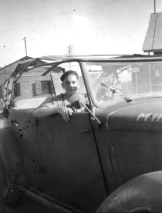 My
own very first involvement in a vehicle collision took place in the main car
park at about 2 mph. Driving forward out of a line of TCVs I turned the steering
wheel too much, too soon with the result that the front wing became a little
squashed. I had to get round the Turkish civilian welder to patch the damage
before anyone could find out about it. Another of my accidents was when I
entered the camp via the main entrance in a Humber Tourer. Thanks to defective
brakes (the Humber was being returned from a test run and the brakes were listed
!), I was unable to stop quickly enough to get the horizontal barrier swung up
out of the way by the guard on duty and contact was made with the top of the
radiator housing; the barrier went up without any assistance from the guard.
Damage was, fortunately, negligible - just a slight dent.
My
own very first involvement in a vehicle collision took place in the main car
park at about 2 mph. Driving forward out of a line of TCVs I turned the steering
wheel too much, too soon with the result that the front wing became a little
squashed. I had to get round the Turkish civilian welder to patch the damage
before anyone could find out about it. Another of my accidents was when I
entered the camp via the main entrance in a Humber Tourer. Thanks to defective
brakes (the Humber was being returned from a test run and the brakes were listed
!), I was unable to stop quickly enough to get the horizontal barrier swung up
out of the way by the guard on duty and contact was made with the top of the
radiator housing; the barrier went up without any assistance from the guard.
Damage was, fortunately, negligible - just a slight dent.
One
of our Workshops lads drove up to the NAAFI shop to collect a tray of goodies
for the mid-morning break and backed his TCV into a veranda supporting pillar,
which gave way. He appeared before the CO and was fined half the cost of the
damage to the TCV; seems that the NAAFI building was nothing to do with the Army
when it needed repairing.
Personally,
I only "appeared" before the CO on one isolated occasion; he had seen,
with his own eyes, a vehicle being driven along outside of camp but passing
within ten yards of his desk, only the barbed wire fence impairing his vision.
He seized on the fact that the TCV was clearly exceeding the speed limit and,
equally clearly, was carrying a plate which read "591 COY - ON TEST".
Very little detective work was required by the Company Sergeant Major, who was
despatched to get the name of the driver, KR
in fact.
Next
morning, after all the formalities of "Cap
off - About turn - Quick march - Left right left right " and so on, the CO
patiently explained to me that speeding normally carried a penalty of a week
inside ("inside" being time spent in the Walled-Off
Astoria at Moascar Military Correction Establishment). He would, he said,
be cutting off his nose to spite his face if he embarked on that procedure;
vehicle mechanics - even inexperienced ones - were not easily replaced in the
short term. So the outcome was (fortunately) "Keep the speed down in
future, Roberts" - "Admonished, Sgt Major" (this for the record
of proceedings !).
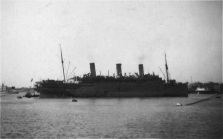 After
many false alarms, and extended active service due to the Palestine situation,
the day eventually arrived for all of Demob Group 113 to leave the Canal Zone.
We sailed aboard the "Empress of Australia" from Port Said with, in my
case, the prospect of attending my sister's wedding the day after arrival in the
U.K.; That was bound to be a time of great celebration, meeting family and
friends and generally enjoying the starting day of civilian life. Not so. The
Liverpool dockers chose this very time to call a total strike and I missed the
wedding by twenty four hours. I have never supported or joined a trade union
since !
After
many false alarms, and extended active service due to the Palestine situation,
the day eventually arrived for all of Demob Group 113 to leave the Canal Zone.
We sailed aboard the "Empress of Australia" from Port Said with, in my
case, the prospect of attending my sister's wedding the day after arrival in the
U.K.; That was bound to be a time of great celebration, meeting family and
friends and generally enjoying the starting day of civilian life. Not so. The
Liverpool dockers chose this very time to call a total strike and I missed the
wedding by twenty four hours. I have never supported or joined a trade union
since !
I
am deeply indebted to Graeme Spink for his patience, determination, skill,
experience and sheer doggedness in unravelling the mysteries (to me) of the
internet and web pages. Without his guiding influence “Ken Roberts’ Army
Service” would have comprised a boring heap of text unrelieved by any colour,
pictures or illustrations, not to mention the sand-coloured background.
Grateful
thanks also go to my wife Margaret, who very carefully embroidered the coloured
RASC badge which appears near the beginning of the page.
Finally, many thanks to daughter Sally for explaining, in words of one or two syllables, how to work the computer in the first place.
MY FAVOURITE LINKS
Ken Roberts and the Navy Department
Ken Roberts and the first Land Rovers
Ken Roberts and the Plymouth Blitz
Kitty to the Cape A journey through Cornish Mining History.
Landscape of a Legend. The Mines of Redruth and Camborne.
Plymouth Mineral & Mining Club
A Tamar Valley Event, An audio / visual experience


|
|
|


