Searching for the shortest path in an obstacle course
Homework #4 – ECE578
Objective
This homework attempted to find the global shortest path in an obstacle course from any arbitrary start and any arbitrary end goal. If has been shown that the globally shortest path lies along the global tangent graph. This graph is made up of all of the lines that connect the all of the vertices of all of the obstacles in the environment. Obviously with even a few obstacles this graph can be rather large. Most tangents can be eliminated because there is no line of sight between them.
The method I used is very straight forward
Unfortunately I could never get the program to work properly. It never did produce the expected graph. The reason is that was, well, I just did not have enough time to debug it. I am very disapointed in the tools available for debugging. When the error occurs deep in a recursion it takes time and patience to get it to work. As of now, I have neither.
Implementation
The code, which I wrote to perform these functions, was written in Lisp of course. I was able to reuse a few of my functions from previous homeworks. The full code is available on the web page. I wanted to highlight some of the core functions used.
The code is available here
codeExpand-Node
This function is the workhorse of the algorithm. Because is uses recursive search it is very compact. The input argument is a list of vertices or nodes. If the list is not empty then it checks for two cases.
(defun expand-node (nlist)
(if nlist
(let ((node (car nlist))
(children-node (get-visible-nodes (car nlist) nlist world-objects)))
(cond
((if (line-of-sight? node goal)
(found-goal
(add-node-lineage goal node))))
((if children-node
(expand-node (append children-node (cdr nlist)))))))))
Get-Visible-Nodes
This recursive function determines the list of other nodes that are visible from the current parent node. It does this in the following steps.
defun get-visible-nodes (parent-node list-of-nodes list-of-objects)
;;node is the vertex that we want to expand
;;list-of-nodes is a list of already traversed nodes
;;list-of-objects is a list of world objects -- the recursion
;; will stop when there are no more objects in the list-of-objects
(if list-of-objects
(if (eq 'node (get-value 'name (car list-of-objects)))
(let ((child-node (car list-of-objects)))
(if (and (line-of-sight? child-node parent-node)
(not (duplicated? child-node list-of-nodes)))
(cons (add-node-lineage child-node parent-node)
(get-visible-nodes parent-node list-of-nodes
(cdr list-of-objects)))
(get-visible-nodes parent-node list-of-nodes
(cdr list-of-objects)))))))
Line-Of-Sight
It was this function which gave me much grief. With more time I probably would have fixed it. Ther goal here was to determine if two objects could see each other unobstructed. A temorary object called a ping-object was created that would traverse the path from object A to object Z. The detect colision would search the world-object list and determine if an object collision was eminent.
(defun line-of-sight? (objectA objectZ)
;;Determine if the two objects can see each other
;;if a ping-object moves from objectA to objectZ without
;;hitting anything else then the two objects can see each other
(progn
(setq ping-object (copy-alist ping-proto))
(set-value 'xpos ping-object (get-value 'xpos objectA))
(set-value 'ypos ping-object (get-value 'ypos objectA))
(set-value 'orientation ping-object
(get-orientation-towards-object objectA objectZ))
;;This "if" statement is a very big kludge. The get-first-object-in-direction
;;function will not detect objects which are on the same x or y
;;values. There is a hard check placed here to capture these
(if
(or (= (get-value 'xpos objectZ) (get-value 'xpos objectA))
(= (get-value 'ypos objectZ) (get-value 'ypos objectA)))
(if t t)
(let ((collided-object (get-first-object-in-direction ping-object)))
(progn
(describe collided-object)
(if (and
(= (get-value 'xpos collided-object)
(get-value 'xpos objectZ))
(= (get-value 'ypos collided-object)
(get-value 'ypos objectZ))) t Nil))))))
Add-Node-Lineage
This is a simple utility function that pushes onto a data list on each node that search history. At each level the parent pushes its ‘lineage’ onto the children. This is how the path is tracked down. The draw line will draw the tangent line from parent to child onto the display. This line is the tangent.
(defun add-node-lineage (child-node parent-node)
(progn
(gp:draw-line display-pane
(get-value 'xpos child-node)
(get-value 'ypos child-node)
(get-value 'xpos parent-node)
(get-value 'ypos parent-node))
(set-value
'lineage
child-node
(append parent-node (get-value 'lineage parent-node)))
))
Found-Goal
and Get-Trip-DistanceThese utility functions are used to determine the length of path once a path from start to goal has been found. The minimum distance is recorded and reported and the end of the search. The path traversed by the shorted route is also saved in the "best-trip" list. This list is drawn at the end of the simulation.
(defun found-goal (node)
(let
((distance (get-trip-distance (get-value 'lineage node))))
(if (< distance shortest-distance)
(progn
(setq shortest-distance distance)
(describe distance)
(setq best-trip (get-value 'lineage node))))))
(defun get-trip-distance (list-of-nodes)
(if (and (car list-of-nodes) (cadr list-of-nodes))
(+ (distance-obj (car list-of-nodes) (cadr list-of-nodes))
(get-trip-distance (car list-of-nodes)))
0))
GUI
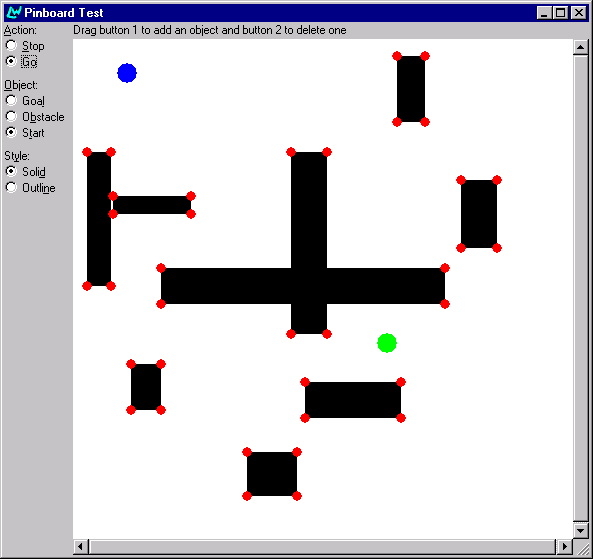
The GUI I allowed the user to design a unique obstacle course. Just with a few clicks of the mouse a custom obstacle course could be entered. The start position (blue) and the end goal (green) are set by the user. The black boxes are drawn by the user. The red vertices are added by the program to highlight the vertices.
Results