 Thursday, August 1, 1996
Thursday, August 1, 1996
costa rica today
The Lure of Fine Wood
By Todd Staley
There are some graphic impressions that stay forever engraved in an angler's mind.A huge armor-plated tarpon, spiraling skyward, its scales glistening like diamonds. The rattling gill plates discharging a drum roll that sends chills up your spine.
The ballet of a sailfish, as it tail-dances across a cobalt stage. A hundred feet or more it glides across the surface as if in slow motion. It dips back into the indigo sea for a split second and returns for an encore to the delight of all on board.
An excited marlin, lit up in neon purple, its bill thrashing through the boat wake as it chases down a trolled offering.
There are many things that can trigger these memories, bringing them back to life just as vividly as the moment it happened. A conversation with another angler can set off a memory as you exchange fish stories about great catches or 'the one that got away'. A fiberglass replica of a trophy catch, mounted proudly in a den or office, will surely draw questions of what, where and how.
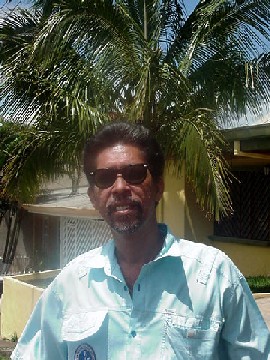
Many anglers today have discovered another way to remember their fishing vacation in a beautiful and practical form. The stunningly lifelike wood carvings of artist Kenneth Dyer.
Dyer began carving wood sculptures more than twenty years ago in his native country, Belize. His devotion to carving began as a hobby that was self taught. As time passed and his carvings improved, it became his livelihood. His craft has taken him to Hawaii and California and , five years ago, landed him in Costa Rica.
Tourists have always been his biggest customers. "In Belize they wanted sharks and dolphins, in California and Hawaii they wanted whales, but here in Costa Rica my greatest demand is for sportfish," says Dyer who, although is capable of making a variety of birds and animals, finds his love is in carving sea life.
Like most truly good artists, Dyer has an eye for detail. To aid him in capturing the finer points, he studies. He looks at photos, scrutinizes fish mounts, and has even gone as far as visiting marine biologists to secure an exact duplicate.
One of the attractions of Dyer's works, aside from its beauty, is the wood he chooses to bring his subjects to life. Costa Rica has some of the finest hardwoods in the world. His favorite is the cocobolo, a type of rosewood with unique grain patterns running through it. Nazareno (purple heart) and ron-ron are also woods he likes to use.
Fining a piece with just the right grain requires scavenging around lumberyards. Many times, pieces of the most spectacular woods are buried in the far corners of sawmills. A raw piece of timber that may not be suitable to cut into lumber and tossed off to the side at the mill, may be perfect for a leaping marlin.
Dyer uses basic tools in his creations. The outlines of his works are formed with a machete. As they begin to take form, he switches to rasps and files for the minute details. "I could use some power tools to make my work faster, but I enjoy the hand tools. I feel I have better control of the finer details like this," Dyer said as he worked on the intricate design of a roosterfish's comb.
His sculptures have become preferred by the tournament set for trophies. Richard Krug started the trend, and other tournament organizers soon followed suit.
A modest man, Dyer does not like to take credit for his own success. "Richard really helped me become known in Costa Rica; he showed fishermen my work and they bought them." Bought them they did. In the last two years, more than 125 pieces of Dyer's work have gone home with tourists that stopped by Krug's sportfishing desk in the lobby of the Hotel del Rey.
Dyer's works start at around $250 for an 18 inch piece. Compared to what similar items go for in the U.S. market, that is a steal.
�
����������������������������
Copyright � 1999, Grupo Jacob Luna S.A.. All rights reserved.
�
�
�