¢OIN I$OLATION
One way to set up the board is to first decide the order in which coins will be placed on the squares. Then put all of the coins in a cup, shake the cup, and sprinkle the coins out in a line. The order of the coins is determined by the position in the line of the center of each coin, from left to right. If it's too close to call, then the coins go in order from highest to lowest vertically. If that doesn't do it, then use the last remaining dimension: top to bottom.
In this example, I decided to start in the upper-left corner of the board, move clockwise, and spiral inward. So I put the coins in a cup and sprinkled about 16 of them out at a time. These four pictures show how they fell.
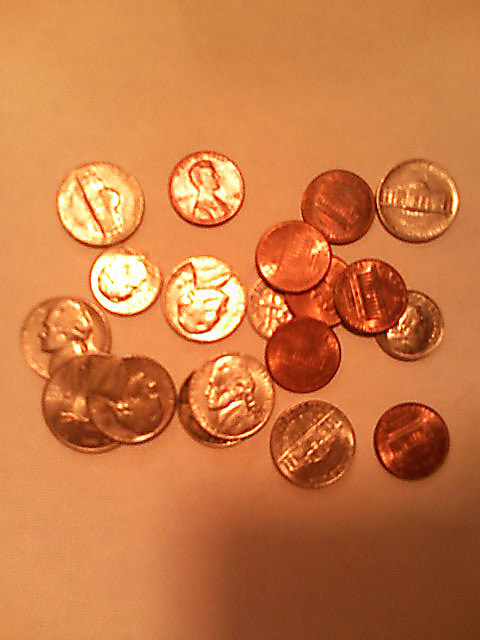
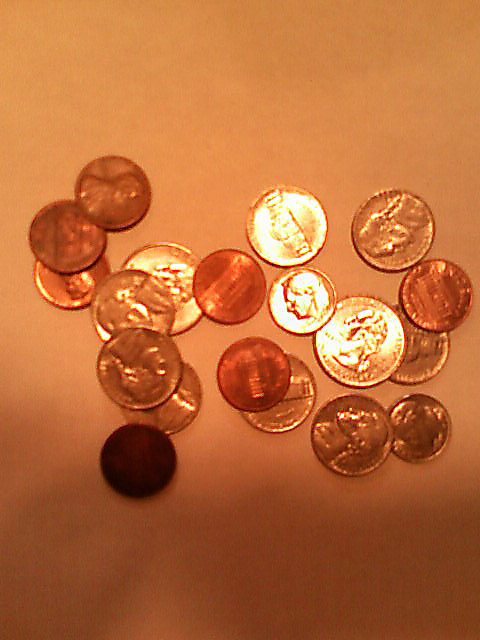
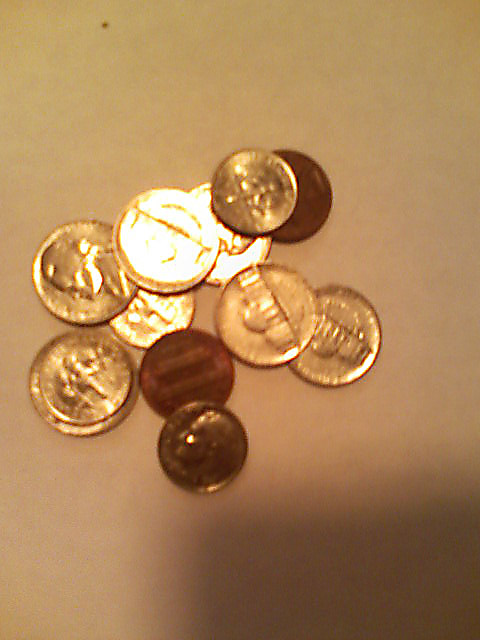
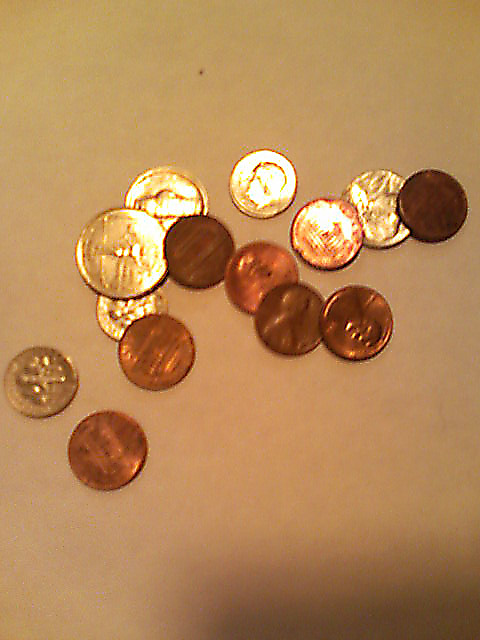
The
coin that is furthest to the left is a nickel. So that nickel is placed
in the first (upper-left corner) square on the game board. It's not so
clear which of the remaining coins is furthest to the left. It's either
the nickel (toward the top of the photograph) or the quarter (toward
the bottom of the photograph). So the
tiebreaker rule is required: The coin that is higher (closer to the top
of the photograph) comes next. That's the nickel. Thus, the nickel takes
square #2 and the quarter goes in square #3.
After that, a dime and a nickel are in contention for that square #4. Even though the right side of the dime lies to the left of the right side of the nickel, that doesn't matter. The rule says that the left sides of the coins are compared. So, since it is unclear which of the two coins is furthest to the left, the tiebreaker rule is used, and thus, the dime takes square #4 and the nickel goes in square #5. Note that, if the two coins were still tied after the first tiebreaker, the second tiebreaker says that whichever coin was lying on top of the other would get square #4.
The diagram below shows the resulting starting position.
After that, a dime and a nickel are in contention for that square #4. Even though the right side of the dime lies to the left of the right side of the nickel, that doesn't matter. The rule says that the left sides of the coins are compared. So, since it is unclear which of the two coins is furthest to the left, the tiebreaker rule is used, and thus, the dime takes square #4 and the nickel goes in square #5. Note that, if the two coins were still tied after the first tiebreaker, the second tiebreaker says that whichever coin was lying on top of the other would get square #4.
The diagram below shows the resulting starting position.
| 5¢ | 5¢ | 5¢ | 10¢ | 5¢ | 1¢ | 5¢ | 5¢ |
| 1¢ | 1¢ | 5¢ | 5¢ | 10¢ | 25¢ | 5¢ | 5¢ |
| 5¢ | 5¢ | 1¢ | 5¢ | 10¢ | 1¢ | 5¢ | 10¢ |
| 25¢ | 10¢ | 1¢ | 1¢ | 1¢ | 25¢ | 5¢ | 1¢ |
| 1¢ | 10¢ | 1¢ | 1¢ | 5¢ | 10¢ | 10¢ | 1¢ |
| 5¢ | 5¢ | 10¢ | 1¢ | 1¢ | 5¢ | 1¢ | 5¢ |
| 5¢ | 1¢ | 5¢ | 10¢ | 10¢ | 5¢ | 5¢ | 1¢ |
| 1¢ | 1¢ | 1¢ | 1¢ | 10¢ | 5¢ | 1¢ | 1¢ |
| 25¢ | 25¢ | 25¢ | 25¢ | 25¢ | 25¢ | 25¢ | 25¢ |
Send comments on this page to Ken Samuel , but don't expect a timely response.