Mill Accessories and Tooling Descriptions
Here I describe the tooling I have purchased to complete several projects, namely the 80% AR-15 and 80% 1911 receivers. This page is intended to serve as a guide the potential purchaser who would like to begin these same projects.
Tooling is broken down by functional area.
Rated from 1 to 5, where 1 = "might use it occasionally" and 5 = "must have it immediately."
Measurement
|
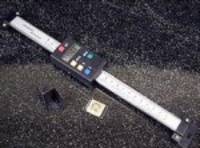
Digital Readouts
|
These are a VERY worthwhile upgrade for the mill. They work like a digital caliper, measuring the movement of the table. They can be reset to zero at any point. I bought them from CalAero supply. Buy Rating: 3 |
|
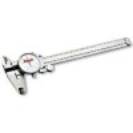
Dial Caliper
|
What can I say, I'd be lost without it. It measures thickness, inside and outside diameters, depths, and about anything else you can think of. Buy Rating: 5 |
|
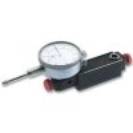
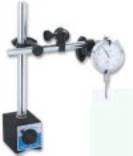
Dial Indicators
|
They are used for lining up the workpieces. As the table moves, the indicators display any unwanted variation from a "true" line. They can also be used to measure the travel of the mill table or spindle for very accurate cuts. Buy Rating: 5 |
|
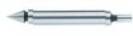
Edge / Center Finder
|
This tool allows you to line the mill spindle up with an edge or the center of a hole, without worrying about damaging the workpiece. I paid like $12 for a combo center/edge finder. If you buy one, get a fairly good one because this is a precision tool, by definition. Buy Rating: 4 |
|
Transfer Punches
|
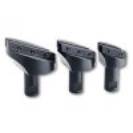
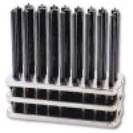
If you have ever tried to trace an existing hole in a finished part onto a piece of raw stock, you will appreciate these. They are made to fit into the hole exactly and transfer a center punch mark onto the workpiece. Great for locating holes, and you'll use them for all kinds of stuff. Buy Rating: 5 |
|
Protractor
|
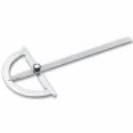
Protractor: For setting and measuring angles. You might not use it too often but when you need one, nothing else will do. And they're not too expensive, so buy one up front. Buy Rating: 5 |
|
Combination Square
|
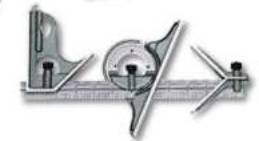
It is a center finder, measuring rule, and is also handy for drawing 90 and 45 degree layout lines on a workpiece. Some, like this one, also come with a protractor. Buy Rating: 3 |
|
Layout Dye
|
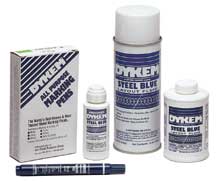
Nothing more than a solvent-based dye that helps you lay out cutting lines on a workpiece. Also handy for seeing where you are cutting, and for identifying rub marks on two mating parts. A magic marker can be used as a substitute, but this stuff is cheap enough. I just bought a 4 oz jar, it should last me quite a few years. Buy Rating: 4 |
|
Scribe
|
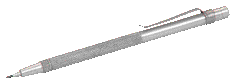
A "pen" with a carbide point for scribing lines into a workpiece, with the help of layout dye. Buy Rating: 3 |
|
Micrometers
|
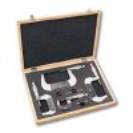
Allows you to measure thickness down to .001". If you use them, you have to get a set of different sizes because they will only measure a piece so thick. They are kinda hard to read, too. Frankly, I never used them. My dial caliper will do everything these will do. Buy Rating: 1 |
Setup
The setup tooling you buy will depend quite a bit on what projects you are going to attempt. But there are several things you cannot live without, and it's better to get these purchases out of the way up front. There are few things more frustrating than having a mill and not being able to use it because you are waiting on your tooling to ship.
|
Clamping Kit
|
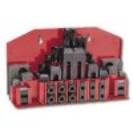
For fastening workpieces and tooling to the mill table. Buy Rating: 5 |
|
Angle Plate
|
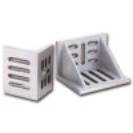
The best way to clamp workpieces in a vertical orientation. A couple different sizes are nice to have. Buy Rating: 3 |
|
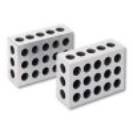
1-2-3 Blocks
|
These are nothing more than fixtures to help with the clamping kit. You can bolt them to the table to support workpieces, and thread your clamping rods into them. I don't use them much. Buy Rating: 2 |
|
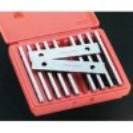
Parallels
|
I always wondered what these were for. They are for lining workpieces up with the bottom of the vise to get them level with the mill table, and also as general spacers. They come in a set of different heights, to get your workpiece just the right height in the vise jaws. Buy Rating: 4 |
|
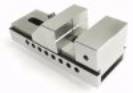
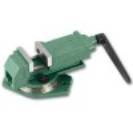
Milling Vise
|
For securely holding the workpiece while milling it. I bought a screw vise that is easy to work with, and it swivels, but it won't hold a very large workpiece. I bought a screwless vise that holds larger workpieces and is more accurate, but it is kind of a pain to use because you have to reposition the bolt underneath if you move the jaw very much. I've decided to use the screwless vise to set up complex projects such as AR-15 receivers, and I'll use the swivel screw vise for quick and repetitive simple jobs. They ran $50 apiece. Buy Rating: 5 |
|
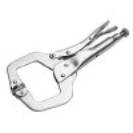
G-Clamps
|
Good for clamping pieces in place temporarily while you are using your hands to get your clamping kit in place. Especially useful when working with an angle plate or rotary table. Buy Rating: 2 |
|
Shim Stock
|
Just thin pieces of soft metal that can be used to raise workpieces to the proper height, or to protect soft material from the vice jaws. Buy Rating: 3 |
|
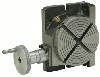
Rotary Table
|
It rotates the workpiece with respect to the cutting tool. Handwheel is usually graduated in degrees or some multiple thereof. Very handy for creating circular and semi-circular cuts and parts. It can be mounted flat, or on end. Buy Rating: 2 |
|
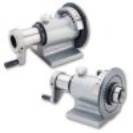
Spin Index
|
This allows you to make measured radial cuts in a piece of stock. The head can be turned a set number of degrees and locked in position. It accepts 5C collets to hold the workpiece. One was given to me, but I haven't needed it yet. Buy Rating: 1 |
|
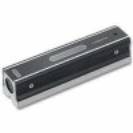
Machinist's Level
|
Just a very precise, very expensive liquid level that will help you get the workpiece level. Of course this assumes your mill table is also level. Frankly parallels will do this a lot cheaper, and a quick and dirty carpenter's level will save plenty of time if you can't use parallels. You're still likely going to have to use a dial indicator anyway if you want a precise cut. Buy Rating: 2 |
Cutting Tools
Like some of the setup tooling, the cutting tools you buy will depend, to a large extent, on the projects you are attempting.
|
Collets
|
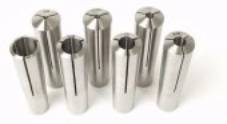
They spring open to accept a straight-shanked tool and have a threaded hole in the other end for the drawbar. As you tighten the drawbar of the mill, the spindle taper squeezes the fingers shut to provide an even, concentric grip on the shank of the tool. Buy as many sizes as you can afford, but it's hard to get by without a 3/8" and a 1/2" inch at the very least. Of course they are specific to the spindle taper (MT3, R8, etc.) Buy Rating: 5 |
|
End Mill Holder
|
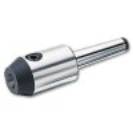
An alternative to a collet. They have a taper on one end and a threaded hole for the drawbar, and the tool's shank is secured by a set screw in the other end. (That's why many tools have that little flat ground on the shank.) I personally don't have any end mill holders, I have collets instead. Buy Rating: 5 (or 1 if you already have collets) |
|
End Mills
|
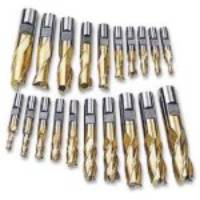
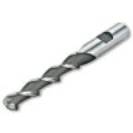
The workhorse of most milling operations. They come in all kinds of different sizes, profiles, materials, and quality. When ordering them be sure you know the difference between the size of the cutting end, the size of the shank, and the length. You will need a collet or some other end mill holder that matches the shank size. I use my set of 4-flute High Speed Steel endmills (1/8" to 1/2") for 75% of the work I do, but mostly I am working aluminum. They can cut on their sides but are mostly intended to cut on their ends, thus the name "end mill." Some general notes:
· Ball end mills will leave a round-bottomed cut in a workpiece instead of a flat-bottomed one. Buy Rating: 5 (at least a basic set of 5 to
10 pieces) |
|
Fly Cutters
|
These use a few sharp cutting edges on the outer edge of the tool to cover a lot of area fast. They are meant for taking light cuts to flatten out a surface in fewer passes than an endmill. They often use replaceable cutting inserts as an economical measure. I don't have one but it would be "Helpful." Buy Rating: 3 |
|
Slitting Saws
|
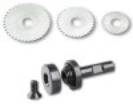
They are used to cut at a right angle to the spindle; useful when you can't lie the workpiece down for whatever reason. They fit on a straight-shanked arbor. Buy Rating: 3 |
|
Boring Head
|
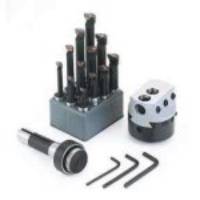
These work on a similar principal as a fly cutter. One asymmetrical cutting surface moving on the outside surface. Mostly used to drill big, wide holes in a workpiece. You can buy different sizes, and the head can be adjusted in or out to increase or decrease the diameter of the hole. You will have to buy one that matches the taper of your spindle. Different lengths of boring bars are available to allow you to drill deep holes. Buy Rating: 3 |
|
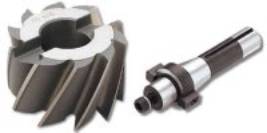
Shell Mills
|
Primarily cutting the side of a workpiece. Kind of like an end mill on steroids. Fits on an arbor. I don't have any. Buy Rating: 2 |
|
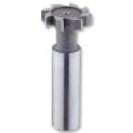
Keyseat Cutters
|
Like slitting saws, for cutting horizontal slots in a workpiece. They can get into tighter spaces than a slitting saw, but they don't cut as deep as a slitting saw. I don't have any. Buy Rating: 2 |
|
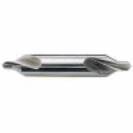
Center Drills
|
Just a little stubby drill that is used to lay out the primary location of a hole for drilling. They are so stubby they aren't prone to wander, and they are tapered to cut a good starting hole no matter what size drill bit you're going to use. Buy Rating: 5 |
|
Cutting Fluid
|
Cutting fluid serves two main functions: to keep the cutting tool cool, and to help wash away chips, which maintains a good cutting action. You can improvise (I use WD-40 for cutting aluminum) but like layout dye, this stuff is cheap and lasts a while. Buy Rating: 4 |