BACKLASH - Distance that you must turn the handwheel before the leadscrew engages the threads of its nut. Usually encountered when reversing compound or cross slide direction, it's the "slack" in the screw. A large amount of backlash is undesirable.
BACKPLATE - A round, flat metal plate that serves as an adapter between the spindle and the chuck.
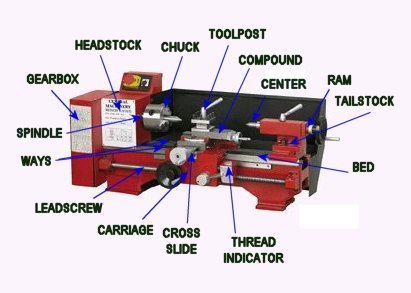
BED - A flat, long surface extending down the length of the lathe axis. The length of the bed usually limits the size of the workpiece you can turn. The CARRIAGE and TAILSTOCK are mounted on the bed, and can usually be positioned most anywhere on the bed.
BORING - The act of cutting a hole in the end of a workpiece by using a single-point tool that is usually held parallel to the lathe axis, and is advanced in or out a small amount with each pass. This is accomplished with the use of a boring bar and a boring bar holder.
CARRIAGE - Also known as the SADDLE. The assembly that ultimately moves the cutting tool. It bears upon the ways, and moves back and forth along the bed by means of a handwheel. The cross slide and compound are located on the carriage. Most lathes can also automatically move the carriage by use of a gear driven leadscrew.
CENTER - A tailstock-mounted accessory whose purpose is to keep the workpiece steady and turning concentrically. Usually mates with a shallow hole drilled in the center of the workpiece. See DEAD CENTER, LIVE CENTER. The center is held tight against the workpiece by the tailstock ram.
CHUCK - Bolted to the spindle, the chuck is similar to a drill chuck in that it has movable jaws to hold a workpiece. 3-JAW CHUCK: has three jaws that are adjusted in unison to automatically center the workpiece. 4-JAW CHUCK: has four jaws that are adjusted independently to allow off-center alignment or to hold oblong workpieces. 6-JAW CHUCK: Like the 3-jaw chuck, the 6-jaw chucks automatically center the workpiece, but more accurately, and the clamping force is distributed among more jaws.
COMPOUND - An adjustable carrier for the toolpost. It can usually be rotated so as to feed at an angle. It is attached to the cross slide.
CROSS SLIDE - An adjustable carrier that slides in and out, with respect to the axis of the lathe. The carriage provides "X" axis movement along the axis of the lathe, and the cross slide provides "Y" axis movement. The compound is mounted atop the cross slide.
DEAD CENTER - A tapered point that remains stationary with respect to the tailstock; the workpiece rotates against it.
DOG - Tool that is clamped to a workpiece on one end and contacts the chuck jaw or faceplate on the other end. Used when turning between centers, when it's not desirable to use the chuck to clamp one end of the workpiece. The dog ensures that the workpiece turns, instead of merely spinning between centers.
FACING - Cutting operation where the tool is advanced perpendicular to the axis of the lathe, resulting in cutting a flat face on the edge of a workpiece.
FACEPLATE - Round, flat metal plate that replaces the chuck. Workpieces are clamped directly to the faceplate (such as bowls or other hard-to-chuck items), or they can be used with a lathe dog.
GAP BED - A bed that can be moved away from the headstock to provide clearance for an exceptionally large workpiece that would be too large to turn over the bed.
GEARBOX - The area containing the gears that drive leadscrew and/or spindle speed. Some lathes require you to change gears to cut different threads, etc. Other (usually more expensive) lathes have permanently installed gears that can be adjusted by means of levers to the desired screw pitch.
GIB - A metal plate that sits between a moving part and its ways and can be adjusted to take up slack. Usually found on carriage, cross slide, and compound.
GIB SCREWS - Locking screws that can be turned to increase or decrease the pressure on the gib.
HANDWHEEL - A handle that is attached to the carriage, compound, or cross slide, which moves the part back or forth.
HEADSTOCK - Usually refers to the housing that holds the spindle; though it can also contain the gearbox, motor, electronics, etc.
LEADSCREW - Long gear-driven screw that can drive the carriage at different rates to automatically feed or thread the workpiece.
LIVE CENTER - A tapered point that is on bearings to allow it to turn with the workpiece.
MT#1,2,3,4,5 - Morse Taper. An industry standard, it is used to ensure compatibility between tools and lathe spindles / tailstocks. An MT-3 spindle will accept only an MT-3 tool; different Morse Taper numbers are not interchangeable.
PARTING - The act of advancing a parting tool to the center of the workpiece, resulting in cutting off the end of the workpiece.
PHASE CONVERTER - A device that allows three-phase motors to operate on a single-phase circuit. There usually is a loss of efficiency when using a converter.
RAM - The sleeve of the tailstock which accepts a center or drill chuck, and which can be adjusted in or out to drill holes or apply pressure against a workpiece. The ram will have a certain taper (see MT#1,2,3) which must match the tools to be used in it. The ram can be locked in place.
SCROLL CHUCK - A chuck that uses a spiral gear to draw the jaws in or out in a synchronized manner.
SINGLE PHASE - A form of electrical power, commonly used in residential wiring. House current is single phase. Lathe motors will usually be single phase or three phase.
SPINDLE - The part of the lathe that is driven by the motor, and accepts a chuck or faceplate on the end. The spindle is hollow and long workpieces can be inserted through the spindle to be clamped in the chuck if facing work is to be performed on one end. Since the size of the hole in the spindle dictates what size of stock you can insert through it, larger spindles are more desirable.
STEADY REST - A device that can be used to support the middle of a long, thin workpiece. It's adjustable for different diameters of workpieces, and it fits on the ways like the tailstock.
SWARF - Metal chips, debris generated from cutting operations. Why they needed to make up a word for it is beyond me.
SWING OVER BED - Technically, twice the distance between the centerline of the spindle to the top of the bed. This measurement is simply the largest diameter workpiece that can be turned with the lathe without interfering with the bed. A lathe with 7" swing over bed means that you can turn up to a 7" workpiece, but nothing larger.
SWING OVER GAP - Similar to "swing over bed" but refers to gap bed lathes. This is how much extra clearance the gap bed provides.
TAILSTOCK - Lathe accessory that supports the far end of a workpiece. It can be moved in or out along the ways, and can be locked in place. The tailstock ram can accept a center or other accessory.
THREAD INDICATOR - Usually a dial that is synchronized with the leadscrew, and whose purpose is to help the operator know when to engage the feed. It assists in making repetitive cuts in the same place, as in deepening a thread.
THREE PHASE - A form of electrical power that is most usually encountered in industrial environments. As it allows more current to be delivered to a motor, three-phase motors are usually installed on larger industrial lathes and machinery. A three-phase motor can be used on a single-phase power system with the use of a phase converter.
TOOLPOST - Adjustable fixture to which turning tools can be affixed. Most toolposts can be adjusted to attain a certain angle, and some toolposts can use tool holders which can be adjusted for height. The toolpost is usually mounted on the compound.
TURNING - The act of cutting a workpiece using a turning tool.
TURNING TOOL - Usually consisting of a single point, turning tools can be ground to a large variety of shapes, sizes, and angles in order to obtain a desired surface or angle when applied to the workpiece. Generally made from either High Speed Steel (HSS) or carbide. They are intended to reduce the diameter of a workpiece a small amount with each pass.
WAYS - The precisely ground surfaces that the carriage bears against. They should be lubricated at all times and kept free of chips and trash.