How to clean your handgun
Introduction
Proper handgun cleaning is somewhat of a mystery to many first-time
handgun owners. It's a bit of information that is all too often assumed
by manufacturers and dealers. The purpose of this page is to, hopefully,
clear up some of the mystery and answer common questions.
Typical Disclaimer
By no means is my way the only correct way to clean a handgun.
For illustrative purposes, the following images and text describes my personal
routine, which has worked well for me for years with no ill effects.
I do not necessarily recommend any of the procedures or products which
follow and cannot be held responsible for any damages or injuries which
readers of this page may subsequently inflict upon themselves or others.
Cleaning Accessories
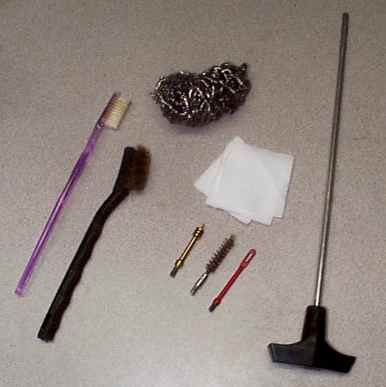 |
These are some of the tools I use for gun cleaning.
1. Swiveling cleaning rod, preferably coated, or stainless steel.
It's nice to have two so you don't have to keep swapping out your brush
and jag. If you're forced to use an aluminum one, wipe the gunk off
the rod after every pass.
2. Bronze brush in proper caliber. Stainless steel is too aggressive
for routine cleaning, and plastic is often not aggressive enough.
3. Patch jag, preferably a round one that will give a tight fit with
the patch.
4. Properly sized patches (preferably cotton)
5. Toothbrush (preferably old)
6. Brass-bristle brush for stubborn fouling or stains.
7. Stainless steel pot scrubbing sponge (not steel wool). This is good
for removing light rust or other stubborn stains from the surface of your
gun without having to worry about damaging the bluing. And a few
strands, snipped off with scissors and wrapped around your bore brush will
make quick work of lead removal inside the bore.
8. You may also find wooden toothpicks and cotton swabs handy, as well
as pipe cleaners.
|
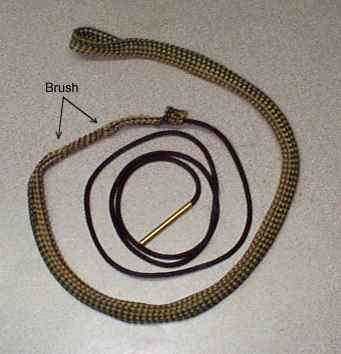 |
This product is called the Bore Snake and is made by Michael's of Oregon
(Uncle Mike's). It's a quick and easy way to clean a barrel.
The weighted cord drops into the breech, the part containing the built-in
brush is soaked in solvent, and the whole thing is pulled out the muzzle.
It works very well for rifles in my experience, but is almost too much
trouble for a handgun. It doesn't replace a thorough cleaning, but
it's a convenient (and compact) way to clean a bore in the field, or when
you don't have time to perform a complete cleaning on your rifle. |
Solvents
Solvents are substances designed to dissolve fouling (powder, lead and
copper residue) and make it easier to remove. They are not to be
confused with lubricants or protectants, however you will occasionally
encounter products such as BreakFree CLP that are designed to clean, lubricate,
and protect. Potential problems with solvents: 1) some, such as Birchwood
Casey Gun Scrubber, will dissolve plastics, paint, skin, or other soft
materials commonly found on guns, 2) some may damage the finish on
wood or even, in rare cases, the metal itself, 3) many solvents,
by nature, remove all oils from the metal, requiring a thorough re-lube.
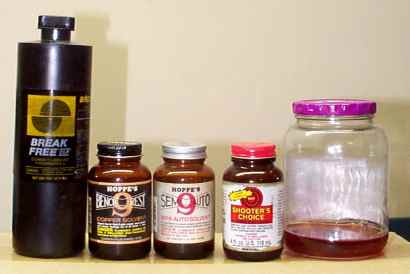 |
Here are the solvents I'm currently using.
From left:
1. BreakFree CLP (mil-spec cleaner, lube, and protectant)
2. Hoppe's Bench Rest Copper Solvent (for copper fouling)
3. Hoppe's Semi Auto solvent (claims to remove copper and lead and
leave no residue)
4. An almost-empty jar of Ed's Red (homemade CLP).
Hoppe's #9, probably the most ubiquitous solvent, is absent from
this lineup at the moment, but I have used quite a bit of it in the past. |
Lubricants
Lubricants are designed to prevent wear and tear on moving parts.
Lubrication, in some cases, is necessary for proper operation of a mechanism.
Potential problems with lubricants: 1) their tendency to collect grit and
dirt over time, eventually impeding functionality or even damaging parts
with the sludge that results 2) the tendency in cold environments
to freeze into a hardened mass, impeding functionality 3) the equally
annoying tendency to evaporate or dissolve under heat or pressure, leaving
your gun dry, and 4) the mess they can make on your clothing and/or
holster.
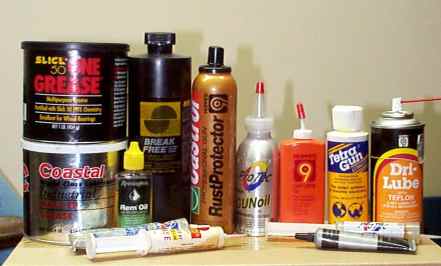 |
Here are some of the lubricants I'm using:
From left:
1. Coastal Industrial Moly Grease (semi-auto slides)
2. Slick 50 One Grease (semi-auto slides)
3. Permatex white lithium grease
4. Shooter's Choice grease (semi-auto slides)
5. Rem-Oil (too light, really)
6. BreakFree CLP (for general lubrication)
7. Castrol/Hoppe's RustProtector (not really a lube)
8. ProTec gun oil (for general lubrication)
9. Hoppe's gun oil (for general lubrication)
10. Tetra gun oil (my favorite low-friction oil)
11. ProTec gun oil (in syringe)
12. Lubriplate grease
13. Hoppe's Dri-Lube Teflon spray
(for cold weather, or to avoid an oily mess)
|
Protectants
The purpose of protectants, as one might suppose, is to protect your
guns from rust or other types of corrosion. Most often used
for guns that will be stored for a period of months at least, protectants
may also be necessary in humid climates or locations, as well as on guns
that are used for carry. Problems with protectants: 1) they
can stain holsters, clothing or other materials, 2) they may be hard
to remove, 3) they may evaporate or be rubbed/wiped off, 4)
they may make the gun too slippery to handle. I've mainly used short-term
protectants, and for the purposes of this page I won't discuss cosmolene
or other long-term protectants.
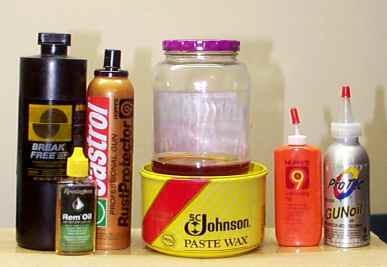 |
The protectants I've used:
From left:
1. BreakFree CLP (works as well as anything else)
2. RemOil (too thin IMHO)
3. Castrol/Hoppe's Rust Protector (again, too thin)
4. That same jar of Ed's Red (used by default)
5. Johnson paste wax (when oil is not desired or when it may evaporate
or rub off)
6. Hoppe's gun oil
7. ProTec gun oil |
Now that we've covered the basics, let's move on to the actual cleaning
procedures:
Cleaning Your Semi-Automatic Pistol
Cleaning Your Revolver
Back to Home