Are we rational in buying pirated software? Note: Still under construction (Last updated: 01/03/2000) (Now playing Zeng ZongJi "Dilemma")
Economic students are commonly viewed, rightfully or wrongfully, as the more selfish students around, because we are taught that human beings act to maximize self-interest. Examples include the axiom that human beings are non-satiated, we must have more and more. Furthermore, when we think about whether we should help another student, we mentally calculate the net present value of the benefits we can get from this student. Thus we are more willing to help a hardworking student than a lazy one.
Okay, I am exaggerating but I am about to use economics to explain why do people buy pirated software. In Singapore, you can see people buying all these stuff, not just in Sim Lim Square but in almost every neighborhood town in Singapore. The most common proposition given is that the prices of software are way too expensive. These people point out that, at present, no one buys imitation computers because the prices of original computers have gone down to what used to be the prices of imitations (Anyone remember the old Apple II and its various imitations?). Thus, if only the prices go down for software, people will also start buying originals. That is the proposal that Sebastian Tan made here
Some moralistic zealots, I have to confess that I used to follow their arguments, claimed a second proposition: that there is no difference between software piracy and the purchase of stolen goods. One favorite argument goes like this: All of us know that cars are expensive in Singapore. Now if someone were to steal a car and you buy from him at rock-bottom prices, surely you are encouraging him in this theft. Thus, merely claiming that software is expensive does not justify you purchasing the pirated software from people who copies software illegally.
Now this article hopes to apply basic microeconomic concepts to understand why do people buy pirated software, and why the above two propositions are not as strong as we think. The most important aim of this article, however, is to establish a case that knowledge, unlike physical goods, should not have a monetary price attached to it. Thus, I hope to prove the following proposition wrong: that if we do not allow people to charge for their creativity, creative ideas will dry up.
I have to state my debt to Bradford Delong of UC Berkeley for inspiring this article. My main reference here is his draft of a new microeconomic textbook that he is coming out with. For those of you who think that economics is a dead science that does not attempt to change since Adam Smith, I recommend you click on that above link. Furthermore, I have to record my intellectual debt to the Free Software Foundation as well as the Free Music Philosophy. Indeed, I very much share their philosophy since I have the privilege of taking their knowledge and share it with others here in this article, without worrying about whether I can get sued for 'infringing copyright'. I have also sent out this letter to the Straits Time Forum and I am certainly glad they published it. It has attracted one reply so far.
Non-rivalry
The fundamental difference between a computer software and cars, which would severely weaken the above moralistic argument, is that the computer software, made up of many '1's and '0's, can be duplicated at almost zero cost. The software is a non-rival good, meaning that, once it is produced, the marginal cost of providing it to the next consumer, is zero because of the duplication process.
In public finance terms, such a good is an impure public good. In fact I can further argue that it is very difficult for the software developer to exclude others from not duplicating the product. Computer programmers throughout the world have broken into the various encryption tools that were used for the purpose of preventing duplication. But this is not necessary for my point.
This difference is by no means trivial to the issue on whether it is theft, as Jane Lim claimed. Imagine, if I cook a plate of spaghetti, intending to feast upon it. If you take it away from me, I would justifiably feel robbed of my effort. Now, if you have a way of duplicating my spaghetti and make off with a identical amount without me knowing it, I do not think I will feel the difference here since I still get to consume the spaghetti that I have made. Even if I know you did it, am I suppose to feel bitter? There is no reason why I should; in fact, I would be happy that someone else gets to taste my creation, and hopefully gives me some feedback on how it can be improved. If he decides to send me a check of any amount as a sort of 'tip', it will be a bonus.
Now, what if I had cooked the spaghetti intending for it to be sold to consumers? This, I believe is the context on Jane's point. Surely, if I want to sell my product, other people duplicating the spaghetti and re-selling at a lower prices to other people are robbing me of my rightful income. To better understand this point, let us use another microeconomic concept: Price Discrimination.
Price Discrimination
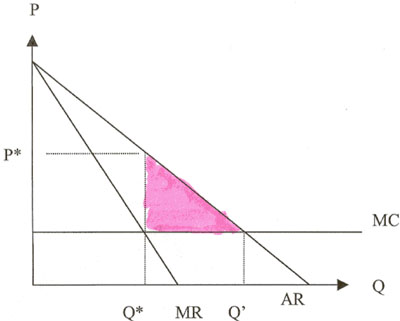
This concept should be familiar to any attentive first year undergraduate in economics. We understand that a monopolist maximizes his profits by equating MR = MC. But we notice that, there is a certain region, beyond the profit maximizing output, where the MC curve is still below the demand curve. That means that, if the monopolist produce some additional output to sell to those people who are only willing to pay the price below the profit maximizing price, he can earn a positive profit. The following diagram would illustrate the above point:
|
If Q* and P* are the profit maximizing quantity and price respectively, the certain region where AR > MC is the region Q*Q', shaded in pink in the diagram. |
Since the firm can earn positive profit, why doesn't the firm sells to these guys from Q*-Q'? It is because if the firm wants to lower the price beyond P* to sell to the guys from Q*Q', it has to charge the same price to every consumer before Q*, i.e. those that were originally paying P*. Thus the change in its revenue falls by much more than the demand curve, given by the fact that the MR curve is twice as steep as the AR curve.
Thus, in contrast to the perfect competition case, where price is given, the monopolist can sell more only if he lowers the price. But the problem is that the monopolist cannot distinguish between those guys who are only willing to pay a price lower than P*, from those who were originally willing to pay P* and above. Thus, without practicing price discrimination, the monopolist will not be maximizing his profit if he charges a price lower than P*. This, however, means that people who are willing pay a price above the cost of producing that good, but below P*, are denied from purchasing that good, resulting in a welfare cost/deadweight loss to society, given precisely by the same shaded pink area.
Thus, I can use this concept to better illustrate my case of selling spaghetti. If I were to sell that spaghetti, I can imagine that there would be a range of buyers who are willing to pay different prices for my spaghetti. I may then mentally calculate the best price to sell, and from that, I can observe how many people buy my spaghetti, thus establishing P* and Q*.
Now, I would know that there will be other people who are only willing to buy my spaghetti at prices lower than P* but again, I cannot sell to them because I cannot distinguish between them and those who are willing to pay prices above P*.
If I were to know of people buying my 'pirated spaghetti', I would naturally feel infuriated. But I would first investigate the nature of the pirated spaghetti.