
What The Phantom Menace has taught me about PhD supervision (Now playing Cui Ruo by Sammi Cheng. To hear it in realaudio, click here. )
If there is one thing that impresses me the most about the Phantom Menace, it will be the brilliant acting of Liam Neeson as Qui-gon Jinn. I have watched the previous Star Wars trilogy and, while those were great shows, I felt that Luke, Obi-wan and Yoda never really displayed the true presence of a Jedi Knight. Of course, it is not to be blamed since Anakin Skywalker murdered many of the Jedi Knights as Darth Vader, and both Yoda and Obi-Wan were so old already. So when I heard of the Phantom Menace, I eagerly watched it in anticipation of seeing the Jedi Knights in their full glory.
|
I was not disappointed indeed. Liam Neeson is perfect as a matured Jedi Knight. As I was sitting in the cinema watching Qui-gon and Obi-wan doing their stuff, it suddenly dawned upon me that the training of Jedi Knights is similar to the training of an academic. Let me take a moment to explain why. |
The key training phase that Obi-wan went through in Phantom is that of an apprentice. He is already a capable Jedi but he is to follow Qui-gon and learn the final steps from him. Obi-wan calls him, "Master" but it is not a simple case of the Singapore pronounced "Asian Values" since he was more than willing to question Qui-gon's actions (See footnote). For example, he opposed the recruitment of Anakin by stating to Qui-gon that, "The boy is dangerous. They all can sense it. Why can't you?" Furthermore, he regarded Qui-gon's decision to take Jar-Jar Binks along as an objectionable one, seeing Jar-Jar as a "pathetic life form"
Here is when Qui-gon's perception came through. As audience, we are well aware of the eventual fate of Anakin Skywalker but we must remember two things: Firstly, Anakin was the one who manages to shut down the power source of the Federation droids in the movie. Secondly, even when Anakin became Darth Vader, it was he who manages to destroy the Emperor while Luke was badly wounded. Thus, it is clear that Anakin is indeed the one who will bring balance to the force, even if he had to go through the Dark side and return. Furthermore, Qui-gon's decision on Jar-Jar proved to be right for it was the presence of Jar-Jar that Queen Amidala manages to connect with the Gungan army, allowing her to have allies to retake her homeland.
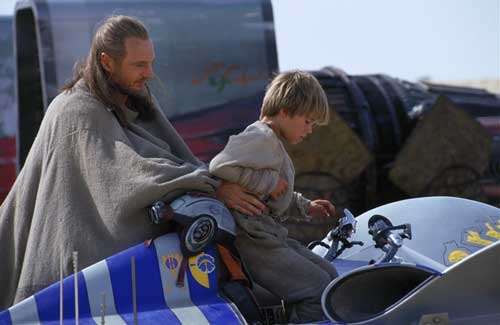
| The other theme that was obvious to me in Phantom was
'fatherhood'. Watching how Qui-gon guides young Anakin Skywalker really
touches me. Qui-gon displays all the attributes of a father.
He patiently answered all of Obi-wan and Anakin's questions with patience
and respect. He is especially fatherly to Anakin, as seen in this
picture, encouraging him as Anakin seeks to win the pod-race.
|
 |
To me, the kind of apprenticeship that Jedi Knights go through in the fantasy world of Star Wars is one that I hope to be able to go through as a PhD candidate in America, training to be an academic. It is clear to me that a PhD candidate is no longer seen as a mere student in America. He is expected to be fully comfortable with economic issues and principles and take the lead in formulating a research piece that would contribute to knowledge. Here the supervisor is a mentor much like Qui-gon, to guide me on my research and to challenge my thinking.
Well, I guess that viewpoint above is a very idealistic one, in the light of so many unpleasant stories I have heard about supervisors and their students. However, I am still very excited over the potential opportunity that I am going to get in going for a Ph.D. Although it might turn out to be a frustrating time with the possible lack of peer support, regular feedback and structure, thinking about the Phantom Menace will be one of the ways that I can continue to feel motivated J.
Incidentally, Amartya Sen (1999, p.178), the 1998 Nobel Prize winner in Economics, also debunks Singapore's views on Asian Values as a distortion of the truth, using Leys (1997) that 'Confucius did not recommend blind allegiance to the state. When Zilu asked Confucius how to serve a prince, Confucius replies, 'Tell him the truth, even if it offends him'.
References to the above comment
Leys, Simon (1997), The Analects of Confucius, (New York: Norton), 14.22, p. 70
Sen, Amartya (1999), 'Human Rights and Asian Values', in Ethics and International Affairs, Joel H Rosenthal (eds), Washington DC: Georgetown University Press, pp.170-93.