Comments on Diablo 2: Does economics makes us buy the original? (Now playing the theme from Nintendo's CastleVania. To hear the cool original Diablo town soundtrack in real-audio, click here.)
Introduction
This article comes in two parts. The first would give my comments on computer games and Diablo. The second would apply the "third law of demand" to see whether we should buy the original Diablo 2 instead of the pirated copy.
Historical Background of Yours truly
I have always enjoyed playing computer games, ever since the old Atari came out when I was but Primary 1. I do remember how I used to go to my Dad's shop when I was Primary 5 or 6 to play the Atari that they have on display for customers there. I distinctly recall how many of my dad's colleagues marvel at my skill at playing Atari, but also wondered whether I will also excel in my studies, since all of us are aware of how many teenagers struggle with the "temptation" of computer games while they are in school.
Well, I guess if most of my dad's colleagues are still around now, they would be surprised by yours truly at present, teaching at NUS J? From Atari, to CBS (Anyone remember this particular video game system? I remember playing Tarzan to the death in the CBS system), to Nintendo, to Sega, to the Personal computer (PC) which, with the power of emulation, can also play all the previous systems, games have always been part of my life.
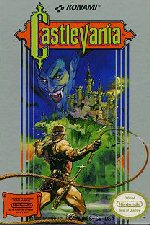
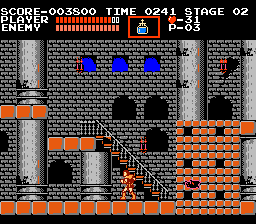
| The theme music you are currently hearing in this article is taken from one of my favorite Nintendo games, CastleVania. Images can be seen on the right. The graphics of such games may be rather simplistic by now but I think the game play of Nintendo games really made up for it. | |
|
I will not consider myself a "hard-core" gamer since I rarely have the incentive to spend time learning how to play new games. Indeed, after my bad experience playing Tiberium Sun, from the Command and Conquer Series, I told myself that I better think carefully before investing money on computer games.
Thus, Blizzard games, to me, became a guaranteed seal of quality. I have never had as much joy as playing Warcraft, Diablo and Starcraft in my university days. The only non-Blizzard game that I bought for the last 3 years was Half-Life. As smashing as Counterstrike (An add-on game to Half-Life) turns out to be in LAN-shops throughout Singapore, I never really got the thrill of playing in a full 3D environment; my head tends to get giddy most of the time. Thus, now that the sequel to Diablo is coming out this summer, all hands are on deck now to receive the game.
If I regard Starcraft as the ultimate real-time chess game, as seen in my comments here, Diablo would be the ultimate real-time Dungeons and Dragons game, a game that was such a smash when I was in Primary School.
I remember playing the first Diablo during my honors year in 1998. Yeah, I did not get it wrong, I never played Diablo when it first came out and only played it after borrowing it from my honors classmate. I thought the single player game was pretty boring but how things change when I started the multiplayer game! I got two of my honors classmates, Soon Hoe and Roger, into battle-net and I had so much fun killing the monsters with the 2 of them, and all the playing took place right smack in my second semester exams J! It was Diablo that made me realize that, the only computer games I buy from now on would be games that can be played over the Internet.
Comments on Diablo2
As good as the original Diablo was on battle-net, I thought it suffered from 2 distinct weaknesses that prevent players from cooperating. Firstly, experience earned by killing monsters are not really shared among all the members of the party. Thus, in Diablo, my sorcerer at Hell level would have no incentive to stick to the party once I realize that the monsters at that level are not immune to lightning. I would wander off by myself and unleash chain lightning like it was free, until I would find myself with loads of experience points. That strategy is not very "friendly" to the rest of your friends who also need the experience points.
Diablo 2 reconciles this by making it such that experience points are shared among party members even if one of them takes no part in the killing of monsters. Thus, my paladin can now concentrate on healing members of the party or my sorceress can now focus on freezing the monsters without worrying that I will not gain experience points. Of course, the party member that actually kills the monster does gain some more points but I think it would be insignificant.
In case you people are not really clear how the above system works, this website explains it better.
The second welcome change in Diablo 2 is that spells are no longer learned through spell books. When my sorcerer join public games in battlenet in the original Diablo, I always feel "sian" or discouraged when I see another sorcerer in the same game. This is because both of us will be competing on who gets the spell books first. Thus, again this feature ruins the fun of a good cooperating game. With Diablo 2, all spells, or skills, are learned from gaining experience levels and thus, my sorceress can now team with a few other sorceresses and unleash all kinds of spells, without any feeling of 'kiasu' (or afraid that I will lose out in English) J.
Of course, another important issue would be that of 'player-killers', where players ruin a good cooperative game by stabbing you at the back. Diablo 2 has improved from the original Diablo. Firstly, your characters are stored in battlenet itself, renders hacking almost impossible. Secondly, you cannot attack a player directly until you declare hostility in town, and then you have to travel all the way back to that player in order to kill him. All these measures will give legitimate coop players enough time to either defend themselves or to quit the game.
What my nicks would be in Battlenet
That is all I am going to say about Diablo 2 in this article, since strategies and information can be found in other web pages. Let me just conclude by saying to you people, get this game if you always love D&D, Muds, or games that involve interaction of any kind. You will not regret it, although I think your boyfriends or girlfriends might J.
| If anytime you have no one in battlenet to play with, you
can message me. Although I will be working and studying like 70-80
hours a week once I am in graduate school in the US, I will play Diablo 2 "in
my leisure time" J.
Maybe Diablo 2 will be used as a reward for me every time I finish a tough
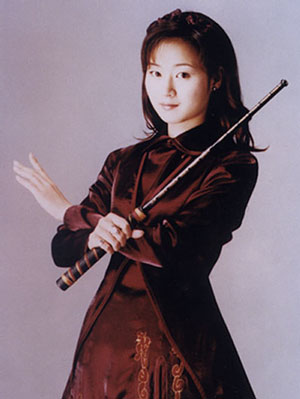
problem set or complete another page of my dissertation J. My first 2 characters that I will use will be the Paladin and the Sorceress. Guojing will be the name of my Paladin since that is the nickname most of my battlenet friends know me in Starcraft. My Sorceress's nickname would be Ma_Xiaoling J, the famous vampire hunter in My Date with a Vampire, seen on the right; I do not have a picture of Guojing since I really don't know which actor is the best J, maybe Julian Cheng? Anyway who cares about Guojing when Ma_Xiaoling looks as cool as that J? So if you want to join in my game, message any of those nicks once you are in battlenet. |
 |
Should we buy the original?
Reason 1: Multiplayer aspect
Of course, do not buy the pirated Diablo 2 for 3 very good reasons. Firstly, and most importantly, you need an authentic CD-key to enter into battlenet servers. Pirated Diablo 2 copies from a particular CD key and only 1 numeric key can enter battlenet at the same time. Trust me, no one gets the full kick from Diablo by playing single player only! You can just treat the money as paying for the multiplayer game and not just for the single player.
Reason 2: The Third law of demand
Secondly, Diablo 2 comes with 3 CD-ROMs. The price of a pirated copy of Diablo 2 would rise arithmetically with the number of CD-ROMs, from say $8 for one CD to $24 for 3 CD-ROMs (Of course, the actual price of the pirated Diablo 2 should be around $15++ I think, but you get the idea). Now, if you were to buy original, the number of CD-ROMs in the original would not cause the price to rise by the same amount, to be confirmed later. In this way, the difference in prices between the original and the pirated copies would be less significant.
While I am at this point, this is actually an economic argument; some people regards this as the "third law of demand" (See references below). Basically, it goes like this: you listen to Sammi Cheng, but you are not really a fan of her. You are currently thinking of watching her concert. Now suppose I give you 2 scenarios:
Scenario 1: The concert is held at home, which is Singapore.
Scenario 2: The concert is held, say at Hong Kong.
Let me close this model by stating the following assumptions:
Assumption 1: There are only 2 types of tickets. Ticket A allows you to sit at the back and cost, say $50. Ticket B allows you to sit close to Sammi and cost, say $100.
Assumption 2: Both tickets costs the same, when expressed in a common currency, either in Singapore or Hong Kong.
Assumption 3: The cost of flying to Hong Kong and staying there until the concert ends is $500.
Assumption 4: There is no other costs under S1 and S2.
What this third law of demand would predict is given by the following proposition:
Proposition 1: Under S2, you are more likely to purchase ticket B. Under S1, you are more likely to purchase ticket A
This may seem to be a very strong proposition, but the proof is simple: Under S2, you would have to fly to Hong Kong, incurring a fixed cost of the air-fare as well as the accommodations, which is $500 under assumption 3.
Thus, under S2, the total cost of buying ticket A becomes $550, while the total cost of buying ticket B becomes $600, after adding in both cases the fixed cost. It is easy to see in this case that, the relative price of ticket B to ticket A under scenario 2 is less, which is $(600/550), which is 1.091. Whereas in S1, this relative price is $(100/50), which is 2.
Thus, the prices of both tickets, although costs the same in absolute terms, changes relatively when we incur the fixed cost. Under S1, ticket B costs twice as much, while under S2, ticket B costs barely more (1.091) than ticket A. To put it in laymen terms, if you bother to fly all the way to Hong Kong to watch Sammi, why would you still go and buy a cheap ticket to watch her performance? You might as well buy the most expensive one J. Whereas the local citizens of Hong Kong who just live close to the concert area would not have to face this fixed cost, and thus ticket A is relatively cheaper.
A point to note, assumption 1 is crucial to this analysis. Gould and Segall (1969) has shown that, if we allow more than 2 goods, the effect here may be reversed, i.e. more would purchase the lower priced ticket. However, this analysis is still quite remarkable. Maybe I will work more on this for my dissertation, but it is such a old topic J.
If you can understand and accept the above reasoning, you can see how it applies to the case of Original vs Pirated Diablo 2. The presence of an additional 3 CD-ROMs would mean that the original Diablo 2 is now relatively cheaper than if it had been released with one CD-ROM. Thus, by the "third law of demand", we should buy the original J.
Reason 3: Blizzard's effort and seal of quality
Finally, Blizzard spend a lot of time (3 years) and money designing this game and testing it extensively. Let's just give Blizzard the support for doing such a great job in all their games. Trust me, I strongly disagree with moralistic people who call buyers of pirated software as thieves; I even wrote a letter to the Straits Times arguing why it is not the case using economics. Yet, I agree in this case that Blizzard deserves my money and I will pay for the original to support them for such great emphasis on quality.
And trust me, I don't get any money from Blizzard for saying all these things J.
References to the Third law of demand
Alchian, Armen A and William R. Allen (1972) University Economics: Elements of Inquiry, Belmont: Wadsworth, pp.70-71.
Borcherding, Thomas E and Eugene Silberberg (1978), "Shipping the Good Apples Out: The Alchian and Allen Theorem Reconsidered" The Journal of Political Economy, Vol. 86, No. 1. (Feb., 1978), pp. 131-13
Gould, John and Joel Segall (1969) "The Substitution Effects of Transportation Costs", The Journal of Political Economy, Vol. 77, No. 1. (Jan. - Feb., 1969), pp. 130-137.
Umbeck, John (1980) "Shipping the Good Apples Out: Some Ambiguities in the Interpretation of "Fixed Charge"" The Journal of Political Economy, Vol. 88, No. 1. (Feb., 1980), pp. 199-208.