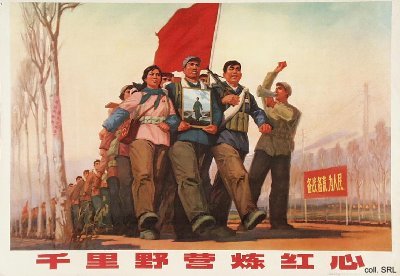
Images of the chairman with a big smile lends itself to kitschy American Coca-Cola advertisements of the 1940's and 50's. The result of the smile in Coke ads propelled the soft drink to world-wide acceptance. Coke, in itself, was a revolution, inviting the world to enjoy the drink, and buy into American capitalist/colonialism. Mao recognized the conventions behind Coke's campaign for success. Mao, essentially, became a Coke ad during the Cultural Revolution.
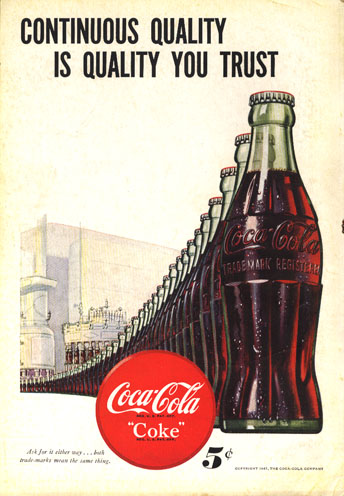
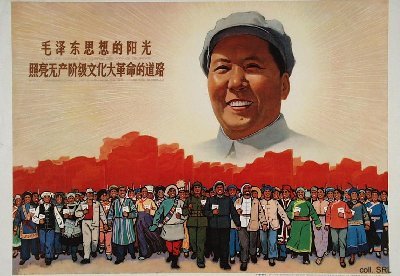 Coca Cola locates it's pride in "Continuous Quality". Imagery of bottles lined up single file, suggesting a marching military, is testament to the sameness one can hope to find in every bottle. Much Like Mao's "correct thought" which strove to churn Chinese people out of an ideology (factory) of sameness.
 The iconic factory appeared in revolutionary posters in China, Russia and Cambodia. Although it symbolized prosperity and mass production, the factory was the catalyst for mass starvation and death. The great majority of peoples who died during the Communist revolutions of the far East did so, not because of executions but because of a forced shift from agricultural production to the factory sphere. The below image has a faint outline of a smokestack in the background. Pol Pot of Cambodia dreamed of having his country littered with towering bellows of production. In China, like in Cambodia, millions of people died because they no longer worked the fields, thus food production came to a halt. It seems ironic that a marching army of correct thought parades past its death, the factory, in an image promoting health, unity and a future of certainty.