Penang, is made up of a 280 square kilometer island in the Straits of Malacca , and a strip of land about 48 kilometers wide, called Seberang Prai on Peninsular Malaysia.
Penang, or Pulau Pinang, as it is known in Malay, is famous for its lush natural beauty and heritage. With it's golden palm lined beaches, the wild rainforest, the azure seas; it's Chinese and Indian towns, Malay kampungs, colonial homes and bustling city, it is not difficult to see why Somerset Maugham found inspiration here for his writing on South East Asia. Where else can one find exotic Chinese and Indian temples, dignified mosques and churches all within a few blocks of each other?
A Brief History
In the early 17th Century, English merchants formed the English East India Company to safeguard their profitable trade with China. For their trade to further flourish, an English port needed to be established between India and China.
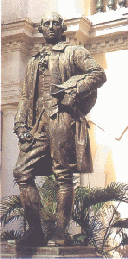
Sitting on the eastern side of the Bay of Bengal was a strategic and largely uninhabited island , Pulau Pinang, (the island of the betel nut), part of the dominion of the Sultan of Kedah. This island was aquired on behalf of the East India Company as a naval and trading base, by a private trader, Francis Light in 1786. Light persuaded the Sultan of Kedah to cede Penang to the British in return for $10,000 annually and a promise of military assistance against his enemies, namely the Siamese.
Light hoisted the Union Jack on 11 August, 1786 and named the place Prince of Wales Island, in honour of the future King George IV. The islands new capital, Georgetown, was named after the reigning British monarch, George III.
A further treaty was negotiated with the Sultan of Kedah in 1790 for the concession of a strip of land on the mainland known to the Malays as Seberang Prai. It was renamed Province Wellesley, after the governor-general in India at the time.
Much of Penang's appeal to traders was due to the fact that Penang was an open, duty-free port. Unlike their Dutch competitors in the region, who pressed for trade monopolies and instituted trade duties, the British were more concerned with maintaining alliances with the regional powers than with controlling and profiting from Malaysian trade. Their primary interest in Penang was that it serve as a safe stopover for British ships plying the far more profitable China trade. To stimulate Penang's growth, superintendent Francis Light allowed immigrants to claim whatever land they could clear. Within a couple of decades, Penang attracted more than 10,000 settlers and traders from the Malay Archipelago, Sumatra, India and especially China.
In 1832, Penang , along with Malacca and Singapore, became Crown Colonies and formed the Straits Settlements, until the Japanese conquest in 1941. With the advent of the Second World War, the Straits Settlements and Malaya (as Malaysia was known then) fell into the hands of the Japanese and were occupied for the next three years, until the Japanese surrendered to the British Allied Forces in 1945. In 1957, Penang, along with Malaya secured her independence from the British and became the Federated States of Malaya. Later, in 1963, Penang became one of the 13 states of Malaysia.

 E-mail Addresses