The Thames Path
from Hampton Wick
Hampton Wick to Walton On Thames
Hampton Wick to Richmond, Kew and Chiswick
Putney to Chiswick, the Boat Race course
External Links
The Thames Path has been widely documented, both in print and
on the internet, all the way from the source of the River Thames to it's
estuary. My purpose in this web page is to document the path local to Hampton
Wick and I was prompted to do this because I am sometimes asked by other cycle
users, whether it is possible to ride into London from Hampton Wick. It is and I
will describe the route between Walton On Thames and Putney. It is not my
purpose to relate too much about the history of the area because, as far as the
Thames Path is concerned, history tends to be made on the far bank, where the
buildings are.
The Thames Path, Hampton Court to Walton-On-Thames - Exceptional new site, which is far more extensive than it appears. Use the F11 key to view the large photos shown by clicking on the thumbnail photos illustrating this site.
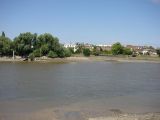
Hampton Wick to Walton On Thames. We start at the Hampton Wick end of Kingston Bridge and
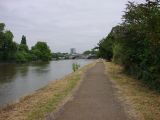
go south, down the tarmac road, onto the barge walk on the Middlesex bank and
start towards Hampton Court. The surface is fair to good. Soon we see St
Raphael's Catholic Church on the far bank, built in the 1860s, in Italianate
style. We pass an island called Raven's Ait, classed as a training ship during
the war, and which the Germans claimed to have sunk with torpedos. After
Raven's Ait, cycle users are now required to take to the upper path, which is a
shame because the lower path is probably a unique relic of the old military
track, dating from the Napoleonic Wars. We see opulent houses on the far bank,
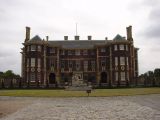
pass the racing punt club and come out at Hampton Court Palace which we can view.
We conduct our bikes south over Hampton Court Bridge, a modern construction, and turn right to Molsey
Lock on the Surrey Bank. The toilets here are moderately ok. We pass Molesey Boat
Club, with a plaque proclaiming the Olympic success of two members, the Searle
Brothers. A memorial is dedicated to writer R. C. Sherriff, who
lived in Hampton Wick. behind the memorial we can see substantial iron gates,
part of Hurst Park Race Course, discontinued in the early sixties. If we stop
when we reach the open ground and sit opposite the grey house, we can see the
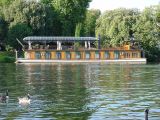
house boat that belonged to music hall star, Fred Karno, the villa built by
actor David Garrick and Garrick's Temple to it's left. Further left, we see
Hampton Church.
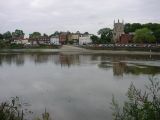
Stopping opposite the church we are able to read from some excellent plaques, erected by the local
population. In particular, note the first British balloon ascent, by James Saddler. The
site of that ascent is now the local football ground. To the left, on the far
bank we can see the buildings of the old Chelsea Water Company. We pass a
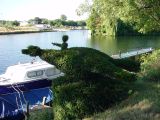
wonderful piece of topiary - a boy riding a bird, then Cherry Orchard Road,
where Hampton Wick artist, Katie Blackmore, once had a studio. To the right there are
fine houses on Sunbury Island. The red building behind is the Salvation Army
Headquarters.
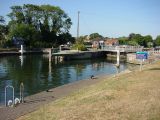
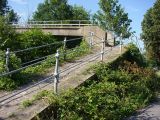
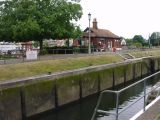
We continue to Sunbury Lock, where we see a curiosity - a bridge with stone slopes instead of steps.
This was to enable working horses to cross the bridge. As we get towards Walton
On Thames, the route becomes more busy. Just after the Thames Valley Skiff Club,
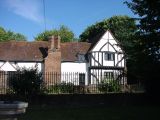
we can turn left into a tarmac road. Turn right and there, behind a pub, we see
a wonderful 14th Century manor house in a fine state of preservation. Were we to
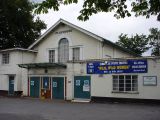
venture into Walton On Thames, we could see the Playhouse Theatre, all that
remains of the premises of film pioneer Hepworth. The building was an electrical generating house.
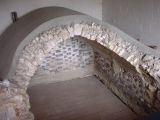
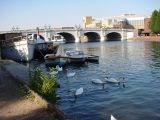
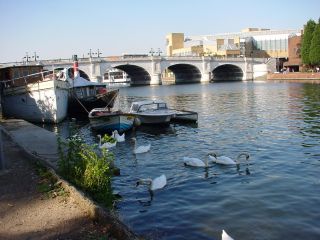
Hampton Wick to Richmond - then on to Kew and Chiswick. We conduct our bikes from Hampton Wick across Kingston Bridge on the cycle path opposing the traffic flow. We can proceed down a slope in front of the retail shop and turn right, under the bridge. Immediately, we are able to look through glass at the undercroft of a medieval building.
We proceed toward Kingston Railway Bridge. The large blue boat opposite is a converted Thames coal barge. We pass through Canbury Gardens, along a tarmac road, then follow the marked cycle route. We immediately pass a sports ground which was once the air strip where aviation pioneers Tommy Sopwith and Harry Hawker flew their planes from 1912 to 1920. We pass Trowlock Island and arrive at Teddington Lock. The path to Richmond is indifferent in parts, with a poor surface, largely enclosed by trees. I think you should wear protection against getting insects in your eyes. At one part one can glimpse Eel-Pie Island, famous or infamous for it's part in the 60s rock scene. This part of the path could be avoided by going across the Ham Lands and going by road to Petersham.
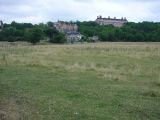
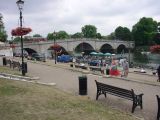
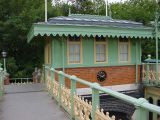
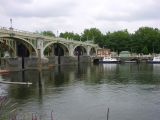
There we encounter Ham House and find views across Petersham Meadows to Richmond Hill and the famous Star And Garter Home for disabled servicemen. There are reasonable toilets at the far end of Petersham Meadows. After passing a huge plane tree, we arrive at Richmond Bridge, where we find a lot going on. I diverted to photograph a bronze sculpture by local artist, Christine Byron. We pass by the site of Richmond Palace, built by Henry VII, in 1501. We soon pass under the Art Deco, Twickenham Bridge. Old Deer Park is on our right and can be reached via a quaint bridge. Another famous venue, The Craw-Daddy, was over to the back. We see the marvellous old Thames Barrier, built in 1894. Nowadays we can cross free of charge, but the presence of a turnstile office indicates that pedestrians once had to pay.
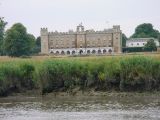
We follow a fairly plain trail, on a rough path, towards Kew. We see Isleworth Old Town and pass Syon House, some way back from the far bank, and Kew Gardens, close at hand.
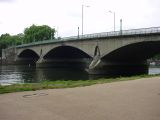
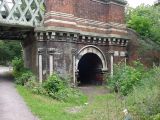
We now pass under Kew Bridge and view the famous Strand On The Green, on the opposite bank. We pass under the rail bridge with it's surprisingly ornate support, and on to Chiswick Bridge.
Putney to Chiswick Bridge, the Varsity Boat Race Course. Putney is the lowest point on the Thames Path that we can find unbroken sections in the London Area. I started at the south side of the bridge and walked down behind the old Star and Garter Hotel. From this point the arch of the new Wembley Stadium can be seen in the far distance.
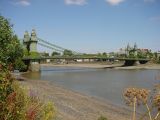
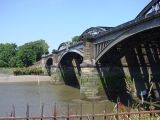
The tarmac road gives way to a good quality path partially enclosed by trees. The wetlands centre is at our side. We encounter the wonderful Harrod's Furniture Depository, then Hammersmith Bridge.
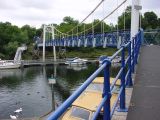
We pass under Hammersmith Bridge, where the path becomes rougher but is wide and passes between trees. We are able to view Old Chiswick and Chiswick Eyot. We head on to Barnes, where the path runs alongside Lonsdale Road, but is safely separate.
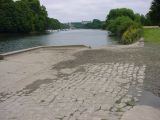
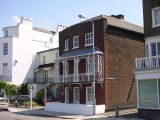
We encounter Barnes Railway Bridge and, just before it, The House Where Gustav Holst was living, when he wrote "The Planets". The track then varies in width and quality and includes sections of old and new cobbles.
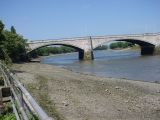
We arrive at Chiswick Bridge, just beyond which, on the far bank, we can view the Westminster Boathouse, used at the end of the Oxford and Cambridge Boat Race.
The Thames Path, online guide
The Thames Path National Trails
The Thames Path A Walking Guide
thames-path.org
Thames Path, The Ramblers Association
Thames Path Project
Thames Path Britain Express
Thames Path London
Urban75 walk from Hampton Court to Hampton Wick
Urban75 walk from Putney to Hammersmith