Kuala Lumpur
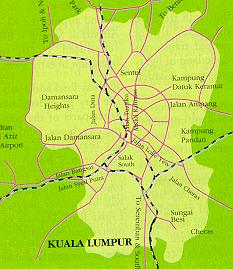 Kuala
Lumpur, a city covering 243.6 sq. km. and house to a population of 1.3
million people. Situated on the west coast of Peninsular Malaysia,
just about midway between north and south and approximately
35 kilometres from the coast, it experience rainfall throughout the year,
the average being about 220 mm. The days are generally hot and humid but
the nights are pleasantly cooler.
Kuala
Lumpur, a city covering 243.6 sq. km. and house to a population of 1.3
million people. Situated on the west coast of Peninsular Malaysia,
just about midway between north and south and approximately
35 kilometres from the coast, it experience rainfall throughout the year,
the average being about 220 mm. The days are generally hot and humid but
the nights are pleasantly cooler.
 Kuala
Lumpur, which is also the capital of Malaysia, functions as the centre
of Malaysia's political, commercial and social life. It is a city of delightful
contrasts - a combination of modern cosmopolitan. Sophistication and lingering
old world charm; a juxtaposition of gracious colonial edifices, pre-war
shophouses and gleaming copper- domed roofs against a backdrop of towering
skyscrapers. Narrow streets of quaint old shophouses open out to wide open
tree-lined avenues. The favourable climate accounts for the lush greenery
and profusion of tropical blooms in a riot of colours - a truly fitting
background for its happy mix of multi-racial populace of Malaysia, Chinese,
Indians and other races. The end result is a unique blend of age-old customs
and traditions: colourful festivals, gay songs and dances and a rich variety
of foods to tempt the palate. Experience the multi-faceted fascinations
of Malaysia - rig here in Kuala Lumpur.
Kuala
Lumpur, which is also the capital of Malaysia, functions as the centre
of Malaysia's political, commercial and social life. It is a city of delightful
contrasts - a combination of modern cosmopolitan. Sophistication and lingering
old world charm; a juxtaposition of gracious colonial edifices, pre-war
shophouses and gleaming copper- domed roofs against a backdrop of towering
skyscrapers. Narrow streets of quaint old shophouses open out to wide open
tree-lined avenues. The favourable climate accounts for the lush greenery
and profusion of tropical blooms in a riot of colours - a truly fitting
background for its happy mix of multi-racial populace of Malaysia, Chinese,
Indians and other races. The end result is a unique blend of age-old customs
and traditions: colourful festivals, gay songs and dances and a rich variety
of foods to tempt the palate. Experience the multi-faceted fascinations
of Malaysia - rig here in Kuala Lumpur.
In 1857, a group of tin-miners led by a Bugis
chief, Raja Abdullah, landed at the confluence of the Klang and Gombak
rivers in search of tin; an event that marked the beginning of a city whose
early development was closely tied up with a flourishing tin-trade and
the able leadership and foresight of the Chinese chieftain, Yap Ah Loy.
It began as a small trading post and meeting place for miners from the
newly discovered tin-mines upriver. Soon after, a small town of attap huts
grew around the trading post and as the tin trade prospered, the town developed.
Then came British intervention and the formation
of the Federated Malay States in 1896. Kuala Lumpur became its capital.
As the seat of British administration in the Malay States, Kuala Lumpur
inherited from this period in its history, a system of roads and the fine
examples of gracious colonial architecture which are still evident today.
When the Federation of Malaya gained its independence
in 1957, Kuala Lumpur was declared the Federal capital. In 1972, it achieved
city status. At the same time, it also remained as the capital of the state
of Selangor, a status it attained in 1887.
However, on the 1st of February 1974, it was officially
declared a Federal Territory in a colourful ceremony full of pomp and pageantry
which also marked the end of Selangor's jurisdiction over Kuala Lumpur.
Kuala Lumpur as it is known today, bears little
resemblance to its humble beginnings. It has emerged from the troubled
early years - the disastrous floods, the Japanese occupation and the Emergency
- to become the most developed city in the country, setting a fast pace
for others to follow. But the endearing old world charm remains within
its lush atmosphere of a garden city in full bloom.
Places of Interesting
Merdeka Square
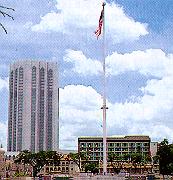
MERDEKA SQUARE, the scene of the annual celebration
of Independence, marks a significant moment in the country's history,
Formerly the venue for Cricket, Hockey, Tennis and Rugby matches, the field
fronting the Selangor Club has been returfed and transformed into an attractively
laid out Square, to commemorate the country's Independence. At the southern
end of the square is the world's tallest flagpole (100metres), majestically
flying the national flag.
On the turf, a flat, round black marble plaque
marks the very spot where the Union Jack was lowered at midnight on August
30, 1957 and the Malayan flag hoisted up for the first time to the resounding
cries of `Merdeka'.
Sultan Abdul Samad B'ldg
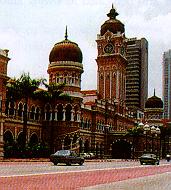
Across the road is the famous SULTAN ABDUL SAMAD
BUILDING. Moorish in design, the building, which was completed in 1897
served as a Government administrative building. It now houses the
Supreme and the High Courts. The clock tower, affectionately dubbed `Big
Ben' is a favourite with photographers.
Memorial Library
At Jalan Raja housed within a the KUALA LUMPUR
MEMORIAL LIBRARY. It serves as both a public library and resource centre
to provide reference materials and information on the city. Also on display
is a permanent exhibition on the city.
Tunku Abdul Rahman Memorial
The TUNKU ABDUL RAHMAN PUTRA MEMORIAL, located
at Jalan Dato' Onn, is dedicated to the memory of Malaysia's first Prime
Minister, YTM Tunku Abdul Rahman Putra, who is also known as Malaysia's
"Father of Independence". Housed in a sprawling complex consisting of three
main buildings, the memorial offers visitors a deeper insight into the
life of a respected world leader and his legacy that continues to inspire
the present generation.
National Planetrarium
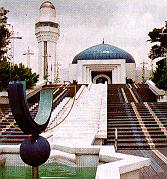
The NATIONAL PLANETARIUM is located at the Lake
Gardens and is surrounded by the National Mosque, National Museum and the
Bird Park. Among the attractive facilities that can be found are the Space
Theater, Space Science Exhibition, Theatrette, Resource Centre, Viewing
Gallery and Ancient Observatory Park. The Space Theater presents two kind
of shows, the Space Science Show and Sky Movie. The National Planetarium
is closed on Monday, Tue-Friday(10.00 am - 7 pm) Closed on friday from
noo to 2.30 pm. irst space show at 11 am
Admission : Space Science Show - RM 3 (A) RM 2(C);
Space Movie - RM 6 (A), RM 4 (C); Exhibition - RM 1 adult, children enter
free
Masjid Jamek
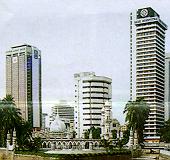
At the confluence of the Gombak and Klang Rivers,
where miners in search of tin first landed at Kuala Lumpur, is the beautiful
MASJID JAMEK with its Indian Muslim inspired style of architecture featuring
onion shaped domes, numerous arched colonnades and shiny marble floors.
Built in 1909, the red-brick structure was designed by A.B.Hubback
Kuala Lumpur Textile Museum
Located along Jalan Sultan Hishamuddin is Textile
Museum, an information centre for Malaysia handicraft, housed within a
beautifully renovated old Moorish styled building.
The centre provides details on cultural background,
current research developments and export potential. The gallery contains
a fascinating range of selected items on permanent display. Attractive
souvenirs ingeniously fashioned out of local materials are also available
for purchase.
Dayabumi
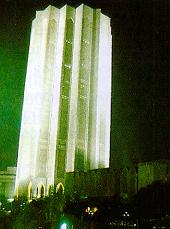
The adjoining multi-storey complex towering over
the area is DAYABUMI. The massive white modern complex was designed to
blend in with the pervading Moorish-Byzantine atmosphere of the earlier
establishments providing an excellent example of the marriage between modern
technology and ancient cultures. It houses a shopping mall, offices and
the General Post Office.
National Mosque
From the Dayabumi, an underground passage leads
to the NATIONAL MOSQUE across the road. Its unique modern design embodies
a contemporary expression of traditional Islamic art calligraphy and ornamentation.
Its most striking feature is the multi-fold umbrella like roof which symbolises
the aspirations of an independent nation. Also prominently featured is
the 73-metre minaret, sleek and stylish against the Kuala Lumpur skyline.
Islamic Center
For a fascinating insight into the Islamic religion,
walk across to the imposing ISLAMIC CENTER, ingeniously built into a hillside
behind the Malayan Railway Administrative Building. The gleaming white
structure reflects the successful combination of modern cubist architecture
and traditional Islamic design. It serves as a centre for Islamic learning,
culture and art. On display is a fine collection of Islamic texts and artifacts,
porcelain and weaponry.
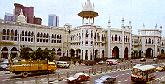
Malayan Railway Building
The MALAYAN RAILWAY ADMINISTRATION BUILDING and
KUALA LUMPUR RAILWAY STATION provide further examples of Moorish
inspired architecture. Once again architect A.B.Hubback continued to feature
arches, domes and minarets with relish, creating what has come to be described
as a Byzantine Arabian nights fantasyland. Built in 1910, it underwent
extensive renovations in 1986 which also linked it to the General Post
Office at Dayabumi. The Station Hotel with its cavernous restaurant, has
become something of a legend.
Central Market
A bridge across the Sungai Klang links the Dayabumi
Complex to the CENTRAL MARKET. A former wet market turned cultural
centre, it is a haven for local artists and craftsmen. The shops and stalls
within the extensively renovated building offer a heady variety of
antiques, Asian artifacts, curios, souvenir items and handicrafts. Portrait
artists and small-time craftsmen set up shop in various corners and proceed
to work, oblivious to the stares of curious onlookers. The riverside amphitheatre
outside is the venue for regular performances of traditional and contemporary
dances and musical concerts.
Central Square
Next door is CENTRAL SQUARE which houses a Cineplex,
antique and souvenir shops, fast food outlets and restaurants. The complex
is an extension of the development concept embodying the Central Market
project and involved the rehabilitation of a row of old pre-war shophouses.
Petaling Street
A short distance away is PETALING STREET, the
heart of KL's CHINATOWN and one of the premier shopping areas in the city
with its distinctly oriental atmosphere. At the end of the street is the
CHAN SEE SHU YUEN TEMPLE which dates back to 1906. The interior of this
highly stylised building features open courtyards pavilions, intricate
carvings and paintings. Outside, elaborate glazed ceramic sculptures grace
the facade and roof ridges.
Sri Mahamarimman Temple
The SRI MAHAMARIAMMAN TEMPLE at Jalan Tun
H.S.Lee, is close to Chinatown. Built in 1873, the temple is said to be
the most ornate and elaborate Hindu temple in the country. The design and
decorative features include intricate carvings of Hindu deities, gold embellishments,
precious stones and hand-painted motifs. Exquisite Italian and Spanish
tiles provide further ornamentation. A silver chariot housed within the
premises features prominently in religious processions, transporting the
statue of the deity through the city streets.
Istana Negara
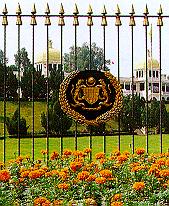
ISTANA NEGARA, the official residence of
the king is located on a hillock at Jalan Istana. The formal grounds is
enhanced by immaculate lawns and formal gardens ablaze with blooms. A lily-
filled pond contributes to the serene atmosphere. The palace is also the
venue for official functions and ceremonies.
Back
Next