 Over the centuries, as trade
links were established with Asian and European countries, new ingredients
and cooking styles were introduced, modified and incorporated into indigenous
Thai cooking.
Over the centuries, as trade
links were established with Asian and European countries, new ingredients
and cooking styles were introduced, modified and incorporated into indigenous
Thai cooking.
Fish and rice, which are naturally abundant in the waterways and vast paddy fields of Thailand, have remained as basic ingredients of the Thai diet since the existence of the first independent Thai kingdom of Sukhothai in the 13th century.
Over the centuries, as trade
links were established with Asian and European countries, new ingredients
and cooking styles were introduced, modified and incorporated into indigenous
Thai cooking.
These influences were diverse, originating from China, India, Portugal and Persia. Even the ubiquitous chilli was believed to have been brought in by Portuguese traders in the 16th century.
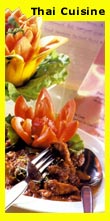
Thai cooking, in general, is a blend of the spicy, sweet, sour and salty, although sometimes one flavour prevails.
Sauces and condiments usually include Ham Ala (a salt substitute made from fermented fish), Ham prik (nam pla with chopped chillies and other ingredients), crushed dried chillies, pickled garlic, cucumbers, tomatoes and spring onions.
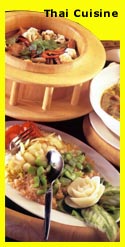
When dining Thai, a large container of rice is usually placed at the centre of the table, surrounded by condiments and other dishes, which might include a soup, curry, salad, a fried dish and a steamed dish.
 Diners are free
to help themselves to any dish. The soup and salad can therefore be eaten
at either the beginning or the end of a meal.
Diners are free
to help themselves to any dish. The soup and salad can therefore be eaten
at either the beginning or the end of a meal.
Among the most widely-known Thai dishes are tom yam goons (spicy prawn soup with lemon grass), gaeng Peon wan gal (green chicken curry) and gal bar bai tory (chicken fried in pandan leaves).
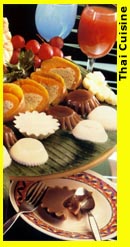
Dessert is usually served after all other dishes have been removed. Fresh local fruits are common, although takaw (a confection of tapioca flour, sugar and coconut served in a banana leaf cup) may also be served.
Thai 'palace cooking', meanwhile, is a refined art practiced in royal and aristocratic households, which involves lengthy hours of food preparation as well as artistic skills in food presentation.
'Palace food' has the most subtle nuances of taste and is noted for its visual appeal, usually The rich cultural diversity of Indonesia, the world's largest archipelago, is reflected in its cuisines, which have drawn inspiration from Malaysia, Thailand, China, India, the Middle East and Europe.
Some of Indonesia's eastern islands were the original 'Spice Islands', where clove and nutmeg grew in abundance.
 While each region
in Indonesian has its own distinct cuisine, an Indonesian meal usually
comprises rice as its basis, accompanied with side dishes of meat, poultry,
fish, vegetables, krupuk (prawn crackers) and a pungent sambal (a spicy
condiment made with chilli, onion, lime, oil and vinegar).
While each region
in Indonesian has its own distinct cuisine, an Indonesian meal usually
comprises rice as its basis, accompanied with side dishes of meat, poultry,
fish, vegetables, krupuk (prawn crackers) and a pungent sambal (a spicy
condiment made with chilli, onion, lime, oil and vinegar).
Food is flavoured with spices such as coriander, cumin, peppercorns, as well as roots, herbs and seasonings.
The Chinese influence on Indonesian cuisine is evident in the use of mie (noodles), taugeh (beansprouts) and Recap manis (soy sauce added with sugar), while the Indian influence is seen in the use of curry powder.
Dutch colonists in the 17th century developed the rijsttafel, an elaborate adaptation of the Indonesian style of serving rice with side dishes and condiments.
A total of 20 or more dishes would be arranged around a large plate
of spiced rice. Dishes could include satay (barbecued meat on skewers),
fried beef, curried chicken, shrimps and scrambled eggs.