 During that
time, mixed marriages between Chinese immigrants and local Malays produced
a unique culture. Their descendants, the Straitsborn Chinese, were known
as peranakan - the ladies were called nyonyas and the men babas.
During that
time, mixed marriages between Chinese immigrants and local Malays produced
a unique culture. Their descendants, the Straitsborn Chinese, were known
as peranakan - the ladies were called nyonyas and the men babas.
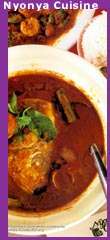
Nyonya food, also referred to as Straits Chinese food or Lank Embok Embok, is an interesting amalgamation of Chinese and Malay dishes thought to have originated from the Malaysian State of Malacca over 400 years ago.
During that
time, mixed marriages between Chinese immigrants and local Malays produced
a unique culture. Their descendants, the Straitsborn Chinese, were known
as peranakan - the ladies were called nyonyas and the men babas.
Straits settlements were also set up in Singapore and Penang. Over the years, however, distinct differences evolved in nyonya cooking found in Malacca and Singapore than that found in Penang.
The proximity of Malacca and Singapore to Indonesia resulted in an Indonesian influence on the nyonya food there. Malacca nyonyas prepare food which is generally sweeter, richer in coconut milk, with the addition of more Malay spices like coriander and cumin.
The Penang nyonyas, meanwhile, drew inspiration from Thai cooking styles, including a preference for sour food, hot chillies, fragrant herbs and pungent black prawn paste.
 Influences aside,
nyonya recipes are complicated affairs, requiring hours of preparation.
Nyonya housewives of the past would spend the better part of their lives
in the kitchen, but they were fiercely proud of their unique cuisine, preferring
nyonya food to any other type of food.
Influences aside,
nyonya recipes are complicated affairs, requiring hours of preparation.
Nyonya housewives of the past would spend the better part of their lives
in the kitchen, but they were fiercely proud of their unique cuisine, preferring
nyonya food to any other type of food.
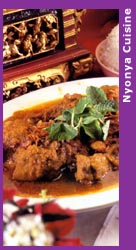
Nyonya recipes are usually spicy, employing pungent roots like lengkuas (galangal), turmeric and ginger; aromatic leaves like daun pandan (screwpine leaf), daun limau purut (fragrant lime leaf) and daun kesum (polygonum or laksa leaf); together with other ingredients like candlenuts, shallots, shrimp paste and chilliest
Lemon, tamarind, belimbing (carambola) or green mangoes are used to add a tangy taste to many dishes.
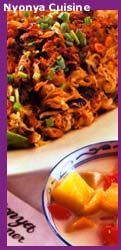
At the end of a nyonya meal, fruits are seldom served for dessert, but instead replaced by cakes.
Nyonya cakes are rich and varied, made from ingredients like sweet potato, glutinous rice, palm sugar and coconut milk.
 In the past,
festive occasions like weddings, birthdays and other ceremonial events
would provide opportunities for young nyonyas to sharpen their cooking
skills. Unwed nyonyas were expected to be well-trained in cooking and sewing,
if they intended to increase their chances of being matchmade with rich
and respectable babes
In the past,
festive occasions like weddings, birthdays and other ceremonial events
would provide opportunities for young nyonyas to sharpen their cooking
skills. Unwed nyonyas were expected to be well-trained in cooking and sewing,
if they intended to increase their chances of being matchmade with rich
and respectable babes
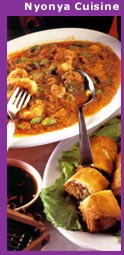
A famous nyonya wedding dish is jantung pisang, made with the heart of the banana bud, coconut creme, chillies, shrimp paste, lemon and belimbing. Heepeow (fish and meatballs in a rich sauce) is usually served for lunch.
Special nyonya dishes are prepared to mark auspicious occasions. For example, nasi kunyit (yellow rice) with hard-boiled eggs coloured red, is distributed by a nyonya to her friends and relatives to celebrate when her baby is one month old. This practice also marks the lifting of restrictions imposed on mother and child during the one-month period.
 Another special
rice dish is nasi lemak (coconut rice), which a nyonya mother-in-law would
present to the mother of her son's bride 12 days after the wedding, to
acknowledge that the bride was a virgin.
Another special
rice dish is nasi lemak (coconut rice), which a nyonya mother-in-law would
present to the mother of her son's bride 12 days after the wedding, to
acknowledge that the bride was a virgin.
An interesting nyonya dish served during Chinese New Year is ayam siyow
(chicken in tamarind sauce). During the festivities, shops and markets
would be closed for four consecutive days. As there were no refrigerators
in their homes at the time, the nyonyas would buy several chickens, then
cook the chickens with spices and use tamarind to preserve the meat. The
ayam siyow dish could then be served during any meal.