Malay Cuisine
Malay cuisine has always been an intrinsic part of Penang and is therefore,
one of the island's most popular cuisines. Historically, the island of
Penang was once owned by the Sultanate of Kedah and was "founded" by Sir
Francis Light in 1786.
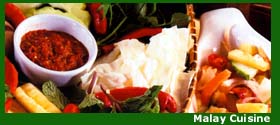 Throughout the
years, Malay cuisine has played a most important role in establishing Penang
as a regional "food paradise". Today, you can find Malay cuisine served
anywhere, at any time of the day, be it at air-conditioned restaurants
or at roadside stalls.
Throughout the
years, Malay cuisine has played a most important role in establishing Penang
as a regional "food paradise". Today, you can find Malay cuisine served
anywhere, at any time of the day, be it at air-conditioned restaurants
or at roadside stalls.
Variety is the spice in Malay food. The traditional culinary style has
been greatly influenced by the long-ago traders from neighbouring countries
like Indonesia, India, the Middle East and China. Malay food is often described
as spicy and flavourful and utilises a melting pot of spices and herbs.
Ingredients commonly used in Malay cooking include serai (lemon grass),
daun pandan (screwpine leaf) and daun limau purut (fragrant lime leaf/kaffir
lime leaf). Fresh herbs are often used, such as daun kemangi (a type of
basil), daun kesum (polygonum or laksa leaf) nutmeg, kunyit (turmeric)
and bunga kantan (wild ginger buds).
Traditional spices such as jintan putih (cumin) and ketumbar (coriander)
are used in partnership with Indian and Chinese spices such as pepper,
cardamom, star anise and fenugreek.
Seasonings play an important role in Malay cooking and they often enhance
the food taste and flavours. Many of the seasonings are not dried spices
but are fresh ingredients such as fresh turmeric, lengkuas (galangal),
fresh chilly paste, onions and garlic. Fresh seasonings and dried spices
are normally pounded to make a fine paste and cooked in oil. Fresh coconut
milk is often added.
In Penang, the Malay cuisine shows distinct Thai influences where a
tangy and fragrant sourness is often added by the use of tamarind, sour
carambola and limes. Fiery hot chillies are very popular.
Fish is most popular in Malay cooking, as is with other seafood such
as shrimps and sotong (squid). Beef and mutton are very popular choices
but never pork as this is against their religious beliefs. The other popular
white meat is chicken.
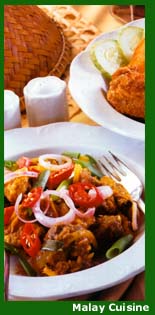 The staple diet
in any Malay meal is white rice, which is often served for breakfast, lunch,
dinner and supper, too. Most meals are eaten by using your fingers, and
eating utensils are kept to a minimum. All dishes are served at the same
time, accompanied by a refreshing drink.
The staple diet
in any Malay meal is white rice, which is often served for breakfast, lunch,
dinner and supper, too. Most meals are eaten by using your fingers, and
eating utensils are kept to a minimum. All dishes are served at the same
time, accompanied by a refreshing drink.
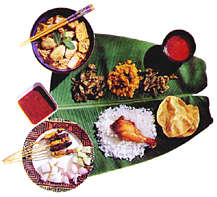
Nasi lemak (rice in coconut milk) is a typical Malay dish, which can
served at any time of the day and is readily available at any restaurant.
Rice is cooked in fresh coconut milk, with pandan leaves which gives it
a fragrant smell. It is usually accompanied by fried peanuts, sliced cucumber
and a curry dish.
One of the most unique Malay dishes is the roti jala (lacy pancakes)
which sometimes replaces the staple rice. Roti jala is an ideal accompanishment
to any dish with lots of rich gravy and is often served during special
occasions. It is made from a mixture of plain flour and eggs, with a pinch
of turmeric powder and butter.
Satay is another popular Malay dish, and is easily found throughout
Penang, especially at roadside stalls. Not unlike kebabs, pieces of marinated
chicken or beef are skewered and cooked over a charcoal fire where they
are periodically brushed over with oil. The skewered meat is then served
hot, accompanied by a special peanut sauce.
Rendang daging is also a popular choice. This rich and fragrant curry
dish features beef cooked to melting tenderness in a fragrant, coconut
gravy.
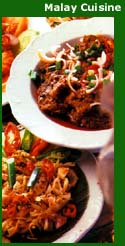 Other popular
Malay dishes include the sambal udang (spicy prawn dish), ikan asam pedas
(spicy and sour fish curry), sup ekor lembu (oxtail soup), sambal ikan
bills (anchovies in a spicy condiment), ayam masak merah (chicken in thick
red sauce) and ayam masak tomato (chicken in a spicy tomato sauce).
Other popular
Malay dishes include the sambal udang (spicy prawn dish), ikan asam pedas
(spicy and sour fish curry), sup ekor lembu (oxtail soup), sambal ikan
bills (anchovies in a spicy condiment), ayam masak merah (chicken in thick
red sauce) and ayam masak tomato (chicken in a spicy tomato sauce).
Desserts are a must for any Malay meal. Easily available at most local
restaurants and roadside stalls, Malay desserts are invariably very sweet
and include ingredients such as coconut milk, palm sugar and flour.
 Popular options
include the kuih badak (sweet potato cake with savoury fillings), pengat
pisang (ripe bananas cooked in coconut milk and sago) and onde-onde (sweet
potato balls with palm sugar filling).
Popular options
include the kuih badak (sweet potato cake with savoury fillings), pengat
pisang (ripe bananas cooked in coconut milk and sago) and onde-onde (sweet
potato balls with palm sugar filling).
Popular Malay restaurants in Penang Eliza The Malay Restaurant at the
City Bayview Hotel The Istana in Teluk Bahang
Back