Japanese Cuinise
Penangites actually acquired a taste for all things Japanese with the
onset of the industrial companies in Penang, which has evidently been an
important factor in promoting Japanese cuisine in Penang. With the increasing
Japanese expatriates in Penang came the increasing demand for authentic
Japanese restaurants. Where there were no more than two Japanese restaurants
10 years ago, there are now many Japanese restaurants to choose from when
the craving for Japanese food hits you.
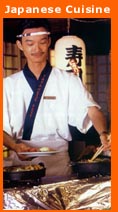 A taste for
Japanese cuisine has to be acquired, and when you have discovered its special
qualities, you are hooked for life! Most people who have been exposed to
the food of Japan do not just accept it, but become happily addicted to
the Japanese style of eating. The unique aspects of Japanese fare include
its beautiful presentation, aroma, taste, freshness and high quality.
A taste for
Japanese cuisine has to be acquired, and when you have discovered its special
qualities, you are hooked for life! Most people who have been exposed to
the food of Japan do not just accept it, but become happily addicted to
the Japanese style of eating. The unique aspects of Japanese fare include
its beautiful presentation, aroma, taste, freshness and high quality.
Unlike other Asian foods, most traditional Japanese cooking is done
in or over water, whereas other cuisines use oil as a cooking medium. Water-based
cooking gives a lightness and delicacy of flavour that is most appealing.
One of the most popular styles of cooking is steaming. This method of cooking
ensures that the pure flavours of the food as well as its nutrients are
retained. As a result, the Japanese are a slim, healthy race.
The Japanese style of cooking is simple and lacks rich spices and seasonings.
This, however, does not lessen the food taste nor flavour, but rather,
emphasises the use of basic ingredients and trains the palate to accept
and appreciate food in its most natural state.
Japanese meals are usually served on individual dishes in small servings.
Soup is served in covered Japanese lacquer bowls. Chopsticks are used to
pick up any ingredients and usually no spoons are used for any Japanese
food, except for a few dishes such as chawan mush), a savoury egg custard,
which is steamed. Chawan mushi is considered a soup in Japan, where the
egg is beaten in the cup, and added with stock, prawns and oysters.
 Japanese restaurants
in Penang offers a wide variety of traditional Japanese fare. The most
popular Japanese dishes use the basic ingredients of raw fish, seafood,
tofu (beancurd), Japanese seaweed, chicken, beef and Japanese noodles.
Japanese restaurants
in Penang offers a wide variety of traditional Japanese fare. The most
popular Japanese dishes use the basic ingredients of raw fish, seafood,
tofu (beancurd), Japanese seaweed, chicken, beef and Japanese noodles.
Seaweed may not be everyone's cup of tea but in Japanese cooking, it
is often used for flavouring rice, stock and other dishes. There are different
types of seaweed, the common ones used being mori and wakame. Tofu or soya
bean curd is the mainstay of the Japanese diet. Low in calories and high
in protein, it is served at breakfast, lunch and dinner.
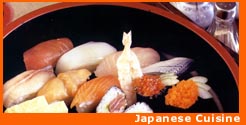
Rice is also a mainstay of Japanese cooking. Great importance is placed
in the cooking of rice, which is also the foundation for many favourite
dishes including tendon, oyaku donburi and sushi.
Noodles also form a great part of Japanese cuisine. This includes chilled
noodle dishes and buckwheat noodles. Two other important ingredients in
Japanese cooking are the essential wasabe (green horseradish) and shoyu,
a Japanese soy sauce made from tofu.
Sake (Japanese rice wine), served warm or chilled, or tea is normally
served with meals.
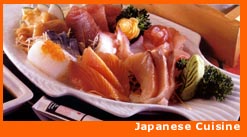
Sashimi or otsuturi Is a famous dish comprising various kinds of raw
fish. There are no strong, fishy tastes to offend because only the choicest
portions of the freshest fish are used. It is truly a dish for the connoisseur,
complemented with the dipping sauces of soy and wasabe, which adds flavour
without disguising the fish itself. The varieties of fish include the ever
popular salmon and tuna.
 Tempura is always
a favourite among many Japanese food lovers. It is a mixture of seafood
and fresh vegetable items which are dipped in an ice-cold special egg and
flour batter, then deep fried to perfection. The tempura batter is feather-light
and so thin that it is almost transparent. Although deep-fried, tempura
is not greasy. The secret lies in its mixture of corn oil, olive oil and
sesame oil, fried at the right temperature.
Tempura is always
a favourite among many Japanese food lovers. It is a mixture of seafood
and fresh vegetable items which are dipped in an ice-cold special egg and
flour batter, then deep fried to perfection. The tempura batter is feather-light
and so thin that it is almost transparent. Although deep-fried, tempura
is not greasy. The secret lies in its mixture of corn oil, olive oil and
sesame oil, fried at the right temperature.
S1'abu Shabu is the Japanese version of Mongolian "firepot" or the Chinese
"steamboat". Guests cook their own meal at the table, holding pieces of
steak and vegetables with chopsticks and dipping them into boiling soup.
Teppanyaki is also a popular choice in Japanese cuisine and in most
Japanese restaurants, you will find a room specially for the teppanyaki
counter. Teppanyaki usually features seafood, beef and chicken, thinly
sliced or cut into bitesize cubes, then cooked on a hot plate in front
of you. Seasonings and marinades are added during the cooking. Sometimes,
the chef might perform a few tricks for you with his cooking utensils.
Sukiyaki is somewhat like the "hot pot" where a combination of fresh
vegetables are cooked together with either beef or chicken. Usually, the
pieces of meat and vegetables are dipped into a bowl of raw, freshly beaten
egg which adds a distinct flavour to the meal.
Back