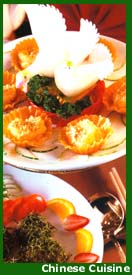
 Today, 'Penang
is widely known as one of the best places in Malaysia for its Chinese cuisine,
from the ever-popular Cantonese food to the chilli-hot cuisine of Szechuan,
Hainanese, Hokkien and Teochew cuisines are also quite popular'.
Today, 'Penang
is widely known as one of the best places in Malaysia for its Chinese cuisine,
from the ever-popular Cantonese food to the chilli-hot cuisine of Szechuan,
Hainanese, Hokkien and Teochew cuisines are also quite popular'.
Chinese food is widely recognised as being among the world's most well-known and well-loved cuisines. It is also an inseparable part of the Malaysian melting pot of culinary cultures, ever since Chinese merchants sailed across the South China Sea to trade in Malacca more than a century ago.
The mass migration from China to Malaya began in the early 1800s with the discovery of tin, which brought about an abundance of job opportunities. Chinese immigrants to Penang brought with them the cooking styles of their homeland, which were mostly from the southern provinces of Kwantung and Fukien
Today, 'Penang
is widely known as one of the best places in Malaysia for its Chinese cuisine,
from the ever-popular Cantonese food to the chilli-hot cuisine of Szechuan,
Hainanese, Hokkien and Teochew cuisines are also quite popular'.
You can feast on Chinese food almost anywhere in Penang, from fine dining restaurants in five-star hotels to open fronted local restaurants and coffee shops to roadside stalls'. Many of these restaurants and stalls are well-known for their own specialties. Any self-respecting Penangite will be able to point you to the places which serves the best stir-fried beef with ginger, the best steamed fish or the best dim sum. Through the years, Chinese cuisine in Penang has evolved into a special cuisine of its own, absorbing influences from the prevailing multi-racial society. Curry leaves used in Indian cooking are added into the cooking pot, as are western condiments such as Worchestershire and tomato sauce, as well as Malay spices.
Chinese cooking styles differ, depending on the type of cuisine and which region of China the cuisine originated from. There are primarily six styles of cooking Chinese food.
If you have seen a Chinese cook at work, you will be amazed at his skill of tossing everything up in the air, with a roaring fire heating up the wok. This method is called the stir-frying method, which is uniquely Chinese. It involves a quick toss of ingredients which are cut into small bite-size pieces in a small amount of oil. The food is usually cooked over intensely hot heat and is cooked very fast, usually in less than two minutes. This method often makes the meat tender and the vegetables crispy. Furthermore, it seals the juices inside the meat and creates a smooth and velvety texture.
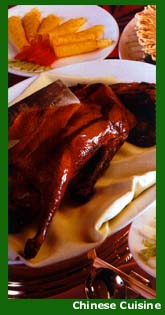 Deep-frying
is when food is immersed in hot oil until fully cooked. The two most important
things to this technique are the temperature of the oil and the timing.
If the temperature is too low or the cooking time is too short, the food
will be soggy, oily or undercooked.
Deep-frying
is when food is immersed in hot oil until fully cooked. The two most important
things to this technique are the temperature of the oil and the timing.
If the temperature is too low or the cooking time is too short, the food
will be soggy, oily or undercooked.
Shallow-frying means food is cooked in a small amount of oil over medium heat, usually in a shallow pan. It is basically easier, in that timing is less crucial and dishes are usually prepared ahead of time and kept warm in an oven for some time. It is also usually used in combination with other cooking methods.
One of the more popular styles of Chinese cooking is stewing, where food is slowly simmered in liquid in a closed pot, usually a deep saucepan or a casserole dish. Food can be stewed in either bite-sized pieces or even whole chunks. For some recipes such as the exotic double-boiled supreme shark's fin dish, ingredients can be stewed several times.
Boiling involves cooking food in boiling water, where heat is continuously applied until the food is cooked. Sometimes, the main ingredients are cooked first, then different items blended during the final boiling stage to add more flavour. The broth can be thickened by adding cornstarch paste.
Steaming food the Chinese way means that only the steam comes in contact with the food, not the boiling water. Usually, this is done in a steamer, which is like a two-tiered pot. Water is placed in the lower pot while the food is placed in the upper pot, some two or three inches above the steaming water. Just about any kind of food can be cooked in this manner. Food cooked this way is moist and never crusty.
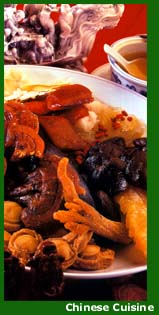 A Chinese meal
does not feature one main dish by itself, but instead offers a variety
of dishes which complement each other. This depends on the dining occasion.
A formal banquet is served in a course-by-course basis which could sometimes
stretch up to ten course dishes or more. At family meals or during informal
meals, all the dishes are placed on the table at the same time.
A Chinese meal
does not feature one main dish by itself, but instead offers a variety
of dishes which complement each other. This depends on the dining occasion.
A formal banquet is served in a course-by-course basis which could sometimes
stretch up to ten course dishes or more. At family meals or during informal
meals, all the dishes are placed on the table at the same time.
Rice is always the basis of every meal, be it plain white steamed rice or fried rice, which can be served as a dish on its own. The place setting includes a bowl, chopsticks and porcelain spoon, cups for wine or Chinese tea and a small sauce dish for dipping sauces.
There are many varieties of Chinese cuisine, which can be separated according to its place of origin or according to the various Chinese dialect groups. Five major varieties are the Peking or Shantung style, Szechuan, Hunan, Fukien and Cantonese styles.
In Penang, the different types of Chinese cuisine is largely influenced by the groups of Chinese migrants who settled on the island. Through the years, each major group adopted certain tastes and style of cooking from each other through intermarriages and experimentation. You may be surprised to find many Chinese dishes here in Penang that you may not be able to find at other Chinese restaurants in other parts of the world.
Chinese cuisine in Penang is dominated by four major dialect groups, with Cantonese being the most popular, followed by Hainanese, Hokkien, Teochew and Szechuan.
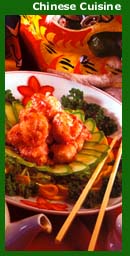 Cantonese cuisine
is most popularly known for its combination of many styles of cooking,
with an emphasis on stir-fried dishes and subtle flavours. It is normally
light, with minimal fat and oil used in its cooking. Cantonese cuisine
is also famous for its variety of soups and broths. Pork, chicken, seafood
and vegetables are the main items featured in Cantonese dishes.
Cantonese cuisine
is most popularly known for its combination of many styles of cooking,
with an emphasis on stir-fried dishes and subtle flavours. It is normally
light, with minimal fat and oil used in its cooking. Cantonese cuisine
is also famous for its variety of soups and broths. Pork, chicken, seafood
and vegetables are the main items featured in Cantonese dishes.
In Penang, there are many restaurants and coffeeshops where they excel in Cantonese dishes like Tai Tung Restaurant in Cintra Street opposite Fu Heong Restaurant (renowned for their stir-fried noodles), and Tho Yuen in Lebuh Campbell. You should try the varieties of soups served at these restaurants, as a meal is never complete without soup. Besides the usual meat like pork and chicken, you could be a little more adventurous and opt for turtle or pigeon soup, boiled with traditional Chinese herbs.
Cantonese cooking is also known for its varieties of steamed dumplings, known the world over as dim sum. You can savour these delightful dumplings almost anywhere in Penang. Dim sum is usually served as breakfast where you can linger away the morning sipping fragrant Chinese tea. Some outlets also serve dim sum for lunch. One of the more famous dim sum coffeeshops is the Hong Kong Tea House at Jalan Macalister. Authentic Hong Kong dim sum specialities are also available at several Chinese restaurants at leading hotels.
Hainanese cuisine is lighter, with mild seasonings. Famous items include noodles and dumplings. In Penang, typical Hainanese fare can be found at the restaurant located at the Penang Senior Citizen's Association premises at Scott Road where you will find mee sua tan (rice noodles soup) and deep-fried spring rolls with special "east meets west" dipping sauces.
You must also try the roti babi where the dumplings or buns are stuffed with shredded vegetables and shrimp meat and then deep-fried until golden brown. Other popular Hainanese dishes are the inche kabin (roast chicken), Hainanese fried bee boon (rice noodles) and of course, the famous Hainanese chicken rice, which can be found at almost any coffeeshops in Penang.
One particular trait of Hainanese cooks in Penang is their deft hand in preparing western-style dishes as well. Penangites know them for their special ways in preparing items like chicken chop, fish and chips and roast chicken. Other place famous for Hainanese food are the Hollywood Restaurant in Jalan Tanjung Bunga and Wing Loke Restaurant in Jalan Penang.
Teochew food originated from the southern part of China and, unlike Cantonese dishes, tend to be bland and easy on the palate. The emphasis is on the natural flavour of the items cooked, which are not weighed down by heavy sauces, herbs or spices.
Porridge is a specialty amongst the Penang Teochews and there are many spots famous for serving Teochew porridge. Two of the most famous Teochew restaurants are Leo Nam Peng Restaurant and Goh Huat Seng Restaurant in Kimberley Street.
 Hokkien fare
is abundant in Penang, as the Chinese community is predominantly Hokkien-speaking.
However, not many of the restaurants or coffee shops serve traditional
Hokkien dishes, due to the strong influences of the other Chinese cuisines.
It is only in family homes where authentic Hokkien dishes are prepared
by either mothers or grandmothers, who have learnt the recipes from their
mothers before them. However, you can still enjoy Hokkien fare at the Ang
Hoay Loh Restaurant in Brick Kiln Road.
Hokkien fare
is abundant in Penang, as the Chinese community is predominantly Hokkien-speaking.
However, not many of the restaurants or coffee shops serve traditional
Hokkien dishes, due to the strong influences of the other Chinese cuisines.
It is only in family homes where authentic Hokkien dishes are prepared
by either mothers or grandmothers, who have learnt the recipes from their
mothers before them. However, you can still enjoy Hokkien fare at the Ang
Hoay Loh Restaurant in Brick Kiln Road.
Hokkien dishes, like Teochew dishes, are very light in the use of spices, oil and sauces. Popular Hokkien dishes include Hokkien char (yellow noodles fried with prawns and fish), bak ki t'ng (cornstarch soup with cornstarch-coated and deep-fried meatballs), beancurd stir-fried with vegetables and dried beancurd with homemade fish bails.
Not all Chinese cuisines are mild, as you will discover when you try Szechuan food. For those who like it hot, Szechuan food is a must try. Although Penangites are known for their preferences for hot and spicy food, Szechuan cuisine is not as popular as Cantonese or Hainanese cuisine.
Szechuan food has a stronger flavour, and features different spices
such as chillies, garlic, ginger, brown peppercorns, preserved soy bean
paste and chilli oil. You may discover that Szechuan dishes are the most
tasty among the other Chinese cuisine. In Penang, Szechuan offerings are
mainly limited to the Chinese restaurants in international hotels. Popular
Szechuan dishes include the Szechuan drunken chicken, hot and sour soup
and steamed red fish with spicy yellow beans