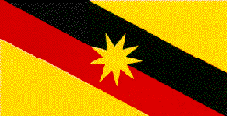
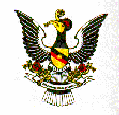
Sarawak is the largest state in Malaysia. It lies on the north coast of the island of Borneo. The coastal plains are swampy, and the interior is mountainous. Most people live in towns and rural settlements near the rivers. Sarawak's chief products are oil and natural gas from offshore fields.
People and government.
The head of state of Sarawak is the yang di-pertua negeri (governor). The government also consists of a state cabinet, and a state legislative assembly. The state cabinet is made up of the chief minister, assisted by two deputies, and 15 other ministers and assistant ministers. The state legislative assembly has 56 elected members. There are nine state divisions, sub-divided into 29 districts. See also MALAYSIA, GOVERNMENT OF.
Economy.
Forestry and agriculture are two of the most important sections of the economy. Timber and forest products account for more than a fifth of Sarawak's total exports. The state has nearly 10 million hectares of forests, capable of yielding 10 million cubic metres of logs annually.
Sarawak is the chief pepper-producing state in Malaysia. The state is rich in agricultural land and there are many farmers with small plots producing crops for sale, or farming at subsistence level (see AGRICULTURE [Subsistence agriculture]). Nearly 3 million hectares are suitable for cultivation but only a fifth of this land is in use. The government is encouraging the large-scale production of cocoa and oil palm.
Sarawak has seven industrial estates in the main towns of Kuching, Sibu, Bintulu, and Miri. Bintulu is the centre of heavy industries, particularly the export of oil and gas resources. Originally a small fishing village, Bintulu has developed into a modern town with an estimated population of 60,000. Industries include a liquefied natural gas plant, an oil terminal, and a urea-ammonia plant that produces fertilizer.
The economy depends heavily on forestry, petroleum, and natural gas, which account for almost half of the state's gross domestic product. Sarawak is rich in natural gas, most of which is in the Laconia field, off Bintulu. Oil was first discovered in the state in 1910. Production is about one-third of Malaysia's total output. The Malaysian Liquefied Natural Gas Scheme is the single largest industrial project in the country.
Tourists from abroad and other parts of Malaysia also contribute to Sarawak's economy. Visitors take an interest in the state's variety of peoples and their different languages and life styles. There are several national parks with unspoilt jungle and scenic views, which offer the attractions of unusual animals, birds, flowers, and insects. Some of them have extensive cave systems and sites of ancient settlements.
Land.
The state consists of three distinct landforms: the coastal plain, the highland interior, and the foothills between. The alluvial coastal plain consists largely of mangrove and peat swamps up to 150 kilometres wide. The mountainous interior rises from 300 metres to more than 1,200 metres, culminating at Mount Murud (2,425 metres). These areas are heavily forested and inaccessible except by river. Within this zone are spectacular limestone outcrops and their caves. The largest of these caves are in Mount Mulu. The intermediate zone consists of undulating land and foothills, extending throughout the length of the state and the most densely settled area.
The Rajang River (560 kilometres) is the longest in Malaysia. Sibu is its largest port and Kapit, 160 kilometres from the coast, can be reached by coastal craft. The Baram (400 kilometres) is the second longest river and provides access to the Kelabit Highlands and the Mulu National Park in the east.
The equatorial climate is hot and humid. Lowland temperatures range from 25° to 31 °C. The average annual rainfall ranges from 330 to 460 centimetres. Humidity is high, and often exceeds 68 per cent. The northeast monsoon from November to February brings heavy rain in the landas season. The southwest monsoon from March to September is less wet
History.
Charles Brooke reigned until 1917 when he was succeeded by his son, Charles Vyner Brooke. In 1941, there was a new constitution which marked progress towards self-government. The Japanese occupation of 1942 to 1945 prevented further development. In 1946, Sarawak became a British Crown Colony under the controversial Cession Bill. In 1963, the region joined the new nation of Malaysia.
PLACES TO VISIT IN SARAWAK