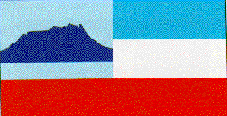

Sabah is the second largest state in Malaysia. It lies on the northeastern part of the island of Borneo. Sabah is mainly rural, with large areas of forest and mountain. Most people live in towns and in small villages.
People and government
There are 30 separate ethnic groups of people in Sabah. The largest
are the Kadazans, Bajaus, and Muruts. Smaller groups include the
Bisayah, Orang Sungei, Kedayan, Idahan, Rangus, Tidong, Suluk, and Brunei.
Each group lives in specific districts and has its own religion, language,
and dress.
Political instability in the southern Philippines in the early 1970's brought many refugees to the state. Large numbers of Indonesian and Filipino workers entered the state in search of employment. They make up a considerable proportion of the population.
The head of state of Sabah is the yang di-pertua negeri (governor). The state government consists of a state cabinet with a chief minister, 8 other ministers, 14 assistant ministers, and a state legislative assembly with 48 elected and six nominated members. The state administration is made up of the chief minister's department and eight other ministries, each overseeing a number of departments and agencies. The state is divided into five divisions, 23 districts, and 5 sub-districts. See also MALAYSIA, GOVERNMENT OF.
Economy
The mining and timber industries form the basis of Sabah's economy. Agriculture is of less importance and manufacturing is still relatively unimportant.
Sabah is the third most important producer of petroleum and natural gas in Malaysia. It produces about 60,000 barrels per day. The natural gas generates electricity which fuels a hot briquetted iron plant and a methanol plant on Labuan Island.
The state also operates the largest copper mine in the country. This is the Mamut mine which is 1,400 metres above sea level, south of Mount Kinabalu. The mining industry contributes 40 per cent of Sabah's exports.
The state is equally rich in timber resources. Logs, plywood, sawn timber, and veneer account for another 30 per cent of exports.
The chief crops in Sabah are cocoa, oil palm, and rubber. Since the 1960's, oil palm and, later, cocoa have replaced rubber as the major crops. Together they account for 12 per cent of the state's exports.
The main industrial products are hot briquette iron and methanol on Labuan, timber in the various sawmills, and consumer goods in the industrial estates of Kota Kinabalu, Sandakan, and Tawau.
Land
Sabah's eastern and northeastern coastlines face the Philippine islands in the Sulu Sea. The northwest coast is on the South China Sea. To the west is the Malaysian state of Sarawak, and to the south is the Indonesian territory of Kalimantan, which occupies about two-thirds of the island. Sabah consists of three distinct zones: the coastal swamps, the plains, and the uplands and mountains. Sabah is dominated by a series of mountain ranges and highlands, and mountains and steep slopes cover nearly half the land area.
The Crocker Range runs parallel to the west coast, from the Sarawak border to the north. It forms a barrier to movement to the interior and to the east coast. Mount Kinabalu (4,100 metres) in the range is the highest peak in Southeast Asia. A few other peaks exceed 2,000 metres. The rugged western foothills of the Crocker Range restrict the coastal lowland to a few isolated pockets. To the east of the Crocker Range is a series of plains which contain the towns of Ranau, Tambunan, Keningau, and Tenom. On the southeastern flank of Mount Kinabalu is the Pinosuk Plateau, a deeply grooved, sloping plain about 1,500 metres above sea level.
The rugged Trus Madi Range, with a maximum height of 2,600 metres, flanks the eastern side of the Tambunan and Keningau Plains. The Witti Range forms the eastern flank of Tenom Plain. In between these ranges is the Sook Plain. The Central Uplands comprise the highlands of Labuk, Kuamut, Segama, and Tawau.
The Kuamut Highlands form the catchment area of the major tributaries of the state's largest river, the Kinabatangan. The highlands are among the most remote, inaccessible, unexplored, and uninhabited areas of Sabah. The region consists of a series of ridges which rise to 1,600 metres. The Segama Highlands are moderately high, and the Tawau Highlands to the south rise to over 1,300 metres at Mount Magdalene.
The Pegalau and Tenom rivers drain Tambunan and Keningau plains. The Pegalan and Tomani rivers join at Tenom town and become the Padas. The Padas River turns northwestward, cutting a gorge through the Crocker Range. The gorge provided, until recent years, the only route through which overland transport could pass between the coast and the interior. The Liwagu River is a tributary of the Labuk, one of the major rivers in the east of Sabah.
The equatorial climate of Sabah is hot and humid. Like other tropical areas, the difference in temperatures between day and night is much higher than between seasons. The mean temperatures are high and consistent throughout the year. At sea level, the mean temperature varies from 25° to 31 °C. In the uplands, average temperatures may drop to 20 °C.
History
Brunei gave the east coast of Sabah to the sultans of Sulu in 1704 in return for favours in a succession dispute. Sabah (known as North Borneo until 1963) was visited by several western adventurers in the late 1800's. Joseph William Torrey, an American trader, obtained from the feeble Brunei sultanate a lease over the greater part of the territory. This lease was later transferred to Gustavus de Overbeck, an Austrian baron, and finally to Alfred Dent, an English businessman. Dent signed treaties with both the sultans of Brunei and Sulu, gaining complete control of the territory. In 1881, he succeeded in establishing the Chartered Company of British North Borneo to manage the territory. The region fell to the Japanese in 1941. After World War II ended in 1945, the territory was a British Crown Colony until it achieved independence by becoming part of Malaysia in 1963.
PLACES TO VISIT IN SABAH