
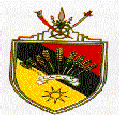
Negeri Sembilan, also spelled Negri Sembilan, is a state in Peninsular
Malaysia. Its name is Malay for the nine states. It shares
borders with Selangor to the north, Pahang to the east, and Johor and Melaka
to the south. There is a short coastline to the west where it meets
the Strait of Malacca.
People and government.
About 46 per cent of the population are Malay, 36 per cent are Chinese,
and about 19 per cent are Indian. Many Malays in Negeri Sembilan
are the descendants of Minangkabau immigrants who first came to the area
from Sumatra in the 1400's.
The head of state of Negeri Sembilan is a yang di-pertuan besar who
serves as sultan (ruler). The state assembly has 28 seats.
Economy.
Negeri Sembilan is an important area for the cultivation of rubber.
Other major commercial crops are forest products, and palm oil. Negeri
Sembilan has also become a centre for industrial development, especially
electronics, food processing, textiles, and ceramic tiles. Negeri
Sembilan has the advantage of being close to both Kuala Lumpur and the
major seaport of Port Kelang.
Land.
A large part of Negeri Sembilan is mountainous. The southern part
of the Main Range (Banjaran Titiwangsa) runs from north to south through
the state. A number of rivers drain east from this range, and flow
through the low-lying country in the east before they meet in the headwaters
of the Pahang River. To the west of the Main Range, the land remains
largely hilly almost as far as the coast. A number of small rivers
drain this part of the state. Most of the short coastline is rocky
and sandy, with minor capes at Port Dickson and Cape Rachado.
History.
During the 1400's, many Minangkabau people migrated from Sumatra to Negeri
Sembilan. The powerful sultan of Melaka granted the settlers his
protection. With the fall of Melaka to the Portuguese at the beginning
of the 1500's, the Minangkabau states came under the protection of the
sultans (rulers) of Johor. But by the early 1700's, Johor was no
longer able to protect the Minangkabau from the Bugis, traders from Celebes
(Sulawesi) now in Indonesia, who had settled in Selangor. Many people
believe that the Minangkabau then looked to the royal house of their Sumatran
homeland for a prince who would unite the nine separate states into a federation.
That prince was Raja Melewar who, in 1773, became the first ruler of Negeri
Sembilan.
But the creation of that confederacy did not bring lasting unity.
For the next 100 years, there was conflict between the states. In
the mid-1800's, Sungai Ujong became the centre of a tin rush. Chinese
miners and merchants fought for control of the tin trade.
In 1874, the British intervened to establish a resident (government
representative) in Sungai Ujong. In the 1880's, the British appointed
officials to other members of the confederacy. Negeri Sembilan became
a confederacy once again under a single British resident in 1875.
The following year, the state, together with Selangor, Perak, and Pahang,
formed the Federated Malay States, with the federal capital in Kuala Lumpur.
During the late 1800's and early 1900's, the state became an important
rubber-producing area. Many Indians arrived to work as rubber tappers.
In 1948, Negeri Sembilan became part of the Federation of Malaya, which
became independent of British rule in 1957.