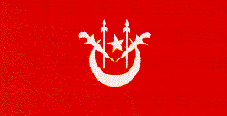
Kelantan is a state in the northeast of Peninsular Malaysia. It
is bounded by the states of Perak to the west, Pahang to the south, and
Terengganu to the east. To the north are Thailand and the South China
Sea.
People and government.
The head of state of Kelantan is a hereditary ruler known as a sultan. The state assembly has 39 seats.
Economy. The single most important source of employment is agriculture. The principal crops are rubber and rice. More than 50,000 hectares are under rubber, of which nearly 60 per cent are in smallholdings and the rest in large plantations. Rice covers more than 22,000 hectares. Other important crops are coconuts, oil palm, and tobacco.
PLACES TO VISIT IN KELANTAN
Many people work in traditional industries, particularly the production of engraved and filigree silverware, woodcarvings, and hand-printed batik cloth (see BATIK). On the northern coast of the state, many communities earn their living from fishing.
Land. Mountain ranges mark borders to the west, south, and east. The highest mountain in western Malaysia, Gunung Tahan (2,187 metres), is on the southern border of Kelantan. Until the construction of a main road linked the area with the east-west Highway in the 1980's, the mountain barriers limited Kelantan's contact with the economically more advanced states on the west of the peninsula. The railway from Pasir Mas heads south toward Johor Bahru rather than cutting west to link Kelantan directly with Kuala Lumpur or the other major centres in the region.
The Kelantan River is joined by a number of minor rivers from the mountains
as it flows northward to the South China Sea. The river flows through
the Kelantan plain and delta, a major rice-growing region.
History.
In December 1941, Japanese troops landed at Kota Bharu to sweep down
the peninsula towards Singapore. During their occupation (1941-1945),
the Japanese returned Kelantan to Thailand. With the defeat of Japan,
the state once again came under British authority. In 1948, Kelantan
became part of the Federation of Malaya. On Aug. 31, 1957, the Federation
of Malaya became independent from British rule.