PARVUM OPUS
Number 164
______________________________________________
WERGLE FLOMP
You still have time to enter the Wergle Flomp poetry contest by the April 1 deadline! Winning Writers invites you to submit an intentionally bad poem to one of the vanity press poetry publishers (which accept everything with praise and then allow you to purchase one of their anthologies). Then you may submit your entry to Wergle Flomp, and the worst of the bad poems wins.
I was excited to learn that the 2005 first prize winner was Alan Farrell for "The Blaming of Parts," a hilarious pastiche of "Naming of Parts" (PO 48). (This was the link that brought Mike Sykes into the PO fold.) Farrell was in Vietnam so the tone is rather different from Henry Reed's, besides the fact that Farrell's not serious. If you liked "Naming of Parts", be sure to read "Blaming of Parts" (but watch out for flying f**ks).
SPAM GEM
This will probably alert your spam filters, but here goes anyway: I opened a piece of spam for a "male enhancement drug" (naturally I usually don't read spam or I'd have no time for anything else), and found this lovely piece of work:
Every man must have a sex! MUST!!!
Everything you need is to know more about it
First, I can only agree that every man must have a sex. Second, I'm glad to finally know what I need, although since I actually still don't know more about it, I still don't have everything I need.
CALLING ALL LESS SHALLOW WRITERS
Ohio Magazine says, "We're looking for thoughtful stories on topics that are more contextual and less shallow."
Maybe if I were less shallow, I'd know what a more contextual story is.
NEXT
Several people had something to say about "next week" and other topics.
Son Jude:
I had a bit of a debate with some other soldiers while in medic school about "next weekend." For me weekend was a thing at the end of the week, so the next one would be the same as this weekend. I think some of them saw it as part of this week, thus the end of the next one would be over a week away. Is it the difference between "weekend" and "week end?"
(No, there's no difference in meaning between weekend and week end.)
And about Scots:
The Scots throwing heavy things comes from the time of the British retribution for the Jacobite rebellion. They weren't permitted to keep swords and shields (they hid those in the thatch roofs) so to practice their war skills, stay in shape, and have an outlet for clan rivalries, they held competitive games with what they had available.
I don't know if you've ever had haggis, but I should've had scotch on hand when I did.
Bill R.:
I learned the "week" (and not just Tuesday) usage as indicating a day at least a week ahead. For example, writing on Saturday March 4, "next Tuesday" is Tuesday, March 7. "Tuesday week" is Tuesday, March 14. "Next Friday is March 10; "Friday week" is March 17.
WRT the "next Sunday," I concur that "it depends." Speaking today (Saturday 3/4), I would call Sunday 3/5 "this Sunday." "Next Sunday" would be Sunday 3/12.
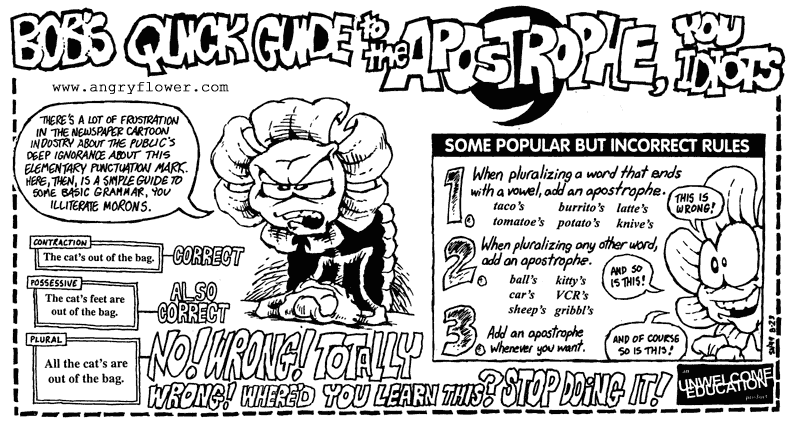
Bill also sent this link to a funny (funny ha ha and funny odd) cartoon about apostrophes: http://www.angryflower.com/bobsqu.gif
I have long felt that "next Sunday" is ambiguous. I recommend using "this coming Sunday" for the very next occurrence of a Sunday and "Sunday after next" for a day two Sundays away. These examples ... illustrate how ambiguous the English language is about time:
# "Let's push up that appointment by two days." Does that mean that the appointment will now be two days earlier or later?
# "Our biannual meeting is very important." Does that meeting take place twice a year or every other year?
# "Our semi-annual meeting is very important." Does that meeting take place twice a year or every other year?
# "The boss will see you momentarily." Will the boss see you in a moment or for a moment?
# "Since 1988, the company has been in the forefront of technological creativity." Does that innovativeness include 1988?
# "The train arrives at 12 a.m." Is that noon or midnight?
It's amazing that we English speakers ever know what time it is.
Quite right. I might add that there actually is no such thing as 12 a.m. (or p.m.). Twelve o'clock is either noon or midnight. "Meridian" is mid-day, and ante-meridian (a.m.) is in the morning before noon (between midnight and noon) and post-meridian is after noon (between noon and midnight). Also, "momentarily" has a specific meaning but it's so often confused that it's almost better not to use it. yourdictionary.com offers this Usage Note:
Momentarily is widely used in speech to mean "in a moment," as in The manager is on another line, but she'll be with you momentarily. This usage rarely leads to ambiguity since the intended sense can usually be determined on the basis of the tense of the verb and the context. Nonetheless, many critics hold that the adverb should be reserved for the sense "for a moment," and the extended usage is unacceptable to 59 percent of the Usage Panel.
That is, "in a moment" is different from "for a moment", as you know when you think about whether, for example, you would want your main squeeze to be with you "in a moment" or "for a moment."
Jes M. consulted one of her daughters about the fashion question:
Sassy is "like funky," according to Rozena, who is now 16. It's "dressing like a street chick." I take that to mean on the sexy side. By "dressy" your student's daughter probably means "femme." "Sporty" I would guess means the kid wants to be kind of gender neutral and not call attention to herself or her blossoming sexuality. Tell your student that's a good thing. I would ask my own 12 year old for definitions, but it's 11:50 on a Sat. night and she is not home! She is boogying at a big fancy Bar Mitzvah party at a country club, in a "dressy" dress, but quite respectable, thank you very much.
Which reminds me, did anyone catch the story about the group of girls who wore flip-flops when they were invited to the White House? I'm sure they were really cute flip-flops, but still.
LITERARY NOTE
From the February 27, 2006 issue of National Review, p. 6:
Ibn Warraq [a pseudonym that has traditionally been adopted by dissident authors throughout the history of Islam] is the nom de plume of a Pakistani Muslim living in the United States and writing about Islam as he sees it. He has been circulating a passage from Beaumarchais's play in 1784, The Marriage of Figaro, adapted by Mozart for his opera. Beaumarchais might have been commenting on the Danish cartoons of today: "I cobble together a verse comedy about the customs of the harem, assuming that ... I can say what I like about Mohammed without drawing hostile fire. Next thing, some envoy from God-knows-where turns up and complains that in my play I have offended the Ottoman empire, Persia, a large slice of the Indian peninsula, the whole of Egypt, and the kingdoms of Barca [Ethiopia], Tripoli, Tunisia, Algeria, and Morocco. And so my play sinks without trace, all to placate a bunch of Muslim princes...."
Hey, something that wasn't our fault.

SOMETHING
NEW! Now you can buy neat products with the Parvum Opus / KeithOps Catti logo
at CafePress.
If you buy books from Amazon using the link below, I'll get a tiny commission, and I'd appreciate it.
Link here to look for books on Amazon.com!

NEED A
WEB PAGE? NEED SOMEONE TO ORGANIZE A MEETING OR CONFERENCE? CALL KEITHOPS.
Go to Babelfish
to translate this page into Chinese, Dutch, French, German, Greek, Italian,
Japanese, Korean, Portuguese, Russian, or Spanish!
Parvum Opus is a publication of KeithOps / Opus Publishing Services. Back
issues may be found at http://www.keithops.us/.
Feel free to e-mail me with comments or queries.
If you don't want
to receive Parvum Opus, please reply with "unsubscribe,"
"quit," "enough," or something like that in the subject
line, and I'll take you off the mailing list.
Copyright Rhonda Keith
2006. Parvum Opus or part of it may be reproduced only with permission,
but you may forward the entire newsletter as long as the copyright remains.