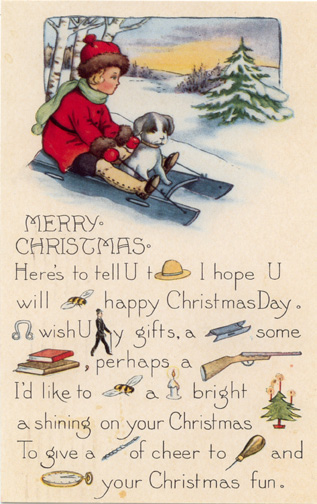
 MERRINESS
Number 104
MERRINESSNumber 104 means two years of Parvum Opus! Thanks for reading and writing. Attached is a Christmas card to all of you. It is a reproduction of an antique card with a message in the form of a rebus, a puzzle using pictures for some of the words or parts of words. I had trouble with a couple of them, but Fred and I eventually got them all. Can you figure them out? Write to me with your answers and I'll mail you a card!
Meanwhile, Merry Christmas and Happy (you fill in the blank)! Also, no offense intended to people who are neither happy nor merry, including the manic-depressive, bipolar, and so on. This holiday wish is not intended to imply or suggest that moods other than happiness, merriness, jollity, gayness, joy, etc. are not equally valid modes of feeling.
I am writing this on Tuesday, the winter solstice, the shortest day of the year. Tomorrow the days will begin to get longer. Ancient peoples were as happy as I am to see winter winding down; the lengthening of days promises continuing life. Two readers noted that Christmas follows the ancient celebrations of the solstice.
Mike S. commented:
That may be true now [i.e., the meaning of Christmas], but have you ever considered the evidence for commemorating Jesus's birth at the winter solstice? See, for example, http://www.funmunch.com/events/christmas/origin.html.
Frank E. said:
I remember a long time ago I was reading about how Christmas was observed at the wrong time of year, given astronomical and anthropological clues in the bible. The reason for the winter celebration was to better blend in with other celebrations, like solstice, the Saturnalia and so on, so as to not bring attention to the practice of their new religion. Sounds plausible. . . . today's [Tucson Star] editorial (which I have no doubt will bring outraged letters to the editor) was "Enlightened solstice". It concludes "with light comes truth, or lux et veritas, as ancient Italians and Yalies like to say. The true message of the winter solstice, then, is that as the days grow longer, we will all be enlightened."
(By the way, would you capitalize Saturnalia but not Bible? Anyway, Frank says he lives in a blue county in a red state. Who decided that "red" now means politically conservative, or right wing, or Republican, when for the last century it's meant Communist? It confuses me, I always have to stop and think about it.)
But seriously ~ where do you think light comes from? Not from General Electric, and not only or originally from the sun. In the early throes of love with Fred, once I had the experience of closing my eyes and seeing more light than when I opened them.
People have always celebrated the return of light, of longer days, but human understanding of the origins and meaning of light have evolved and deepened. The word itself has always meant understanding ~ illumination.
An evolutionary case in point: A philosopher named Anthony Flew, at the age of 81, after a lifetime of atheism, has just recently concluded that there is a god, in the sense of an intelligent creator. This isn't just a pre-death-bed scare, because he hasn't gone so far as to believe in an afterlife. If he lives to be 162, he might discover other ideas new to him. More light may shine on him.
And may more light shine on him. (Note that in some other languages that change in syntax would not change the meaning, as it does in English.)
"Will cold weather effect holiday shopping?" read a TV news caption. "Effect" as a verb means to bring into being. "Affect" as a verb means to produce a change in something or to influence. Cold weather will not result in or cause shopping, but it could have some bearing on whether or not people go shopping ~ a fine but real distinction.
What about the nouns? "Effect" is a result. "Affect" as a noun is rarely used; an obsolete meaning is affection, and now it is a term used in psychotherapy to denote an emotional state.
Though sometimes seen with no comma at all, "God rest ye merry, gentlemen" from the 1833 Christmas carol often has a comma after "merry" rather than "ye" (or "you"). This makes it an adverb rather than an adjective, as it would be if it were "God Rest Ye, Merry Gentlemen." So ~ rest yourselves merrily. Ladies too.
When I was a kid, the carol "It Came Upon A Midnight Clear / The First Noel" confused me because I heard a couple of lines wrong:
The first noel the angel did say
Was to certain poor shepherds in fields as they lay.
"To certain" sounded to me like an infinitive verb, rather than an adverb or adjective. But even reading it properly, the verb "was" is a bit sloppy ~ "The first noel was to shepherds"? You might expect a direct object following "was" ~ "was to shepherds a harmonic sign" or something along those lines.
Dave daBee referred me to a web site about misheard lyrics, www.kissthisguy.com (as in "Excuse me while I kiss this guy" for "kiss the sky" by Jimi Hendrix, "Purple Haze") but going there opens up an ad screen that freezes the window, you can't even click "yes" on the ad, so go there with caution. Maybe they'll fix it, but I couldn't go there at all. Try Amiright (Making fun of music. One song at a time).
You can make free phone calls from your computer to another computer if both have free Skype software installed, and microphones.
Last week I asked, "But who gets la grippe anymore? . . . I also have a vague memory of a humorous poem that went 'Hey hey for the goodly la grippe,' but can't locate it on the Web."
Mike remembered: I believe I once enjoyed a piece by Ogden Nash that referred to 'la grippe', but it was a long time ago, and I can't find it, well not in the time I'm willing to spend on it anyway.
This is "A Word about Winter" from Pocket Book of Ogden Nash (I found it on Amazon) but it doesn't have the line I remember.
And someone I also don't remember, because I deleted the e-mail too quickly after I copied this excerpt, wrote (isn't that a rather Nashian line?):
La Grippe ~ Miss Adelaide's lament in "Guys and Dolls" ~ "La grippe, la grippe, la post nasal drip/ With the wheezes, and the sneezes, and a sinus that's really a pip. . ."
Sorry ~ do identify yourself again.
Meanwhile, avoid catching la grippe by keeping your neck and glands warm by wearing something around your neck, a muffler or a scarf, perhaps. According to some TV chatterers, "muffler" is not the currently understood term for "scarf". So if a very young person asks for a muffler for Christmas, check his wheels, then his neck.
Regarding this:
A professor said that while he was trying to help a student with a problem, he asked her, "What is 20,000 minus 600?" He went on to say, "She literally could not answer without the calculator." He rhetorically questioned, "Should a person receive a college degree that cannot answer that in their head?"
Mike wrote: Should a person be a professor who doesn't know the difference between that and who, and who insists on changing from "a person" to "their" in the course of a sentence?
Good point! Yes, well, I didn't want to get into the grammar here when more serious matters are at hand, i.e. simple math. . . . Fred also asked about the literally literally. In this case I believe it's literally literally. (She literally and really could not do the math without a calculator.)
Anyway, I was giving the math professor some grammatory slack. But who refers to persons, that to things. I heard a commercial recently that referred to a company who does something or other than you want, but despite corporate law, a company is not a person. And a person should do math in her or his head, just one head, not their head.
Mike: And was that literally literally, or figuratively literally?. . . ;-) Or, you could look at it sidelong, in which case it would be literally laterally literally.
So now when someone says something is literally true, it's not at all. That's what you get with descriptive rather than proscriptive grammar. People say the opposite of what they mean. Literally.
Mike: I sympathise completely, and can recall having to restrain myself from remonstrating with my boss on one occasion. But there comes a point when one might as well stop flogging the dead horse and move on to a stable door from which the horse has not (quite) yet bolted.
But I'm all about flogging both dead and bolting horses. ( Though not literally.)
Parvum Opus is a publication of KeithOps / Opus Publishing Services. Feel free to comment in the Guestbook, linked below the back issue links. You're also welcome to e-mail me with comments or queries.
If you don’t want to receive Parvum Opus, please reply with “unsubscribe,” “quit,” “enough,” or something like that in the subject line, and I’ll take you off the mailing list.
Return to KeithOps.
