




The Canadian voting system
I have a list of problems that I have with the organization of government currently. If I could create a political party it would be a party that advocates political reform on a number of issues. Mostly the administration of the Canadian government and the voting process. These opinions stem from observations I have made about government in Canada since turning 18 and getting to vote. I'll just list my ideas off and then go into a rant about our voting system at the end.
the list of ideas:
- A senate elected by the public
- Either give the senate a real job to do, or just send them home. As of now the Senate is a waste of taxpayer money
- Have a blended electoral process. For example somehow blend the current �past the post� system with a �popular vote� system. Therefore parties such as the green party would achieve seats in the House of Commons. The green party had 4% of the popular vote and no seats in parliament. 4% of 305 is about 13 seats. More detail below
- Bring the voting system to the people instead of having MP�s do it. This is not achieved by having every Canadian vote on every issue� that�s what MP�s are for. But rather for major bills have the MP consult a large number of their constituents on their opinions on the matter so that they can more accurately represent their riding
- Have a system of voting for the prime minister separate from voting for the MP. Also by doing this, the Prime minister should act as the figurehead for the country when conducting international affairs as the leader of the country. Let the MP�s settle all the voting and such on their own
The Status Quo Voting system
Canada currently employs a "first past the post" system of electing federal officials. This system has some major flaws. The foremost problem being that whomever gets the most votes in a riding wins. The popular vote doesn't matter. the popular vote being the how many votes each party gets. Basically what happens is that the liberals get majority governments when they get less than half of the popular vote.
Example:
We have three parties. The green party, the black party, and the white party. There are 100 seats to be won in our example. Using our current system the green party gets 50 seats, the black party 50 seats, and the white party gets none. 100 000 votes are cast and there are 1000 people in each riding. In the 50 ridings that the green party won, they received 510 votes in every riding, the white party 490 and the black party none. In the other 50 ridings the black party gets 510 votes in each riding, the white party 490 and the green party none. After all is said and done the green and black party have 50 seats each, and each party has 25 500 votes total. The white party has 49 000 votes, more votes than the other two parties, but no seats.
Green party: 50 seats, 25 500 votes, 25% of the popular vote
Black party: 50 seats, 25 500 votes, 25% of the popular vote
White party: 0 seats, 49 000 votes, 49% of the popular vote
That last example contradicts my next example somewhat, but these are extremes and both are problems with the current voting system anyway. Our voting system really only endorses 2 parties. You usually either vote for either the party you normally vote for, or, you vote for a party just to keep the party expected to win the election from winning.
Example:
It is now 2004 and you must vote. You seemingly either vote Tory or Liberal. Either you like the liberals and vote for them, or you fear that the liberals will win so you vote for the conservatives. Why the conservatives? Because they have the best chance of beating the liberals. This effectively reduces the Canadian political system down to a two party race. This example can be used the other way around as well.
Let's be real, the New Democrats, and Green party will never even win a minority government at this rate, and will never have much of a say in how our country is run. Or at least their ideas won't surface as often.
The Proposed System
I voted for the green party. In effect I threw my ballot away in a sense, but they will get federal funding because they got more than 2% of the popular vote. I knew they wouldn't win any seats in Parliament. Despite the fact that they got 4% of the popular vote, more than 500 000 of votes cast, they won't have their ideas broadcast in Parliament. This is where popular voting comes into place. If we had a system where we voted using a popular system, the white party from the previous example would have some sway in parliament. The white party was the most popular choice, yet they aren't in parliament.
This voting system I propose is a blended system, using past the post and the popular vote. Many countries employ voting systems based on the popular vote, such as: Belgium, Switzerland, Finland, Sweden, etc. Mostly European countries. The voting system I'm about to explain is based on the German system of voting. And I did not choose this system because it is German. This system is good, but only used by 4 countries: Germany, New Zealand (who copied it from the Germans in 1991), Venezuela, and Turkey.
How the new system works is as follows: The new system has twice as many seats, 200. Half are for the candidates, and half are for the parties. We would still vote for candidates as we always do, these people would represent us in parliament. But we also vote for the party we like most on the same ballot. So we get two votes. One for a candidate, and one for a party.
Example:
Here's an example ballot:(this was borrowed from another site)
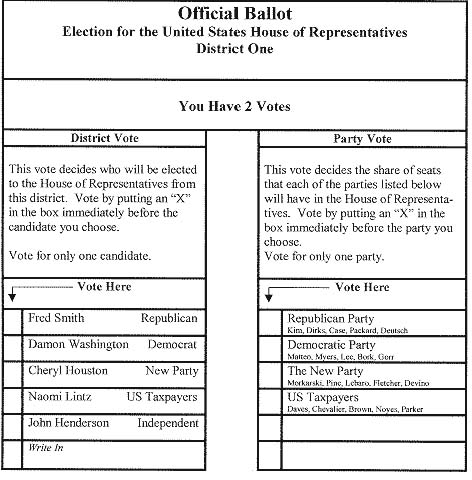
As you can see you get two votes. Now back to our example. Let's add the Pink party. Now assume the green party gets 61 seats, the black party 30, the white party 9, and the pink party none. Look at the diagram below for up to date info.
Green party: 61 seats, 40 000 votes, 40% popular vote
Black party: 30 seats, 22 000 votes, 22% popular vote
White party: 9 seats, 14 000 votes, 14% popular vote
Pink party: 0 seats, 25 000 votes, 25% popular vote
This example is a bit more realistic and could happen. As you can see the second favorite party of choice has no seats and no power. But lets assume they use the new voting system. There are now 200 seats, the first 100 have been decided, as voted for above. The other 100 seats are based on the popular vote whereby each party receives additional seats based on their percentage of the popular vote.
Example:
Green party = 40% popular vote, so they get 40 out of the extra 100 seats.
Black party = 22% popular vote, so they get 22 out of the extra 100 seats.
White party = 14% popular vote, so they get 14 out of the extra 100 seats.
Pink party = 23% popular vote, so they get 24 out of the extra 100 seats.
So after all the smoke clears the country looks like this:
Green party: 101 seats (61 + 40)
Black party: 52 seats (30 + 22)
Pink party: 24 seats (0 + 24)
White party: 23 seats (9 + 14)
As you can see each riding gets to elect the person they want to represent them, just like the current system. And they also get to vote for a party, which helps get parties seats in parliament to help get their voice heard.
So we have 100 seats filled with the "first past the post system" just like normal, and then we have another 100 seats filled by the parties based on the popular vote. How do these extra seats get filled? On the second vote we voted just for the party, not for anybody in particular. There are two methods, a closed system, and an open system. In a closed system the party keeps their list of possible candidates private, whereas in an open system the public knows each parties possible candidates.
Conclusion
In conclusion, I propose a blended system. We still vote for our representative in parliament as usual, but we get a second vote, a vote on the party we want to vote for. The parties then wins additional seats based on the popular vote. The party fills these extra seats with a list of people that the party picks. This way everything is doubled, and we have a government with a louder voice and a bit better representation. This system isn't perfect, but it's better than the status quo.
Just for fun let's see how our Government would look after the 2004 federal election.
Before:
Liberals: 135 seats, 36.71% of popular vote
Conservatives: 99 seats, 29.61% of the popular vote
Bloc: 54 seats, 12.4% of popular vote
NDP: 19 seats, 15.69% of the popular vote
Indepentant: 1 seat, .13% of the popular vote
Green party: 0 seats, 4.3% of the popular vote
How things wouls look like under the new system:
After:
Liberals: 249 (135 + 114)
Conservatives: 191 (99 + 91)
Bloc: 93 (54 + 39)
NDP: 68 (19 + 49)
Green: 14 (0 +14)