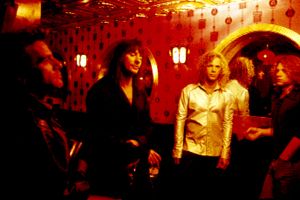
Once upon a time, not so long ago...
After John Bongiovi signed a record deal with PolyGram
Records, he formed a band called the Wild Ones formed by Tico Torres - drums; David Rashbaum - keyboards; Alec John Such - bass; Dave Sabo - guitar. Richie Sambora later joined the band
by replacing Dave. When Jon signed with the record company, it was supposed to be a solo effort. However, he demanded the contract be changed so it could be a band project.
"I only thought the group would stay together for a couple of weeks," Jon said. "A band playing original songs in New Jersey in the '80s. You could get, max, a hundred bucks a night, maybe
two nights a week. So I figured having a song on the radio meant I could maybe get two hundred bucks, three hundred bucks. Maybe I could get an opening slot at a bigger club."
Since the contest version of "Runaway" had already been released and widely publicized under the name John Bongiovi (for more information on ”Runaway” and the contest entry, see Jon Bon Jovi’s section), PolyGram executives felt it could have been
to confusing for the audience if the band adopted an entirely different name such as the Wild Ones. Also, groups names like "John
Bongiovi and the Wild Ones" were kind of passé by then, so a completely new name had to be found. Derek Shulman, PolyGram's chief A&R man, decided to anglicize Jon's name: Jon Bon Jovi - the band: Bon Jovi.
BON JOVI (1984)
Their first album was originally entitled ”Tough Talk”. It was produced by Tony Bongiovi (Jon's cousin) and Lance Quinn while
Jon's brother, Anthony, created the Bon Jovi logo. This album was the only album on which there was a song that they didn't write. It was "She Don't Know Me" composed by Mark Avsec.
The basic tracks for some of the songs on the album were recorded by a myriad of non-professional musicians months before the
Bon Jovi band was assembled. These songs needed a complete overhaul or minor touches. Four professional record making
musicians were called in: Doug "Gling" Katsoras from the group Balance and Aldo Nova - background vocals; Chuck Beregie - drums; and Huey McDonald - bass.
After the album came out, the band went back on the road. "We played bars coast to coast," Jon remembers. "Thirty shows in 29
days. I got off the bus the second day, it's snowing, we're in Buffalo, and I saw we were playing a place with one of those flashing arrows you see at a used car dealer. It said '50 cent beers."'
In September 1983, Jon was invited by concert promoter John Schear to play Madison Square Garden as the opening act for ZZ
Top. They had no equipment, no manager, no roadies... They got their friends to help them move their stuff. They were supposed
to play for about 35 minutes but ended up doing the set in 18 minutes. Bon Jovi's performance impressed a promoter who booked
them on a tour with Eddie Money for about a week. It became the "Station Wagon Tour" because they packed their gear into the back of a beat-up station wagon to follow Eddie Money.
When Jon got back to New York, he decided to find them a manager. He got Doc McGhee who was also involved with Motley Crue.
Bon Jovi embarked on a full-scale tour of America with the Scorpions. "We weren't heavy metal," Richie remembers. "We're singing
"Runaway" when the Scorps are singing kill your mom. So if we got off stage without being pelted, we were happy." But that
taught them how to make the fans pay attention. "During the 50 minutes we were on each night, we never let up", Richie says.
During a concert in North Carolina, the band marched on-stage dressed in the 1776 tradition, complete with fife, drums, bandages
and the American flag while the Scorpions were in the middle of "Still Lovin' You".
After the Scorpions tour, Bon Jovi went overseas to tour with Kiss. In Paris, as a joke, they dropped 3000 Ping-Pong balls on Gene
Simmons' head and coated Eric Carr's drum kit with talcum powder. "We played about 100 places that I swore I played in high
school," Jon told Faces magazine. Bands rarely played real arenas in Europe like the States every night.
Bon Jovi's debut LP went gold in Japan while they were busy touring the States and Europe. Furthermore, they were named
"Group of the year" there. When they stopped in Japan, they always had to stay in their hotels 'cause fans would chase the cars,
chased them on the streets, would stay at the hotel 24 hours a day and give them presents all the time.
When they got off the road, Jon faced some serious personal as well as professional growth. Lance Quinn moved to Philadelphia
and Jon had a contractual disagreement with Tony and Bob that resulted in a severe split between himself and his cousin. He chose, therefore, to record the next album in Philadelphia with Lance.
78000
FAHRENHEIT (1985)
They came off the road in November 1984. Jon and Richie started to write for the second album in Richie's basement. "Jon and I just
went down there with a 6-pack off beer and a Panasonic tape recorder, a Roland jazz chorus amp and 2 acoustic guitars", said Richie.
Once several songs were completed, the band booked time in a Perth Amboy rehearsal studio. It was during this time that $40,000
worth of equipment were stolen or destroyed from the studio. They lost synthesizers, custom-made guitars, basses, microphones...
They thereafter joined Lance Quinn in Philadelphia to record their second LP at the Warehouse with Obie O'Brien. They also went
to the Hit Factory in New York City to work with David Thoener and Fernando Kral. Bon Jovi found themselves competing for the
attention of producer Lance Quinn with Nils Lofgren. "I can't really complain about that album; it was a rushed job but that was my
fault and in a way it was the perfect second step because it allowed us more time to build," explained Jon. Their second album was entitled 78000
Fahrenheit which refers to the melting point of rock and the term Fahrenheit is only used in the States - the album title referred to American hot rock.
In April 1985, Bon Jovi began their first major headlining tour in Japan. After Japan, they toured Europe starting in Paris. In the
States, they were the opening act for Ratt's American tour. "It was hell," Jon later explained. "Me and Stephen (Pearcy, Ratt's
frontman) definitely didn't get along." Jon later overcame any revalry to contribute backing vocals to the Ratt track "Heads I win,
Tails you lose". Another event that year was they performed at the Texas World Music Festival with Deep Purple, Scorpions, Night Ranger, Ted Nugent, Grim Reaper and Victory, and at Farm Aid I in Illinois.
For Farm Aid (September 22, 1985) Bon Jovi opened the show at the ungodly hour of 10 a.m.. They performed "Heart of America"
which was written especially for that occasion. Richie explained that they wrote the song "while we were driving in from Montana
and watching the corn go by. We decided to write a special song, and rather that the usual 'Oh, the farmer, he's so sad' tunes, we'd
go for a positive message of 'Let's pull together and beat this problem'." "The song's about generations," Jon added, "from
grandfather to father to son, to hopefully my future son, to whom I can tell these things. It says how we all came together, how
you can hear the voices calling in the heart of America." The band took two days off after the concert and recorded the song at
Summit Sound Studios in Lake Geneva, Wisconsin and at Ted Nugent's Studio in Ann Arbor, Michigan.
On October 18, 1985 they played Meadowlands in New Jersey. During that night, they received their gold record awards for 78000 Fahrenheit and Bon Jovi.
"After we finished the 78000
tour, the whole band flew down to the Cayman Islands. All we did was lie on the beach in front of this bar that served exotic drinks," Jon.
FARM AID II - July 4, 1986: Jon flew to the concert site in Austin, Texas, the night before the show. That evening, Jon went to
Alley Oops and watched John Henry Jone's group, the Unforgiven, play. Jon was asked on stage to sing "Suspicious Minds" and
other songs that included appearances by David Soul, Bonnie Bramlet and Rick James. The next day, Jon joined Willie Nelson to
perform "Amazing Grace". Joe Walsh joined them in singing Walsh's "Rocky Mountain Way". And to finish it off, they all sang with Vince Neil on "Smokin' in the boys room".
SLIPPERY WHEN WET (1986)
For their third album, they rented time in Sayreville, New Jersey at Century Productions. They brought in Desmond Child to
co-write a few songs such as "You Give Love A Bad Name", "Livin' On A Prayer" and "Without Love". He was a semi-successful
disco artist back in the 70's. He also did the music for the movie "The Warriors". His songwriting career took a huge leap when he wrote "I Was Made For Loving You" for Kiss.
They invited some local fans into the rehearsal studio for their opinion on picking the songs for the album; this group was later
known as the "pizza pie jury". The band would go out for a pizza break at a pizza parlor right around the corner from the rehearsal
studio. On the final eve of Bon Jovi's stay at Century, Jon invited about 30 kids back to the tiny control room, played them the potential cuts and let them pick what was going to be on the album.
They chose Bruce Fairbairn as the producer and the band went to Vancouver, British Columbia to record the album at Little
Mountain Recording Studio. The engineer would be none other than Bob Rock, who used to play guitar for the Payolas.
It was Fairbairn's free-spirited, "come-as-you-are" attitude that introduced Bon Jovi to a whole new approach to recording. "We
just set up like we were playing (live) and played," Jon told Staline magazine. "We cut 13 tracks in 4 days and overdubbed from there. We don't usually do that".
During the overdubbing process, Richie dug out his talk box. "On this LP, I wanted to bring in some new sounds that would open
up people's ears. That's why I loved the Beatles albums, 'cause the sounds are indescribable," - Richie.
After a day in the recording studio, the band would go to this local Vancouver bar which happened to be an exotic dancing club
called Number 5 Orange. One night, after a long haul in the studio, Jon and Richie headed to the bar to look at the Polaroid
pictures they had taken during that day's photo session for the new album cover (originally titled Wanted Dead Or Alive). In a few
words, they hated the pictures. "There was this girl who was in a Plexiglas shower soaping her body up and doing everything short
of banging on the walls of this shower," explained Jon. It caught the guy's eyes, and Jon said: "My God, I bet she's wet". One thing
lead to another and they came up with Slippery When Wet for the album title.
Allot of controversy and headaches came with preparing the album cover. One idea for the album cover was a shot of Angela's (a
girl spotted by Tico sunning on a Jersey shore) voluptuous form wearing a yellow shirt. Someone in the art department at
PolyGram made the cover with a hot pink border and the back cover was also hot pink. Jon didn't want that cover to go out. So
they threw out half a million album covers in America. However, several thousand copies escaped and made it into record bins in Japan. These covers are now collector's items.
Six hours before the deadline, Jon came up with an idea. He took a squirt bottle and squirted a black garbage bag down to make it
look wet. He took his fingers and wrote Slippery When Wet... and said: "That's your album cover... it doesn't jump off the shelf but let's take the attitude of ‘let the music do the talking’."
Bon Jovi went to Japan even before the album came out. It came out the second week they were there. It was a big thrill for them to be able to headline at the Budokan.
In a month's time, SWW sold 1,300,000: it was #11 in Sweden, #8 in England, #1 in Finland and gold in Japan. By the end of
October, Bon Jovi was the 5th "heavy metal" act in history to achieve #1 in Billboard behind Led Zeppelin, AC/DC, Quiet Riot and Van Halen.
In November, "You give love a bad name" was their first #1 hit. The video was filmed live at the Olympic Auditorium in Los Angeles.
"When we decided on the format of this video and knew that we were going to film it live with an audience," Richie explained to
Faces, "we decided right then that we'd do a mini concert instead of playing the same song 42 times. If I were a kid at a video shoot, I'd hate hearing the same song over and over again."
Due to an overwhelming response, the SWW tour was extended beyond it's original closing date in April all the way through
August. Every concert hall visited was sold out and for each month the band performed, another 1,000,000 copies of the album
were sold. Even the first two albums reentered the Billboard charts - a rare occurrence in the music industry.
Breakout was named "Best long form Video" at Billboard's 8th Annual Video Music Awards, while "You give love a bad name" was
awarded "Best Overall Video". They were also awarded "Best Performance from a Group", "Best Audio" and "Best Concert Performance".
During the 1987 MTV Video Music Awards, Jon and Richie played acoustic versions of "Livin' on a prayer" and "Wanted dead or alive", starting the Unplugged craze.
But the band's most astounding achievement in 1987 occurred when SWW regained its #1 position in Billboard after slipping to the
third sport for an extended period of time; a historical event matched by one other album, "Born in the USA". Which album did SWW dethrone? Springsteen's 5-volume live album.
The Songs
You give love a bad name
"When I and Richie decided to write songs for other bands Desmond Child helped us, because we didn't have the time to go out
and sell the songs. All began when we wrote, "You give love a bad name" for Loverboy and I said 'I want to keep this one for me'" - Jon
Livin' on a prayer
"‘Livin' on a prayer’ is a song of hope. We created two characters, Tommy and Gina, and let them speak for us" - Richie
"It's a great song, it has a nice groove, and the lyrics are amazing. When we say "'Cause it doesn't make a difference if we make it
or not, we've got each other and that's a lot....", these are words that people have said at least one time in their life" - Richie
"I knew that Livin' on a prayer was a great song but I didn't expect that people would like this one. Fortunately things have gone in a different way" - Jon
Wanted dead or alive
"‘Wanted’ is a latter-day ode to the road. Rock ‘n’ rollers do have a nomadic cowboy style existence. We come to town, do a show, pick up women, take the money and you don't see us again," - Jon.
Never say goodbye
"We wrote this one initially for trash metal band Pantera, but we turned this one in a ballad" - Richie Sambora
NEW JERSEY (1988)
The SWW tour ended in Hawaii and the band stayed there a while 'cause everybody needed the rest. After that, they started
working on their next album. "We demoed the first batch of songs. There were a couple of good ones in there but we really started
to feel the pressure then because we didn't have the amazing song," said Jon. "There was this real fear of not being able to write
'Bad name' again. We sat in the house and wrote this song called 'Love is war', and it sounded great, but I wanted to write 'Bad
name' so much it came out with exactly the same chord progression. Richie was saying, "Don't worry about it, we'll get back in the
groove." And I'm walking about the house yelling, "I gotta pay for this place, we gotta write some fucking hot songs." Then we started on the second batch and they came flooding out."
They recorded the album at Little Mountain Studios in Vancouver with Fairbairn and Rock. The original title was "Sons of beaches".
The idea was ditched in favor of New Jersey, which came with problems of its own. "I was never compared to Bruce Springsteen
until I called the fourth album New Jersey," complained Jon. "And if I made one mistake in my career, calling that record New Jersey was it!"
"The album title actually has nothing to do with the place," explained Richie. "It's about an attitude. It's like Liverpool. If you grew
up there you have a Liverpool attitude. It colors your life, and with the record we're trying to bring the fans close to us, so they
know what we're about... It's an attitude of friendship and camaraderie and it's very 'street'."
Blood on Blood: "Bobby and Danny are two guys I know who used to live in Jersey, we used to hand out. I think that anybody
out there who had buddies when you were about 13 you swore you were friends forever, y'know? And, although I haven't seen
these guys for years and years, I still remember when I was 13, so I started writing a song, and I hope it's one of our best we've ever done," explained Jon.
The tour started in October '88 and was called the "Jersey Syndicate tour"; Bon Jovi played 232 shows, for a total of over three
million people in 23 countries. During the tour, Bon Jovi jammed also with famous musicians, as Elton John, Jimmy Page and Bryan
May. The tour ended in Mexico in 1990, not without some trouble, because of the sizeable student riot that occurred as a protest towards the gig promoters.
The Songs
Bad medicine
"We wrote this one when we were making a commercial spot for a Japanese video-cassettes mark" - Jon
Lay your hands on me
"We wrote this one in the studio, this doesn't happen very often, although we wrote other songs in the studio. I wasn't very happy
of this song, I thought it was a stupid rock song, but Curt Marvis thought that this one was a great song, he was right. People like this one live" - Jon
"It was the ideal song to open the album" - David
I'll be there for you
"This song belongs to the magic moments of Slippery When Wet, we were leaving our parents houses to go live in our own
houses. This happened only after Slippery because we didn't make much money with the first two albums" - Jon
The Moscow Music Peace Festival - August 12 and 13, 1989
Doc McGhee was convicted on charges of smuggling $40,000 of marijuana. Despite receiving a 5-year suspended sentence, he was
fined a mere $15,000 - due, perhaps, to his willingness to become involved in a major community service project. He subsequently
formed the Make A Difference Foundation, a non-profit organization that seeks to raise money for the fight against substance
abuse. This resulted in 2 concerts in August 1989 at Moscow's 140,000-capacity Olympic Stadium. Participants: Bon Jovi, Skid Row,
Motley Crue, Scorpions, Cinderella, Ozzy Osbourne, Gorky Park. While the rock stars involved were undoubtedly well-qualified to
highlight the dangers of drink and drug abuse, there was a feeling that they were less than perfect role models.
Controversy
New Jersey was the first contemporary Western rock album released in Russia. A landmark boast, but one which highlighted the
way in which the charitable intentions of the Foundation were unavoidably intertwined with promotional and commercial
opportunities. Although Bon Jovi topped the bill and appeared last, the event was promoted as a co-headlining event. Just prior to
the first gig, Ozzy was unwilling to play fourth on the bill, under Motley Crue. But the real problem over status came when Motley
Crue took exception to a firework from the closing display that was inadvertently ignited during one of Bon Jovi's closing songs.
Tommy Lee, Motley Crue's drummer, punched Doc and the band stormed off, giving notice of their desire to obtain new management.
There was an album to tie in with the concerts, 'Stairway to Heaven, Highway to Hell', featuring the bands that participated in the gigs, covering songs by artists whose deaths had been linked to drink or drug abuse.
"It was only after New Jersey that we'd admit we were tired. Then we knew it was time to take a couple of years off for ourselves,"
explained Jon. "It's a nice feeling for a change, just to go home, see your own bed, put the suitcase away and know that you won't
have to look at it for a while." "Looking back there was a lot of bad shit that went down. And by the end we were zombies," Richie remembers.
But Sebastian Bach (Skid Row singer) helped perpetuate break up rumours by saying that Jon and Richie had a major blowout
over the handling of Skid Row's publishing. Actually Skid Row were signed to The Underground, Jon and Richie's publishing
company. Since then, most ties between the two bands has all but deteriorated. Skid Row claimed that Jon and Richie owed them
money. Jon and Richie came to blows after Richie gave Skid Row his share of the money. Jon did not and to this day, things have been edgy between Jon and Skid Row.
KEEP THE FAITH (1992)
When the band regrouped for what became the Keep the Faith album, musical climates had changed almost beyond recognition.
Prior to recording, Jon spent 3 weeks incognito, driving motorbikes round the backwoods of America. "A day when you wake up
at 7 in the morning and you're out riding until 7 at night is so fulfilling." Keep the faith was "the biggest leap we've made between
records since 7800 and SWW," noted Richie. "But we didn't want to leave behind the 30 million people that bought the last 2 Bon
Jovi albums. We didn't want to make a Pink Floyd record, but we needed to evolve our own style."
Some old ties had to be severed. Jon decided to split from long-time manager Doc McGhee a decision which Richie (apparently
reluctantly) went along with. "In order for us not to slip into our old habits, it was better just to turn the page," explained Jon. So
with the firing of his manager Doc McGhee and lawyers, he "took back control" as Jon emphatically declares. And then began a
process of rebuilding. "I wanted to get back to being five guys in a basement," he says. So that's what they did. They all went
down to Jon's basement (and later back to the studio in Vancouver) to make what after 6 months spent in recording eventually became their 1992 album "Keep The Faith", produced by Bob Rock.
The band played a different of low-key gigs to tie in with the album's launch, including a show at the Fast Lane in New Jersey billed, as Jon Bongiovi and the Wild Ones.
This, as Richie says, was "a transition record" or as David puts it, "an experimental record. We didn't want to put out "Slippery 3" or
"New Jersey 5". This isn't Freddy Krueger. The music is expression, it's growing." So there were new rhythms, especially in the
album's title track, along with a new kind of social concern, and, for the first time in the band's career, the fans didn't immediately
respond. "I hoped it was going to be wow, look at the chances the band took,"' Jon says. "But you knew when you played St.
Louis and broke into the new songs and nobody moved, that wasn't what you'd been used to. I had to go out there and prove "Keep The Faith" was a good song by performing the Fuck out of it."
In the end, "Keep the Faith" was a victory. The album went on to sell over eight million copies world-wide. If anyone thinks that's
not enough because New Jersey and Slippery sold so much more, well as Tico says, "there's a time in our life when you exploded, but to expect that every time, it's impossible."
The Songs
Keep the faith
"People were expecting another Bad Medicine from us, but they have been a little surprised by this one" - Jon
Dry County
"I was in a place somewhere in New Mexico. I was thirsty. I went into a service area and I met an old man that asked me to cross
the border with him and to go play darts. I did that all night. The morning after I wrote Dry County" - Jon
THE BEST OF BON JOVI: CROSS ROAD (1994)
The band celebrated its 10th Anniversary with the album "Crossroad - The Best of Bon Jovi", that contained 13 old classics and 2
new songs: 'Always', world-wide single hit and 'Someday I'll be Saturday Night'. This album sold more than 12 millions copies and brought to the band a World Music Award 1995 as "Best selling rock band".
The diner in which Bon Jovi is in on the picture on the album cover is the Roadside Diner in Wall Township, New Jersey, located at the "crossroads" fo route 33 and 34.
After this recording, Alec John Such left the band; there are a lot of rumours about the cause of this break up. In an interview Alec
supposedly said "I have enough of Jon, he's puffed up, he thinks that I'm a weak bassist, he dislikes each note I play...". More
officially Jon said that Alec wasn't into it anymore and that he needed some time off for family and things, and that "a rock band is not a life sentence for us".
In the America On-Line chat with fans, Jon said, "It was obvious that we were growing apart, and Alec had different priorities that
led to this decision. And it wasn't fair to the band to continue in that manner." Officially no one replaced him in the band, because as
Jon says "a band is like family and you couldn't replace family", but unofficially Hugh McDonald (former Alice Cooper/Michael Bolton session man) took Alec's place.
The Songs
Always
"I wrote this one in a Norwegian hotel for a movie called "Romeo's bleeding". I recorded the first version of Always with Richie
playing guitar, David on the piano and Pino Paladino played bass. But when I saw a preview of the movie, I decided to keep the
song for me, I recorded this one with the whole band, and because it didn't fit the new album project, I decided to put Always into the greatest hits" - Jon
THESE DAYS (1995)
For "These Days", "Jon and I have written 40 songs," Richie said. "We've explored new avenues of music, and a lot of the songs,
they're not political, but they relate to today's problems" or in other words to things he and Jon find they think more about as they
grow older. "I go through that every day" Jon said, "almost like 'Why me?' 'Why did all these wonderful things happen to me,
when you're walking across a homeless man or see some kid that didn't eat last night. If there's supposed to be this a God, what the ****, he doesn't work 57th Street?"
So maybe the most important thing about this record is as Jon says, "it's the first "we" record since Slippery. Everything since, as he
looks back now, was what he calls a "me" record". In a rush to get New Jersey out, he and Richie wrote the songs, he alone wrote
most of "Keep The Faith" because, as he says, "This was my way of trying to keep things together." Richie adds that his own input
had to be limited, because he'd been supporting his solo album. But now, he happily says, "We went out and spent two years
together on the road again, and all the friendship, the family stuff is back full bore." During the world tour that promoted this
album, Bon Jovi played for the first time in countries like India and made a lot of busks and free concerts.
The Songs
Hey God
"A moment of coming to my senses. I walked through 57th street in Manhattan and carelessly step over a guy that was lying on the
sidewalk. Just like that, as if it's the most normal thing in the world. But why do we do that? Why do I do that? And why is it not me laying there? Anyhow, it's a song that makes you think." - Jon
Something for the pain
"This was the toughest job of all. We rewrote this song no less than 10 times! The last time on request of John Kalodner, one of the
Columbia Records big-shots. He just said: "Put some accordion in there. And a twelve-string guitar" so we did that immediately, ha
ha. Originally we meant for this song to be in the seventies-legend T-Rex tradition, but now it sounds so unique that there is no
trace of any of that influence left. Except of the influence of Kalodner that is. I had originally named the song "I've been Lovin' You
Too Long To Turn Back Now'" but John didn't like that at all. So it became 'Somethin' for the pain'. But other than that nothing but good about John!" - Jon
This ain't a love song
"Just another good rhythm & blues song without any psychological depth. It's about broken hearts, you know. A better singer
than Jon Bon Jovi could have made it into something of a huge magnitude. Imagine if Otis Redding would have done this
song...wow!" - Jon "The first line is a partial reference to Bed of Roses, it's a nice picture that will remind people of that."
These days
"Well, that's funny. Now I think about it, for a large part, this album deals a lot with my past. I used to always want to be one of the
Asbury Jukes, after-all my dearest possession is a blue satin Jukes-jacket from 1977. That Rhythm and Blues influence you can
clearly hear in the first two songs of These Days. In the title track, I sort of play with people from the past. At one moment, I sing
'Jimmy Shoes busted both his legs'. Jimmy Shoes is the nickname of Jimmy Lovine, the big boss of Interscope Records, but in my
song he's just a little boy. A little boy that breaks both of his little legs. It's the one that I'm most excited about playing live, because
of the lyrical content, the emotion of the song, and what it says." - Jon
Lie to me
"And there's Tom and Gina again. They are having some problems with their relationship and at one point one of the two says: 'If
you can't tell me you love me, lie to me!' And I didn't make that line up!" - Jon
Damned
"I can't wait until we get to play this live sometime. We recorded with the original brass section of the Asbury Jukes. Hey, this way I turn out to be a Juke after all!" - Jon
My guitar lies bleeding in my arms
" A lesson I learned during the struggle that preceded the making of 'Bed of Roses': Never throw your guitar in a corner when you
can't make it work, but keep on trying, keep on trying. Do you know that scene from 'Tommy', where he walks into a room and
sees all these posters of himself? I had a dream like that too. I walked into a room and I saw my head all over the walls. And the
posters growl: 'Come on Jon, write another song. Come on, you remember how to do it don't you?'. That is the shit I always have
to deal with. The constant fear that you dry out creatively. I always have those thoughts wandering around in my mind. Will I ever
write a good song again? Can I still do it? Will I still enjoy doing it? In 'Guitar lies bleeding' I write all those frustrations off of me. And that feels great, you can take my word for it!" - Jon
(It's hard) Letting you go
"I made this for 'Moonlight and Valentino', and it will surprise the fans. This really isn't a Bon Jovi song. You just hear Richie, some
electronic equipment, and me. I play the keyboards in this song and did the singing live. It really was a gift for the producers of
'Moonlight and Valentino', recorded on a tape. A sort of 'thank you' for letting me play in the movie. And promptly they used it as a
soundtrack. And now I put it onto this album too. It's funny really, originally only a few people would have heard this song. And
now, all of a sudden, it's both movie-music and a real album-track. But I'm happy with it anyhow." - Jon
Hearts breaking even
"I wrote it together with Desmond Child, when Richie was out of town. Great guy, our Rich. Comes up to me and just tells me: 'I
don't have time right now, I have to catch my plane. I have a date with Heather Locklear'. So I answered something like 'Have
Fun'. And the moment he's back there's another song finished: 'Hearts Breaking Even'." - Jon
Something to believe in
"The first song I wrote for this album. It deals with my state of mind at the end of our last tour. I needed something to believe in. I felt good, but I did have to sort things out for myself." - Jon
If that's what it takes
"We knew from the start that the chords and couplets were alright. But we just couldn't get the chorus to work. Until suddenly, just
before finishing up the album, it was there." - Jon "It's a typical Bon Jovi song in the vein of I'll be there for you. Musically it was greatly influenced by Richie. He's real fond of it."
All I want is everything
"With this song I intended to deal with the apathetic attitude of the so-called Generation X. I am not saying that everyone can get
himself a house with a swimming pool and some expensive sports car, but you can always strive after it. You should never start with
telling yourself: 'I'm not going to be able to do this'. And never let anyone else tell you that you won't make it, damn-it! Always try
to strive after a certain goal, is the message that Bon Jovi wants to give you through this song. I admit, not very in depth, but certainly sincere." - Jon
Bibliography:
BATEMAN, Bill. (1995) "Bon Jovi" Carlton Book. ISBN 1-85865-135-9
JAN, Ramona. (1988) "Bon Jovi - The inside story of rock's runaway superstars" PaperJacks Ltd.
ISBN 0-7701-0807-5
|

