RICHARD LAWRENCE ATTEMPTS
TO ASSASSINATE ANDREW JACKSON
|
|
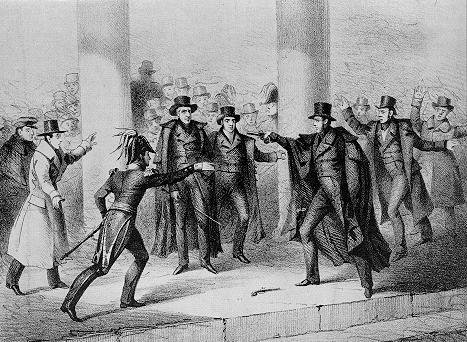

The first presidential assassination attempt took place on January 30, 1835, when Richard Lawrence attempted to shoot Andrew Jackson. Lawrence attacked Jackson on the rotunda of the Capitol as the president was returning, with others, from a funeral. Lawrence had patiently waited behind a pillar on the east portico for Jackson to appear, and when the president did so, he pulled out a pistol and pulled the trigger with Jackson no more than eight feet away. The pistol misfired, but the cap exploded noisily. The President, an old soldier and veteran of many battles, started. Realizing he was not wounded “Old Hickory” advanced toward his assailant, cane upraised. Thereupon Lawrence produced a second pistol, pointed it at Jackson, and pulled the trigger. It misfired as well. Apparently Lawrence was inexperienced in weaponry, as the pistols had been loaded incorrectly, and in both cases powder and lead balls had fallen out in the would-be assassin’s pockets. Clearly, the would-be assassin's practical experience with his weapon of choice was limited. President Jackson, never one to shrug off an assault, was enraged and might have beaten Lawrence seriously had he not been held back by a number of on lookers. As others wrestled the assailant to the ground, Jackson flailed his cane shouting, "Let me alone! Let me alone! I know where this came from."
Jackson, who had many political enemies and was currently engaged in a war with the National Bank, would remain convinced to his dying day Lawrence was the triggerman in a Whig conspiracy to assassinate him. The Whig position, on the other hand, was that it had all been a staged event, managed by Jackson himself to gain public support at a time of waning popularity. Almost certainly neither theory was accurate, as Lawrence had a history of mental illness and apparently believed he was shooting the President for personal, if bizarre, reasons. Nevertheless, the claims and counterclaims set a precedent early in American history that presidential assassinations, momentous events whether successful or not, would have to be of some political nature that consisted of a grand conspiracy.
The prosecutor in Lawrence's case was Francis Scott Key, author of the "Star Spangled Banner." Rather than demanding his execution, Key looked at the precedent set 35 years ago in England, when the attempted assassin of King George III was acquitted on the grounds of insanity. He instructed Lawrence to be examined by independent authorities, who soon readily accepted the opinion that the assassin was mentally afflicted, in a way that would today be diagnosed as paranoid schizophrenia. Born in England in 1800 or 1801, Lawrence came to the United States with his family when he was 12 years old. He was described later by relatives and acquaintances as "a remarkable fine boy" and one "reserved in his manner, but industrious and of good moral habits." He became a landscape painter, and later, when this failed to generate the needed income, took to painting houses. By his thirties he did exhibit some strange behaviors. He was subject to fits of rage and wild laughter, threatening those around him, including his landlady, whom he threatened to kill when she came to collect his rent. He had for some time been making claims that the United States owed him money for confiscating his property in 1802—although at the time he was in England and still a baby. He particularly saw Jackson as an enemy. He claimed that Jackson had killed his father three years earlier (although he had been dead over ten years). He also claimed he was the rightful heir to the British throne and maintained the President, in league with various steamship companies, had prevented him from getting money which would enable him to claim the English crown.. He was certain that the Vice President, Van Buren, would pay his claim if the President was out of the way.
At his trial for the attempted assassination, Lawrence looked down his nose at the jury, declaring, "It is for me, gentlemen, to pass upon you, and not you upon me."
The evidence of his unstable past and present behavior was so overwhelming that the jury readily concluded that Lawrence was not criminally responsible for his act. On his acquittal, Lawrence was confined for the rest of his life to mental hospitals, where he died in June 1861.
Taken from: Sifakis, Carl. Encyclopedia of
Assassination. New York: Facts on File, 2001; Hastings, Donald
W. "The Psychiatry of Presidential Assassination." The
Journal-Lancet 85 (1965). The Warren Report. Photo: Courtesy of
Library of Congress.