CHARLES GUITEAU
 Charles Julius Guiteau was born
on September 8, 1841, in Freeport, Illinois, the 4th of 6 children born to
Luther Wilson Guiteau and Jane Howe. After his mother's death, when Charles was
still quite young, Luther Guiteau remarried.
Charles Julius Guiteau was born
on September 8, 1841, in Freeport, Illinois, the 4th of 6 children born to
Luther Wilson Guiteau and Jane Howe. After his mother's death, when Charles was
still quite young, Luther Guiteau remarried.
As a youth, Charles Guiteau worked in his father's business, then was employed as a cashier in Freeport's Second National Bank; however, he was unhappy in these pursuits. Luther Guiteau was very much against sending his son to college. According to one source, Luther Guiteau's father “beat his son recklessly and accused him of wanting ‘things beyond your earnings.’” However, in 1859, a fortunate inheritance from his maternal grandfather made it possible for Charles to attend the University of Michigan in Ann Arbor. Guiteau was unhappy at the university. For solace and direction, he turned to a religious doctrine that had been adopted by his father, known as Perfectionism, which taught that because Christ had destroyed the cause of sin, belief made sin impossible. This extraordinary license to wanton behavior won many converts. This doctrine was taught by John Humphrey Noyes, who founded the Oneida Community in upstate New York in the 1840s, to live out a kind of "Bible communism" that embraced holding all things in common, including marriage. Interestingly, Noyes was an acquaintance of Guiteau’s father, and it was his father who introduced him to the cult through religious literature, which he sent to Ann Arbor.
Eventually, in 1860, Charles Guiteau joined the Oneida Community in New York. Still unhappy, he then left the community in April 1865, convinced that he had been chosen by God to spread Noyes' self-named "millennial communism" by founding a daily newspaper. His attempt to start a paper, called the "Daily Theocrat," was unsuccessful, and in July 1865 he applied to reenter the Oneida Community. Then, just over a year later, he again quit, in November 1866, taking with him some money that he had previously given the community.
By August 1867, out of money, Guiteau sought out his sister Frances, who had raised him after the death of his mother. She was to provide him often with both moral and financial support throughout his life. Her husband offered Guiteau a job in his law office in Chicago, as well as a place to live. However, after a few months, the latter quit his position and returned to New York, ostensibly to work for Henry Ward Beecher's newspaper, the "Independent." Guiteau was soon disappointed to find that there were no editorial jobs available at the "Independent," and he ended up selling subscriptions and advertisements on commission.
Increasingly unhappy in his situation and depressed for his future prospects, Guiteau decided to sue the Oneida Community on a trumped up charge of withholding payment for the work he had performed there. For a few months, Guiteau sent threatening letters to Noyes that amounted to blackmail. Eventually, he desisted, when Oneida's lawyers threatened to prosecute him for extortion.
In 1868, Guiteau left New York and returned to Chicago, where he obtained a job as a clerk in a law office. He managed to pass the Illinois bar and set up a small private law office on his own. Dealing mostly in collections, he became adept at keeping what he collected, as well as taking fees for services he would not or could not perform. In 1869, he married a librarian from the local Y.M.C.A. that he frequented. Predictably, the marriage was an unhappy one. Guiteau's business was meager, and as an attorney he was mediocre and disorganized. He was abusive to his wife, reportedly locking her in a closet for whole nights. Following the Chicago fire, they moved to New York, where in 1874 she divorced him.
The next year, Guiteau's behavior started to become increasingly erratic. He failed to obtain funding to buy another newspaper and was forced to move into his sister's home once again. One day, Frances reported that her brother had gone out to chop wood. When she approached him, he threatened her with the ax. She ran for the doctor, who examined Guiteau and declared that she should have him institutionalized. But Guiteau would not cooperate. Fleeing precipitously from the scene, he was not heard of again for some time. In 1876, he resurfaced, as a regular attendant of Dwight Moody's revivalist meetings. From 1877 to 1880, Guiteau himself became an itinerant preacher, writing and disseminating his own sermons.
In 1880, the year that his father died, Guiteau turned to politics, having been, since childhood, an avid reader of the staunchly Republican paper, Horace Greeley's New York Tribune. Later, Guiteau became enmeshed in the Republicans' intra-party conflict between the "Stalwart" faction, led by Roscoe Conkling, and the "Half-Breeds," led by James G. Blaine, who supported then president-elect James Abram Garfield. Initially, Guiteau favored the Stalwarts and their attempt to nominate Ulysses S. Grant for a third term. When Garfield was nominated, however, Guiteau changed sides. He soon became a familiar figure stationed outside Republican headquarters on Fifth Avenue in New York City. Here, on August 6, 1880, he delivered his speech, "Garfield vs. Hancock." After Garfield's election, in 1881, Guiteau moved to Washington, D.C., in the hope of receiving a political office as a reward for his labor. He bombarded Secretary of State James G. Blaine with letters. Finally, after receiving either a rebuff or no response at all, Guiteau again changed sides, readopting the Stalwarts' cause.
It was in mid-May 1881, according to testimony given in his trial, that he conceived the idea to "remove" the president.
On June 16, 1881, he delivered
the first of several "explanations" for his action, an "Address
to the American People." In case circumstances did not permit his doing so
after the event, he wrote two letters in advance to both the White House and
General William T. Sherman, stating, "I have just shot the President...His
death was a political necessity. I am a lawyer, theologian and politician. I am
a Stalwart of the Stalwarts..." 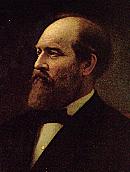
Guiteau stalked President Garfield (seen left) for some time. On July 2, 1881, he shot the President, as he was about to depart for a vacation from the Baltimore and Potomac Railroad Station. Premeditation was obvious. Not only were there the letters to incriminate him, but he had also taken the precaution of hiring a cab ahead of time to take him to the jail so that he would not be mobbed by the crowd. Garfield, shot once in the arm and once in the back, did not immediately die but declined steadily until September 20th, helped along by his doctors and the primitive state of medical knowledge at the time, a point which Guiteau was to make, unsuccessfully, at his trial. He stated with some truth: “The president died from malpractice. . . . if he had been well treated he would have recovered.” However, in the proverbial Catch 22, he destroyed his insanity defense by showing enough clarity of mind enough to use insanity for a defense, when he pleaded: “Insanity, in that it was God's act and not mine. The Divine pressure on me to remove the president was so enormous that it destroyed my free agency, and therefore I am not legally responsible for my act.” Furthermore, he noted as an afterthought, “The president died in New Jersey, and, therefore, beyond the jurisdiction of this court.”
Guiteau's trial lasted from November 14, 1881, until May 22, 1882. Chief defense counsel was Guiteau's sister's husband, George Scoville, who was not a criminal lawyer and would not have taken the case had a viable alternative presented itself. The case was a landmark in that it entailed a plea of insanity, which was heartily supported by neurologists, members of the Guiteau family, and the defendant's own behavior during the trial. Playing to a packed house, with an audience who appreciated the festive nature of the event, Guiteau made a spectacle of himself repeatedly, calling out abusive comments towards his attorney, alternately haranguing and addressing the audience, complaining to the judge, and making speeches to the press. At one point Guiteau leaped to his feet and pursued the unfortunate Scoville across the courtroom, crying out, "You are no criminal lawyer. I can get two or three first-class criminal lawyers in America to manage this case for me."
 The bailiffs held him down and perhaps
thumped him a little, so that he shouted at them, "Mind your own business!
Mind your own business!" The question of whether or not an
insanity plea was valid in the case of assassination would take another century
to decide. In any case, an examination of the case in the 1960s by a
psychiatrist, Dr. Hastings, led to a diagnosis of a mild schizophrenia. On
January 23, the jury deliberated for less than an hour before sending Guiteau
to the gallows. After the sentencing, he tried to cash in on his new-found
celebrity. He tried to sell the suit he shot Garfield in for $100; he sold his
autographs or autographed pictures ($9 a dozen, advertised in local
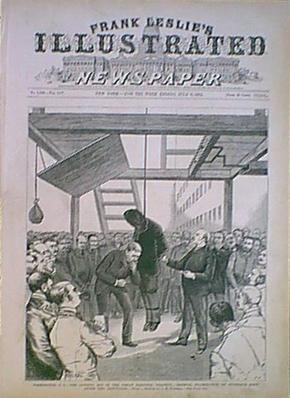
newspapers). On June 30, he awoke to be led to his death. He requested the
flowers that would doubtlessly be sent by his legions of admirers be sent to
his cell, only to be told there were none. He recited a poem while standing
before the gallows, which was long and repetitious, but boiled down to: I am
going to the Lordy, I am so glad/ I am going to the Lordy, I am so glad/ I am
going to the Lordy, I am so glad, etc.
The bailiffs held him down and perhaps
thumped him a little, so that he shouted at them, "Mind your own business!
Mind your own business!" The question of whether or not an
insanity plea was valid in the case of assassination would take another century
to decide. In any case, an examination of the case in the 1960s by a
psychiatrist, Dr. Hastings, led to a diagnosis of a mild schizophrenia. On
January 23, the jury deliberated for less than an hour before sending Guiteau
to the gallows. After the sentencing, he tried to cash in on his new-found
celebrity. He tried to sell the suit he shot Garfield in for $100; he sold his
autographs or autographed pictures ($9 a dozen, advertised in local
newspapers). On June 30, he awoke to be led to his death. He requested the
flowers that would doubtlessly be sent by his legions of admirers be sent to
his cell, only to be told there were none. He recited a poem while standing
before the gallows, which was long and repetitious, but boiled down to: I am
going to the Lordy, I am so glad/ I am going to the Lordy, I am so glad/ I am
going to the Lordy, I am so glad, etc.
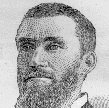
Guiteau, from a contemporary engraving
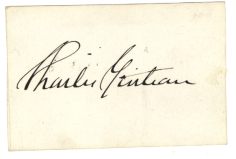 Guiteau's signature. While in prison, Guiteau raised money to pay for his
legal defense by selling his autograph for $5.00 each on small white cards.
Guiteau's signature. While in prison, Guiteau raised money to pay for his
legal defense by selling his autograph for $5.00 each on small white cards.
Sources:
Clarke, James W.
American Assassins : The Darker Side of Politics Rev. ed. Princeton, N.J. :
Princeton University Press, 1990; Clarke, James C. The Murder of President
Garfield: The President's Last Days and the Trial and Execution of His
Assassin. Jefferson, NC: McFarland & Company, 1993; Rosenberg, Charles E.
The Trial of the Assassin Guiteau: Psychiatry and the Law in the Gilded
Age. Chicago, IL: University of Chicago Press, 1968; Hastings, Donald
W. AThe Psychiatry of
Presidential Assassination.@ Journal-Lancet 85 (1965); Hayes, H.G., and
Hayes, C.J. A Complete History of the Trial of Charles Julius Guiteau, Assassin
of President Garfield. Philadelphia, PA: National Publishing Company,1882;
"Charles Guiteau Collection." Lauinger Libray, Georgetown
University: Special Collections Divison. 31 Dec. 1999. “Garfield I; Who Shot
Garfield?” History House: An
Irreverent History Magazine. 11 Nov. 2002 http://www.historyhouse.com/in_history/guiteau/. "Guiteau Head in That Noose."
History House Stories. 31 Dec. 1999.
The
papers of the assassin of President Garfield are on display in the Georgetown
University Special Collections department. They are described
and indexed on Internet, along with his life story.
Also see James Garfield: How
Alexander Graham Bell helped kill the President


.gif)
.gif)