
The Knowledge Economy
The knowledge economy is the economy. Economic value is no longer assumed to lie in things; rather, it lies the special knowledge and talents that each individual brings to the job. "Human capital" is a phrase people encounter more and more. They start to run into problems, though, when they start assuming that human capital can be treated pretty much the same way as the more traditional capital of machines, buildings and rolling stock.
Frederick W. Taylor once said to factory workers: "You are not paid to think. Other people are paid to think around here." Now, even in factories, there is an increasing expectation that everyone will be responsive to what is going on around him or make decisions accordingly. This is also true for the fastest-growing sectors of the economy, the service and technical sectors.
The knowledge-based economy is no longer a mass production economy where, as Henry Ford is reported to have said, " You can have a Model T in any color as long as it�s black." The rise of production processes based on information technology has allowed companies to develop "flexible" factories and offices in which costs rise little when variety expands. More flexible and agile companies are better able to efficiently target new and diverse markets. Moreover, fiercer business competition has meant that companies are constantly developing new products and services in order to gain new markets. Consumers benefit because their needs are more specifically addressed.
Today in the world, there is a shift from industrial to post-industrial knowledge based economies. The productivity and growth largely determined by the rate of technical progress and the accumulation of knowledge. The networks or systems which can effectively distribute knowledge and information �like internet or intranet- are of key importance.
Where timing and the need for speed are critical, business and economic activity will propel the coming technology evolution. Simultaneous and parallel webs, and all the resulting connectivity, will transform the way business is done -allowing to determine and respond to client needs and requirements in a continuous space.
Increased connectivity will create new economies of scale. The challenge is how to leverage technology to gain an advantage -creating unique supply webs, valued-added customer service, and product marketing initiatives. The companies must start imagining what the future will look like and put investment plans in place that reflect this new awareness.
In the new economy, winning will spring from organizational capabilities such as speed, responsiveness, agility, learning capacity, and employee competence. The organizations will need to find ways to use and leverage their intangible assets, including intellectual capital, data rights, and trade and cyber policies. In addition, how they use and leverage their human capital will determine not only their success, but also their ability to survive. So they exactly should boldface the human capital. What can organizations do to improve human capital?
Training should emphasize the whole person. People are not just a function or a collection of skills. They also have natural talents, values, interests, families and lives. People should be encouraged to look at the long term. How do what I am doing now fit into my plans for my whole career? People should pay attention to their natural talents and abilities. Each person has an individual set of natural talents. Recognizing this and making it a part of the company�s vocabulary can significantly in people honoring and utilizing to the maximum the differences among themselves. Above all, the company must be willing to put its belief in the talents of its employees. By trusting employees to take the information and use it to work more effectively and efficiently, the company goes a long way toward creating a work force that can think.
Today, the knowledge-intensive or high technology part of the economy tend to be the most dynamic in terms of output and employment growth, which intensifies the demand for more highly skilled workers. The value of high-tech companies such as software and biotechnology companies, is not in physical assets they own, but in their intangibles such as knowledge and patents. But what change the business environments drastically? In order to answer this question we must analyze the driving forces of the knowledge-economy:
Globalization: The success of firms today and future depends on their ability to operate globally. Globalization of the world�s industrial economies greatly enhances the value of the knowledge to the firm and offers new opportunities to businesses. Today, information systems provide communication and analytic power that firms need for conducting trade and managing business on a global scale. Because of global communication and management systems, customers now can shop in a worldwide marketplace, obtaining price and quality information reliably, 24 hours a day. So, to become effective and profitable participants in international markets, firms need powerful knowledge-systems.
Knowledge-intense products: Knowledge and information are becoming the foundation for many services and products. Today, most people no longer work in farms or factories but instead are found in sales, education, health care, banks, insurance firms, and law firms; they also provide business services such as copying, computer software or deliveries. These jobs primarily involve working with, distributing or creating new knowledge. Computer games, credit cards, overnight package delivery and worldwide reservation systems are some knowledge-based products or services that are great economic value. In the production of traditional products, the knowledge utilization also intensified.
Networking and Connectivity: The power of computer technology has enabled powerful communication networks that organizations can use to access vast storage of information from around the world and to coordinate activities across space and time. Developments such as Internet bring the �global village� ever nearer. The net result is that goods and services can be developed, bought, sold and in many cases even delivered over electronic networks. Electronic commerce offers many advantages in terms of cost savings efficiencies and market reach over traditional physical methods.
Knowledge Codification and Learning
The main two characteristic of knowledge economy is its dependence on both the codified knowledge and the competencies to use the information. Due to codification, there is positive implication for economic growth, that�s market transactions are facilitated, diffusion of knowledge accelerated, reduced additional investments to acquire further knowledge and lets the growth of knowledge stock. Knowledge codification is
Know-what : knowledge about "facts"
Know-why : scientific knowledge of the principles and laws of nature
Know-how : skills or capability to do something
Know-who : information about experts.
Learning-by-doing is the paramount. In other words, knowledge is best acquired not by passive rote memorization but by the active involvement of the learner. Learning is by doing, not by watching or by memorizing.
Measuring Knowledge
Measuring Knowledge Inputs
Measuring Knowledge Stocks and Flows
Measuring Knowledge Outputs
Measuring Knowledge Networks
Measuring Knowledge and Learning
Creating Knowledge Management Programs
While organizations have always had some form of �knowledge management� system, usually under another name, it is now apparent that the ability to systematically identify, generate, acquire, diffuse and capture the benefits of knowledge can provide a substantial strategic advantage. The extent of intangible assets in major firms, exceeding their tangible assets many-fold, is one illustration. Based on analysis of the new rules of competition under the global knowledge economy, and extensive experience in a range of firms, a diagnostic has been developed to allow organizations to determine the effectiveness of their knowledge management, and thereby to benchmark their activities.
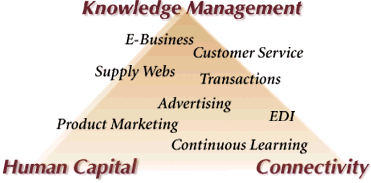
New approaches are being developed to provide a sounder basis for the strategic management of knowledge. For operational purposes, a clear distinction can be drawn between information, which is digitisable, and knowledge, which exists only in intelligent systems. This provides the basis of formulating a �Knowledge-Information Cycle�, which draws attention to the management challenge in the transformation of knowledge to information, and vice-versa, in the context of creation and application. Hence the requirements of �knowledge management� become that of managing organizational information, organizational knowledge and individual knowledge, and the transfer and translation processes between each of them.

Many business are now realizing the role of knowledge and are creating knowledge management programs and appointing CKO(s) (Chief knowledge officers). Such responses should be a part of a coordinated effort that:
Implications for business
Recognizing the importance of knowledge to their business bottom line:
Example: Buckman Laboratories recognizes the value of solving customer problems by enhancing knowledge flows from their chemical experts direct to customer interface.
Develops new measures of corporate performance based on knowledge:
Example: Skandia�s supplements annual reports with intellectual capital reports using measures from the Skandia Navigator.
Systematically enhances organizational learning and knowledge through new organizational arrangements and processes:
Example: Price Waterhouse has created knowledge centers to improve the capture, codification and dissemination of �best practice� knowledge.
Provides a technology infrastructure to enhance knowledge creation and sharing:
Example: Hewlett-Packard�s Intranet provides a key means of knowledge sharing throughout the company on global basis.
Encourages the sharing of knowledge through effective organizational settings and business practices:
Example: Steelcase designs �smart� working environments and has developed a culture of knowledge sharing.
Issues and Challenges
The main challenges facing policy makers and business leaders are the following:
It is difficult to �go it alone�. Stakeholders, especially employees and business partners must share similar views for own initiatives to succeed..
			
		Organizational recognition and reward systems usually do not sufficiently recognize
		knowledge contributions. They are linked to performance measures of traditional economy.
		Measures of return on investment are done using traditional accounting methods, thus
		investments in knowledge enhancing activities need strong advocates at senior levels.
Knowledge Culture
Success in the knowledge economy requires a change in knowledge culture. This change is achieved first of all if there is a change in ways of thinking which can be explained by putting knowledge and education �especially science and technology- in the center of process. Also scientific approach which is concentrated on only academic area, should be implemented in every corner of life.
The other important concept in knowledge culture is non-codified or tacit knowledge. There exists some difficulties in local adaptation of this knowledge. In other words, there are difficulties in transferring company�s tacit knowledge �the resource of this knowledge its staff-. To gain competitive advantage, the ways to overcome these difficulties should be investigated.
Anyone who wants to know about detailed and contemporary approaches should strictly refer to www.worldbank.com.
Conclusion
In development work, the focus has shifted to the intangibles of knowledge, institutions, and culture. In the 21st century, the long-term prosperity of organizations will depend to a large extent on their ability to leverage human and intellectual capital and on their ability to create a continuous transaction environment.
In the emerging knowledge economy, the ability to manage knowledge is becoming ever more crucial. The creation and diffusion of knowledge are increasingly important factors in economic competitiveness. The kind of creativity that is essential for the knowledge economy requires the engagement of the mind. Organizationally, small new enterprises often have provided more fertile ground for this kind of creative engagement than do large established bureaucracies. Many of the most important innovations have originated in these small enterprises. Innovations which is one of the key managerial challenges of knowledge economy, builds the trust on which idea-sharing depends.
To sum up, the companies should investigate new technology and explore new ways to facilitate Knowledge Management not just because it is profitable, but because knowledge is at very heart and core of every business and the source of ability to compete.
Reference:
1) Knowledge Management Briefing, David J. Skyrme, 1997
2) The Economics of Information : A user�s Guide, Roger G. Noll
9) dasan.snu.ac.kr/faculty/keunlee/knowledge.html