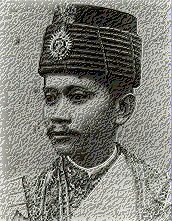
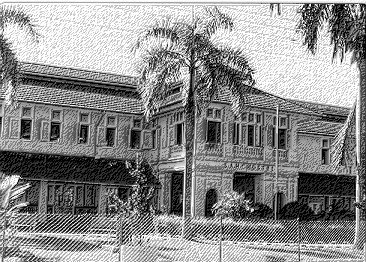
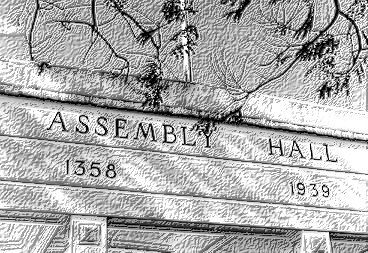
~The Stuart Library~ Stuart Library, named after the 6th Headmaster, E.A.G Stuart. Mr Stuart passed away in 1927 and was interred at the Christian Cemetery at Jalan Maxwell. He served GES for 9 years (1917-1926). In 1930 the Library was erected in his honour with money collected from the public and donation from the Kedah government. Mr Stuart himself bequeathed a thousand odd books.
Oh what shall I
do when my aching head
Oh what shall I
do when every night
|
Work on the present building started in 1915 with the identification of thirty acres of padi field in Tanjong Bendahara. At that time, it was.."a padi field with Malay houses dotted here and there amidst coconut trees, cashew nut trees and plantains.." The actual construction was completed late in 1916 and the opening ceremony was done on the 1st of January 1917 by Mr. E.A.G Stuart, who was also the 6th Headmaster. "The original building consisted of a two-storied structure in the centre with two class-rooms running on each side. It was not the imposing building that it is now and many who were not aware of the Government's education plans for the future thought that His Highness the Sultan of Kedah had constructed a new stable for his strings of horses. But it spoke highly of the foresightedness of its designers that ample provision was made for expansion, with adequate space for playing fields and the construction of more classrooms to cater for more than a thousand boys. The muddle that was later caused in the arrangement of the building was the result of the short-sightedness of others in whose hands the expansion of the school was entrusted. The almost frivolous excuse of saving a tennis court caused an entire new wing to be built out of line."
"Any comparison with the present is entirely out of place. The playing
field was a mire in the wet season and strayed buffaloes from the neighbouring
villages would wallow comfortably in the muddy pools that dotted all over
the field. Roads as we know now were non existent. Jalan Langgar was only
a gravel path with a crude metal surface in the centre. During the monsoons,
the sides would churn up badly and boys walking barefooted to school had
their legs so badly smeared with mud that a special tank of water had to
be erected in front of the school where boys could wash their dirty feet before
entering the classrooms. The boys' dress had not very much changed since
1908. The majority of the Malay boys were still averse to wearing shorts.
They came to school in sarongs and Malay bajus. A few Chinese boys still
had pig tails. It was most amusing to see the boys doing physical training
at this time. The Malay boys often had their songkoks on their heads and
had the front bottom end of their sarongs folded and tucked up between
their legs to be fastened at the back slipping the end into the back fold
of their sarongs. It can be imagined what fun the boys had when the tucked
up ends come off in the middle of a jumping exercise, which it often did,
or when the Chinese boys' pig-tails came too close to some mischievous hands."
- The Gate, No 7,1956.
<<PREV |