MAK INANG DANCES
The Malays are the main community in Malaysia. They have
been here a long, long time ago (may be in the 3000 century b.c.) and can
be said as the origin of Malaysia (was known as Malaya). And so... there are so many Malay
dances, from the original Malaysia's Malay dances to the 'influenced' Malay dances (Malay
dances from other countries (such as Indonesia and Brunei) or simply other countries' (such as Arabia and India) dance but was adapted into Malay culture). The Malay dances can be divided into four categories. Those are the court dances, folk dances, theatrical dances and modern dances.They have their own differences.
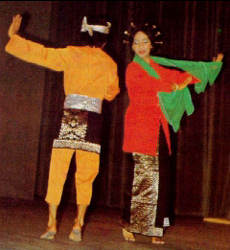
MAK INANG DANCES
The Mak Inang originated during the period of the Mallaca
Sultanate. It was also popular at that time as it is today.A song, the Mak Inang from which the dance derived its name was
composed by the order of Sultan Mahmud Shah.The song and dance are very graceful and have all the qualities of a palace
performance.This dance is also called Tarian Si Kembang Cina.Sometimes the dancers hold long scarves during the
performance.
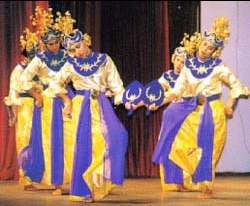
GAMELAN DANCES
This classical dance began in the courts of Riau and Lingga in the 17th century. It was first performed in Pekan Pahang in 1811 on the occasion of the marriage of Tengku Hussain, the son of Sultan Abdul Rahman of Lingga, to Wan Esah, the sister of Bendahara Ali of Pahang.
It was transferred to the court of Terengganu after Tengku Mariam, a Pahang princess married Tengku Sulaiman, the son of Tengku Zainal Abidin of Terengganu.
According to Tengku Mariam there was actually 77 gamelan. But, today only 33 dances are extant in the repertoire.Among the 33 dances are Timang Burung, Ayak-ayak, Lambang Sari, Ketam Renjung, Geliung, Lantai Lima, Kending Gajah, Togok Rompin, Kunang-kunang Mabuk, Galuk Merajuk, Silatin, Lolo and Monab.
The dances, exclusively performed by girls, can be staged indoors or in the open.
Javanese elements are evident in the costumes of the dances. They are aesthetically beautiful and are the most luxurious of all Malay dance costumes.
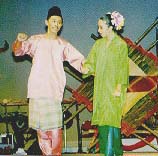
JOGET DANCES.
The Joget is the most popular traditional dance throughout Malaysia. It is performed at cultural festivals, wedding celebrations and other social functions. The Joget's origin has been traced back and associated with a Portuguese for dance which was introduced to Mallaca during the era of the spice trade. The Joget is performed by couples who combine fast hand and leg movements. It is lively rendition with fast upbeat tempo and is greatly enjoyed by the young and old. It is usually performed during cultural celebrations and Malay weddings.
In Mallaca it is better known as Chakunchak.
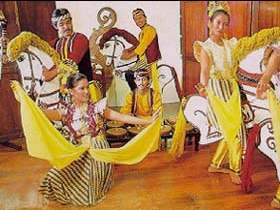
KUDA-KEPANG DANCES
The Kuda Kepang is a peculiar dance feature from Johor. The dance was once a totemistic worship however with the spreding of Islam, it renders the tale of nine Javanese men who spread the Islamic faith in the interiors of Java. In order to draw attention of the congregation, the nine Muslim evangelists rode on horse-back and dramatised stories of the battle waged and won for the cause of Islam.
Kuda Kepang is performed by nine dancers who are seated astride a two dimensional 'horse' made of hide or pleated rattan. The dancers re-enact the early Islamic battles in enthusiastic gestures and vigorous action.
This dance drama is performed in accompaniment to a rich and exotic rendition of traditional music played with indigenous instruments such as gongs, tambourines and angklungs.
GAMELAN DANCES
JOGET DANCES
KUDA KEPANG DANCES