|
The
Breakthrough
Ron
Davis, author of "The Gift of Dyslexia" believes that dyslexia is a result of an inherent mental gift or
talent.
People who develop dyslexia think in pictures, rather than
words; they are imaginative and creative and they try to solve problems by
looking at the whole picture, rather than working step-by-step. The 'correction'
course relies on using the mental talents that dyslexic people share to
overcome the learning problems.
To
do this, students learn to follow a different approach to learning
which suits their learning style. When dyslexic students recognise their
mental talents, they develop a renewed sense of self esteem and confidence.
When they employ study methods which capitalise on their talents,
progress is very rapid.
Go
to page links
The
key components of the course
Two major components of the process are
counselling and the mastery of symbols.
Counselling helps the dyslexic students
recognise and control the mental state that leads to distorted and confused
perceptions of letters, words, numerals and other symbols. Through a simple
mental technique, the student learns to turn off the thought processes that
cause misperception and then restore their minds to a relaxed and focused state,
suitable for reading and other studies.
Once orientation is learned, the student is ready to
build the conceptual skills that allow him or her to overcome problems stemming
from dyslexia.
Mastering symbols allows dyslexic students to learn to
think with words and symbols and so develop the ability to read easily and
with full comprehension.
Using clay, students initially work with the
alphabet and punctuation marks to ensure that they have an accurate
perception of these symbols and an understanding of their meaning. Students then
use clay to model the trigger words (these are abstract words that dyslexics
can't form mental pictures for, such as THE, TO or WHEN).
In this way the
picture below of the rat is a metaphor for the noun "rat"

The student makes a
three-dimensional clay model of the meaning of the word, together with a model
of the letters of the word. With this approach, learning is permanent.
The program sessions are designed to suit
the individual's particular problems identified during the initial assessment.
Parents are coached into supporting the student use and
develop their newly acquired tools to correct their dyslexia.
Go
to page links
About
Kay Distel M. App. Sci.
Kay Distel's background is 20 years as a
Psychotherapist, Trainer and Researcher. She trained in the UK in the 1980's and
whilst there worked in Mental Health and as a Trainer/Staff Development Officer
in the Social Services.
On returning home in 1989, she started a
part time practice Sound Education, whilst she further studied perception and
learning for her Masters in Applied Science(1996). After this study she
further trained in the Tomatis Listening Training process and
established this as her primary practice in 1997.
Kay sponsored Ron Davis to Australia (author of
'The Gift of Dyslexia') in 1996, in an effort to get more information about
innovative dyslexia programs.
She has been a professional
course facilitator since 1999.
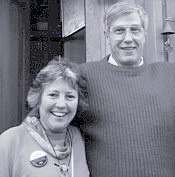
Kay with Ron Davis
Go
to page links |
The
First Step-Assessment Meeting
We meet to assess both whether the client
is suitable and whether the client finds me suitable to facilitate their
learning. We both need to have a positive attitude towards making change.
A summary of strengths and weaknesses is completed and together
we reach agreement on what the focus of attention for the course should
be,
eg. reading, writing, controlling attention etc.
As I intend to help the client become a self-directed
learner, so as to solve their own problems, motivation and a realistic attitude
towards 'the problems' are essential qualities I'm looking for.
I provide counselling and training support for:
-
reading
-
writing
(dysgraphia).
-
mathematics
(arithmetic, algebra, etc) (dyscalculia)
-
balance
and coordination problems. (dyspraxia).
-
hyperactivity,
ADD, ADHD
-
life
skills.
Course Details
The course is
an intensive 30 hours (taken over 5-6 days) with review/follow-up times
as required. It includes support training for parents and others, and all resources
needed for the home study.
Back to Page
Links
For
more information on the program
Read the book:
Order this
book
Read this Article:
Case Reports:
Contact Kay Distel
Sydney:(02) 9634-2510
(main)
or 02 4423 1140
(South Coast)
or Email
kay'at'soundeducation.com.au
Please change 'at' to @ in your mail program)
I work in Sydney, do residential
programs on the south coast of NSW and have times available for outreach to other areas
Back to Page Links
Process
-
It has been a marvellous
journey out of low self-esteem, confusion and frustration to a releasing
of their gift and more importantly to an understanding of what dyslexia
is and is not.
-
My girls now have
the sparkle back in their eyes that I used to see when they were toddlers.
-
…she no longer
makes up the story as she reads.
-
The follow-up interview
was particularly helpful in correcting our coaching methods. · Better
understanding of himself and is more confident in coping with the difficulties
he experiences at school
-
His concept of
multiplication has at long last been established, and I am seeing the beginning
of an understanding of division
-
His handwriting
has improved .
-
She used orientation
during a Maths exam and for the first time in her High school years passed
a Maths exam She got 93%
-
He no longer made
the once common error of reversed letters in his written work
-
A more positive
attitude toward learning
-
He's getting 9/10
for spelling which would have been impossible before
The program helped
control temper and reduced his nightmares.
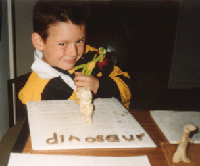
A young student using clay
-
Kay presents the
program in a professional manner and with an empathy that helped my son
feel comfortable and enjoy the work
-
The follow-up sessions
were well structured and to my surprise lead to further improvements to
strategies at home
-
From my first contact,
I was impressed with Kay's caring and professional approach.
Go
to page links
|