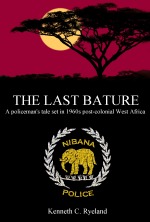
The Last Bature
A policeman’s story set in Nibana, an imaginary West African state, shortly after gaining its independence from the British in 1962.
What begins as a straightforward investigation by the last British policeman in the Northern Region and an African police inspector, quickly turns to intrigue when the intelligence services of the superpowers vie with each other to secure a breakthrough in weapons technology. Combine this with the machinations of an irrational regional military governor hell-bent on overthrowing his brother, the head of state, and the basis for an exciting story emerges. With the cold war as a backdrop and a second coup imminent, the action moves quickly from the heat of the Omdu Hills, through the stench of the Laguna slums to the waters of the Bight of Laguna, giving the reader an insight into the grubby world of espionage and life in West Africa during the turbulent sixties.
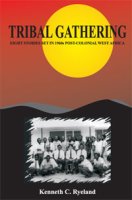
Tribal Gathering
A collection of stories set in an imaginary West African state shortly after gaining its independence from the British in 1962. Struggling to come to terms with the tribalism, nepotism, corruption and greed that flourishes at all levels of society is part of everyday life and relatively simple compared to the problems of surviving three military coups and a civil war. It is against this backdrop and that of a rapidly failing infrastructure that the stories evolve. From the dry heat of the Northern Desert to the suffocating humidity of the Delta, the stories tell of the daily ordeal as the characters try to live out their lives against all the odds. Betrayal, revenge, ignorance, pride and stupidity intermingled with witchcraft, African Deities and Freemasonry, these stories have it all and Ryeland deals with them in his usualconsummate way to provide interesting and compelling reading.
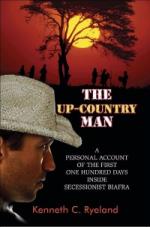
The Up-Country Man
When the "Winds of Change" began to blow through the African colonies in the late fifties and early sixties, the author began to take a deep interest in these vast territories. Even after leaving school, he nurtured his secret desire to live and work in the ex-colonies of Africa. His ambition was eventually fulfilled shortly after his 25th birthday.
Having finished his engineering apprenticeship and obtained the necessary academic qualifications, the author joined a British company with commercial interests in the West African state of Nigeria. In the six and a half years since independence in October 1960, the people of this ex-British colony had already experienced civil unrest and two military coups. Now the country was on the brink of three long years of civil war, primarily because of an argument over oil revenues between the Federal Military Government and the Governor of the Eastern Region. The author arrived in Nigeria in April 1967, just as the Biafran crisis was about to enter its final and most devastating stage.
The author's book records his personal views and experiences of the events leading up to and beyond the act of rebellion that created the short-lived Republic of Biafra. The work concentrates on the author's arrival in the territory and the first one hundred days following secession when he was resident in Enugu, the capital of Biafra. His job as a manager with one of the most important companies in the region gave him a particular insight into the bid for independence and the consequences arising from many of the policies adopted by the Biafran Government thereafter. It is this unique perspective that will be appreciated by the readers of this work.
The narrative deals with the culture shock that everyone experiences when they arrive in a country where the lifestyle, customs and climate are vastly different to their own. It also looks closely at the relationship between the Africans and the Europeans who lived and worked in Nigeria, reflecting the reality of post colonial Africa in the nineteen-sixties.The reader will quickly appreciate that these difficult subjects are treated in a sensitive and honest way. Though there is cognisance of the wider political machinations in Biafra, Nigeria and the UK during the period of the crisis, the work is really a personal reflection of the day-to-day difficulties and problems encountered by both Africans and Europeans as Nigeria raced headlong into civil war.
Despite being resident in Biafra for only a short time, the author has been able to capture the mood and relate some of the incidents that occurred during the build up to all out war in July 1967. Some examples include: the close surveillance of all foreigners by the Biafran secret police; an activity that caused many problems for the author; the difficulty he experienced with the Biafran military when the company driver was beaten close to death by drunken soldiers; the illegal and barbaric activity of the police and army personnel who manned the hundreds of road blocks; and the effect that all this chaos had on the lives of the people and the economy of Biafra. The work also reflects the feeling of vulnerability that pervaded the author's daily life as the Federal Nigerian Army penetrated the northern and western sectors of the new republic and began to advance inexorably towards Enugu, the seat of power of the rebel regime.
Though the book relates many harrowing incidents and troublesome situations, it is not all gloom and misfortune. The reader will be amused and impressed by the many passages that touch on the humour and grit of the ordinary citizens trying to cope with the chaos around them. The sections of dialogue written in the style of spoken Pidgin English will provide the reader with an intriguing insight into the use of English as a means of communication in a country where 250 languages are in daily use. The work is presented from the viewpoint of a young Briton, seemingly abandoned by his company, stranded in a rebel enclave, threatened by war and separated from his wife and child.
The climax of the book describes the author's evacuation by road from Enugu to Port Harcourt under the most stressful and frightening conditions. During the journey the civil defence volunteers manning the roadblocks subjected the author and the other Europeans in the vehicle convoy to many threats, and there is an account of the evacuees being dragged from their vehicles and lined up at the side of the road ready for a firing squad.
The author, together with over 800 other expatriates, was eventually evacuated from Port Harcourt to Lagos by sea on the MV Isonzo, a small, 7,500-ton Italian freighter. This was the last vessel to leave rebel held Port Harcourt and required a special agreement between the warring parties for its safe passage. Even at this late stage, however, the Biafran military continued to harass the evacuees as the ship steamed down the river Bonny on its way to the open sea.
The work will satisfy a wide spectrum of readers ranging from those interested in British post-colonial African history to the many who simply enjoy a good, true life adventure story. Though the outline for the book was written twenty-five years after the events, this does not dilute the impact of the story. Contemporaneous diary notes, a sharp memory, reflection and hindsight give the work an unusual strength and character.
This book will provide the reader with a detailed insight into the traumatic conditions that prevailed in Nigeria as the country embarked upon a bloody and cruel civil war. It was a war fuelled on both sides by the Western Powers because of the importance of Nigerian oil. No other British author has written an account of the misfortunes and sufferings of ordinary individuals caught up in the power politics and lust for oil revenues that broke the uneasy peace in Nigeria during the late sixties.
 |
 |