Waiting for Godot
à
àEstragon=Gogo=Adam
Act I
1. privation (8b)- A state of extreme poverty
2. wheedling (11b)- Influence or urge by gentle urging, caressing, or flattering
3. cawm (11b)- Probably
just to emphasize the pronunciation of “calm.”
4. bawd (11b)- A woman who engages in sexual intercourse for money
5. prerogatives (13b)- A right reserved exclusively by a particular person or group (especially a hereditary or official right)
6. greatcoat (15a)- A heavy overcoat; surcoat, topcoat
7. conciliating (15b)- Overcoming animosity or hostility
8. the clap (15b)- A common venereal disease caused by the bacterium Neisseria gonorrhoeae; symptoms are painful urination and pain around the urethra
9. peremptory (16a)- Offensively self-assured or given to exercising usually unwarranted power
10. jaded (17a)- Dulled by surfeit; exhausted
11. affectation (19a)- A deliberate pretense or exaggerated display
12. grampus (20b)- Predatory black-and-white toothed whale with large dorsal fin; common in cold seas
Slaty-gray blunt-nosed dolphin common in northern seas
13. vaporizer (20b)- a device used to vaporize medicine for inhalation
14. to cod (21a)- No definition for verb, but cod can mean scrotum
NOTE: (21a) Atlas is not the son of
Jupiter. His parents are the Titan Iapetus and the nymph Clymene
15. knook (22b)-
16. briar (23b)- A pipe made from the root (briarroot) of the tree heath
17. dudeen (23b)- A short-stemmed clay pipe
18. Kapp and Peterson (23a)- Brand of pipe.
http://www.knoxcigar.com/petersonpipes.html
19. firmament (24b)- The apparent surface of the imaginary sphere on which celestial bodies appear to be projected
20. qua (25a)- Which?
NOTE: Effulgence (one of our vocabulary
words) is on 25a.
NOTE: (25b) Estragon says “Oh tray bong,
tray tray tray bong.” I
interpreted that as “Très bon,” French for very good.
21. farandole (27a)- A
lively dance from
22. the fling (27a)- A kind of dance; as, the Highland fling
23. the brawl (27a)- Branle: Simple French dances from the 1500s. Branle means "to move from side to side." Pronounced brawl.
24. the jig (27a)- Any of various old rustic dances involving kicking and leaping (usually in 3-4 time)
25. fandango (27a)- A provocative Spanish courtship dance in triple time; performed by a man and a woman playing castanets
26. hornpipe (27a)- A British solo dance performed by sailors
27. aesthete (27a)- One who professes great sensitivity to the beauty of art and nature
28. pulverizer (27a)- ??
30. quaquaquaqua (28b)- ??
31. athambia (28b)- ??
32. aphasia (28b)- Inability to use or understand language (spoken or written) because of a brain lesion
33. anthropometry (28b)- Measurement and study of the human body and its parts and capacities
NOTE:
Stuttering probably on purpose- caca= have a bowel movement, French child’s word for
excrement
popo= possibly Mexican volcano
http://volcano.und.nodak.edu/vwdocs/current_volcs/popo/popo.html
OR… I think you know.
34. Essy-in-Possy (28b)- Possible esse and posse which are
Latin for “to be” and “to be able”
35. Testew and Cunard (28b)- Distortion of testes and (you know).
OR “Test you” and
A ship of the Cunard fleet, presumably a passenger liner.
36. Fartov and Belcher (28b)- Distortions of fart and belch
37. conating (29a)- Perhaps from the French “connaître” and meaning “knowing”
38. camogie (29a)- Camogie is the female
version of hurling. The game of hurling is unique to
39. succedanea (29a)- A substitute
40. Feckham Peckham Fulham Clapham (29a)- Feckham is distortion of f--- him.
The rest are
either similar distortions, or refer to places in
He now became devoted to a plan
of establishing a college in the Bermuda Islands, went to London to further the
project in 1724, and in 1725 published A Proposal for the Better Supplying
of Churches in our Foreign Plantations, and for converting t he savage Americans
to Christianity by a college to be erected in the Summer Islands, otherwise
called the Isles of Bermuda. By his enthusiasm and persuasiveness, he won
many expressions of sympathy, and came to believe that the government would
support the plan. In September 1728, he sailed for
Three years of waiting on
funding for his project convinced him that his hopes were futile, and in February
1732 he returned to
42.
43. Steinweg and Peterman (29a)- ??
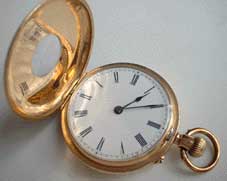
44. half-hunter (30b)- Type of gold fob watch.
Here’s a picture:
http:/www.geocities.com/kcirtap27613/image001.jpg
45. escapement (30b)- Mechanical device that regulates movement
46. fob (30b)- A pocket in a man's vest to hold a pocket watch
NOTE:
Act II
1.
2. Cackon country (40a)- Another pun on caca.
3. charnel-house (41b)- A vault or building where corpses or bones are deposited
4. (For you non-French speakers)
Que voulez-vous? = What do you want? (42a)
5. canter (42a)- An smooth 3-beat gait; between a trot and a
gallop
6. minces (46b)- Walks daintily
7. gonococcus (47a)- The pus-producing bacterium that causes gonorrhea
8. spirochete (47a)- Parasitic or free-living bacteria; many pathogenic to humans and other animals
9. precipitately (47a)- At breakneck speed
10. morpion (48b)- A louse
11. the tree (49a)- May refer to movements involved in stretching (a shoe or boot) onto a shoetree, or the movements associated with swinging on the gallows.
12. ballsocked (50b)- Perhaps a pun on Balzac, French writer in the realist school of fiction.
NOTE:
(51a) “Let us not waste our time in idle discourse!”
13. congeners (51b)- An animal or plant that bears a relationship to another (as related by common descent or by membership in the same genus)
NOTE: (51b) “We are all born mad. Some remain so.”
14. crablouse (53a)- Parasite that infests the pubic region of the human body
15. zenith (54a)- The point above the observer that is directly opposite the nadir on the imaginary sphere against which celestial bodies appear to be projected
16. caryatids (55a)- A supporting column carved in the shape of a person
17. (For those of you who aren’t in Latin)
Memoria praeteritorum bonorum = Memory of good things past
(55b)
18. the Board (55b)- ??
19. forceps (58a)- A pair of pincers used in medical treatment; especially for the delivery of babies
20. dropped (59b)- Meant to mean break association with, but also has double meaning of gave birth to.